5 Best Intelligent Document Processing Software (2026 Ranked)
Table of Contents
- Compare the 5 Best Intelligent Document Processing Software
- 1. Onymos DocKnow: Best for AI-Powered Lab Document Extraction and Automation
- 2. ABBYY Vantage: Best for Enterprise Multi-Document Processing
- 3. Google Document AI: Best for Developer-Led Document Pipelines
- 4. AWS Intelligent Document Processing: Best for AWS-Native Architectures
- 5. Doxis DocHorizon: Best for SMBs and Finance Document Automation
- Why Onymos DocKnow Is the Standout IDP Solution for Healthcare Labs
- Automate Lab Document Workflows With Onymos
Need a custom demo?
Use your own workflow and see where DocKnow can reduce manual work.
Get your demoKey Takeaways
- Onymos DocKnow is the best intelligent document processing software for clinical and diagnostic labs that need AI-powered data extraction and error prevention before data reaches billing systems.
- ABBYY Vantage is the go-to for enterprises needing a pre-trained skill library across 150+ structured and semi-structured document types.
- Google Document AI suits engineering teams that need flexible, API-first document processing at scale using deep-learning AI technology.
- Doxis DocHorizon is the best fit for growing SMBs with multi-functional use cases across departments and/or industries.
Manual data entry is one of the most expensive operational liabilities in any document-heavy organization.
Whether you’re a lab processing thousands of test requisition forms per week, a finance team reconciling purchase orders, or a legal department managing contracts, the bottleneck is almost never the actual work.
It’s getting clean, structured data out of unstructured documents. Intelligent document processing (IDP) software solves this by combining Optical Character Recognition (OCR), Natural Language Processing (NLP), Machine Learning (ML), and Large Language Models (LLMs) to capture data from any document type at scale.
Here are the best IDP software of 2026, covering multipurpose use cases, including for healthcare labs.
Compare the 5 Best Intelligent Document Processing Software
| Tool | Best For | Standout Feature | Starting Price |
|---|---|---|---|
| Onymos DocKnow | Clinical and diagnostic labs | No-Data Architecture + SmartSync AI reconciliation | Custom |
| ABBYY Vantage | Enterprise multi-doc processing | 150+ pre-trained document skills | Volume-based, custom quote |
| Google Document AI | Dev teams building custom pipelines | Pre-trained and custom ML processors | Pay-per-use from ~$0.0015/page |
| Amazon Textract (AWS IDP) | AWS-native cloud automation | AWS Textract + Comprehend + Glue + Lambda stack | Per-page, usage-based |
| Doxis DocHorizon | SMBs and finance teams | Fast OCR + pre-built financial document flows | Custom |
If you run a diagnostic or clinical laboratory, general-purpose tools won’t be the best fit for your workflows. Onymos DocKnow is the only IDP platform designed specifically for lab accessioning, test requisition form processing, and revenue cycle management (RCM) enablement.
See how Onymos DocKnow superpowers your document processing.
1. Onymos DocKnow: Best for AI-Powered Lab Document Extraction and Automation
Onymos DocKnow is the intelligent intake layer purpose-built for healthcare and life sciences. DocKnow automates document data capture without ever exposing patient data to third-party servers.
Organizations like Guardant Health, Personalis, and Vanta Diagnostics use Onymos to hyperscale their document-driven operations. Unlike general-purpose IDP tools, DocKnow is built around the specific document types labs deal with daily:
- TRFs
- Insurance cards
- Medical records
- Supporting clinical documentation
- Claims, denials, and appeals
Onymos DocKnow Key Features
Here are the features that make DocKnow perfect for IDP.
- AI-Powered Laboratory Intake
DocKnow captures relevant documents from email, cloud storage, or connected systems. It then automatically extracts and validates the key data using NLP and machine learning, flagging conflicting or incomplete fields before they reach downstream systems. Labs report dramatically reduced manual QA overhead and faster specimen turnaround times.
- SmartSync AI Reconciliation Engine
SmartSync is Onymos’s proprietary data reconciliation engine, powered by Nucleus. It compares extracted values against connected systems, medical lab software platforms, and supporting documents, detecting mismatches before data moves downstream. Missing patient insurance details or mismatched physician identifiers are caught at intake.
- Revenue Cycle Document Automation
DocKnow can capture and categorize revenue-related documents such as superbills, EOBs, and claims from any source. It also enforces configurable business rules via AI, performs automated eligibility checks, and reconciles conflicting data points before anything reaches your billing platform, supporting critical revenue cycle management software workflows for diagnostic labs. Every change is logged with a field-level audit trail, keeping teams compliant and audit-ready without manual oversight.
- No Data Architecture
Onymos addresses the risk of third-party data exposure as the platform never accesses, captures, or stores customer data. All patient records, healthcare documents, and extracted data remain exclusively within the customer’s own environment. DocKnow is SOC 2 Type II certified, HIPAA-compliant, and supports adherence to CAP/CLIA.
Exploring HIPAA Compliant Document Management Systems? See how they compare.
Onymos DocKnow Pricing
Onymos uses custom pricing based on volume and modules.
DocKnow is modular, so labs can adopt specific features without purchasing the entire platform.
Where Onymos DocKnow Shines
- DocKnow is designed ground-up for labs: Purpose-built for diagnostic, clinical, and medical laboratory intake workflows (this makes it one of the most effective lab automation solutions for capturing and reconciling documents)
- SmartSync catches conflicting data: Errors are caught before it reaches billing, allowing error prevention at intake
- Patient data never leaves the customer’s own environment: This eliminates third-party exposure
- Field-level audit trails are built in: Enabling a full RCM integration
Where Onymos DocKnow Falls Short
- Not designed for general use: Primarily focused on solving document workflow challenges in healthcare and life sciences
- No self-serve pricing: Onboarding timelines and cost depend on volume and workflow complexity
Onymos DocKnow Customer Reviews
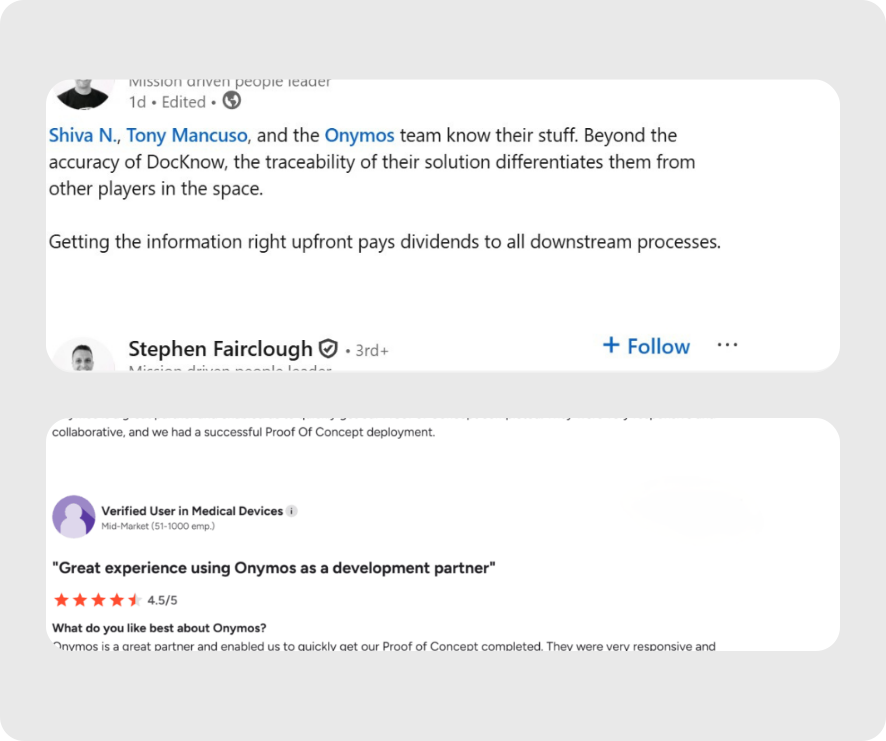
A verified user in medical devices praises, “We’ve used Onymos solutions and services for two major projects. It has been an incredibly positive experience in every aspect. Team members are extremely knowledgeable, reliable, articulate, and accommodating.”
Personalis’s former VP of Informatics, Stephen Fairclough, called out two things that set DocKnow apart from competing platforms: accuracy and traceability. In a LinkedIn post, Hanson wrote: “Getting the information right upfront pays dividends to all downstream processes.”/
Check out our customer success stories.
Who Onymos DocKnow is Best For
- High-volume labs: Processing TRFs, insurance cards, and clinical docs at scale
- Any lab losing revenue to claim denials: Especially those caused by incomplete intake documentation
- Organizations that are scaling: That can’t afford manual workflows
Say goodbye to intake errors and denied claims.
→ See Onymos DocKnow in action
2. ABBYY Vantage: Best for Enterprise Multi-Document Processing
ABBYY is one of the longest-standing names in document processing. Its cloud-first IDP platform, ABBYY Vantage, comes with a library of 150+ pre-trained document skills covering invoices, purchase orders, legal documents, medical records, and more.
Key Features
- Pre-trained Skill Library: 150+ ready-made skills covering structured, semi-structured, and unstructured data across industries
- Data Validation Rules: Configurable validation logic that flags anomalies before data enters downstream systems
- Human Verification Workflows: Low-confidence extractions are automatically routed for human review
Pricing
ABBYY Vantage offers volume-based subscriptions. Enterprise quotes are customized by page volume and document type.
Where ABBYY Vantage Shines
- Mature skill library: The broadest pre-trained document coverage of any IDP platform on this list
- Enterprise-grade controls: Strong audit trails, role-based access, and compliance tooling
- Classification and splitting: Excellent at separating multi-document batches and routing correctly
Where ABBYY Vantage Falls Short
- Heavy for narrow use cases: Skill licensing and tuning can feel over-engineered for simple, single-document workflows
- Steep learning curve: Configuring custom skills requires meaningful technical investment
Customer Reviews
Vijay R. notes, “ABBYY provides consistently reliable and highly accurate table extraction, maintaining the original structure of documents.”
Khắc Dũng warns, “There are still tickets open and the documentation on how the scripted rules should be combined is NOT available. Furthermore the out-of-the-box skills are not easy to maintain (for example upgrade from Technology Core 2.0 to 2.4 is NOT easy via Advanced Designer).”
Who ABBYY Vantage is Best For
- Enterprises standardizing document capture across multiple business units with varied document types
- Finance and operations teams processing invoices and purchase orders at high volume
3. Google Document AI: Best for Developer-Led Document Pipelines
Google Document AI is a cloud-native, API-first intelligent document processing platform from Google Cloud. It offers pre-trained processors for common document types alongside the ability to build fully custom ML models.
Key Features
- Pre-trained and Custom Processors: Out-of-the-box support for invoices, forms, receipts, identity documents, and medical records
- Enterprise Document OCR: High-accuracy character recognition with handwriting recognition and form parsing
Understanding IDP vs OCR is important here, since Document AI goes beyond traditional OCR by combining extraction with structured document understanding. - Human Review Workflow: • Built-in human verification step for low-confidence extractions
Pricing
Pricing is pay-per-use from approximately $0.0015/page for basic OCR to higher rates for specialized processors. Enterprise pricing via Google Cloud contracts.
Where Google Document AI Shines
- Highly flexible: API-first design lets engineering teams build custom document processing pipelines
- Strong OCR accuracy: Google-grade character recognition, including handwriting recognition
Where Google Document AI Falls Short
- Requires engineering resources: Not a no-code or low-code solution so meaningful developer investment is required
- Limited out-of-the-box workflow automation: Workflow routing and business logic must be built separately
Customer Reviews
Sini L. praises, “Document AI has been extremely useful for us in OCR implementation. It was pretty straightforward to train, get up and running, and to integrate into our existing flow.”
Johnny L. notes, “Having instructions for non technical users would be better. I am not impressed by the support and lacks the ability to extract data from PDFs. Google Cloud Document AI has its advantages there are areas where it falls short. The accuracy of data extraction is not consistently reliable which leads to errors in extracted information.”
Who Google Document AI is Best For
- Engineering teams building document understanding directly into SaaS products or internal data pipelines
4. AWS Intelligent Document Processing: Best for AWS-Native Architectures
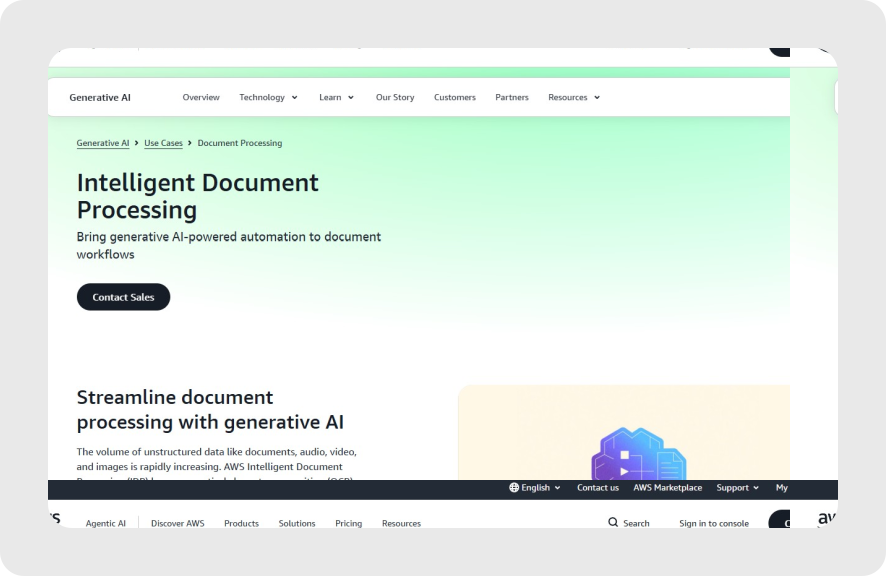
AWS Intelligent Document Processing is not a single product but a reference architecture combining Amazon Textract (OCR and structured data extraction), AWS Comprehend (NLP and entity recognition), AWS Glue (data transformation), and AWS Lambda (serverless workflow execution).
Together, these services cover the full IDP lifecycle inside AWS.
Key Features
- Amazon Textract: Extracts text, tables, and form fields from scanned PDFs and images
- AWS Comprehend: NLP-powered entity recognition, classification, and sentiment analysis on extracted text
- Serverless Architecture via Lambda: Event-driven document processing that scales automatically with volume
Pricing
AWS offers per-page usage pricing across each service. Costs vary significantly by document type and volume. It’s recommended to run an AWS calculator estimate before committing.
Where AWS IDP Shines
- Native to AWS ecosystem: Zero integration lift for teams already on AWS infrastructure
- Massively scalable: Serverless architecture handles unpredictable document volumes without manual scaling:
Where AWS IDP Falls Short
- No pre-built UI: Validation workflows and business logic must be custom-built
- Not a turnkey solution: Requires significant AWS architecture expertise to assemble and maintain
Learn how build vs buy decisions impact IDP implementation speed and cost
Customer Reviews
Arup M. notes, “It eliminates the need for manual data entry or complex OCR setups, making it simple to integrate into workflows.It processes large volumes of documents quickly, which is ideal for businesses with high data processing demands.”
Kyle S. complains, “I found the process a bit convoluted. And compared to competitors, you needed to use some other Amazon services as well.”
Who AWS IDP Is Best For
- Cloud engineering teams building document automation inside existing AWS infrastructure
5. Doxis DocHorizon: Best for SMBs and Finance Document Automation
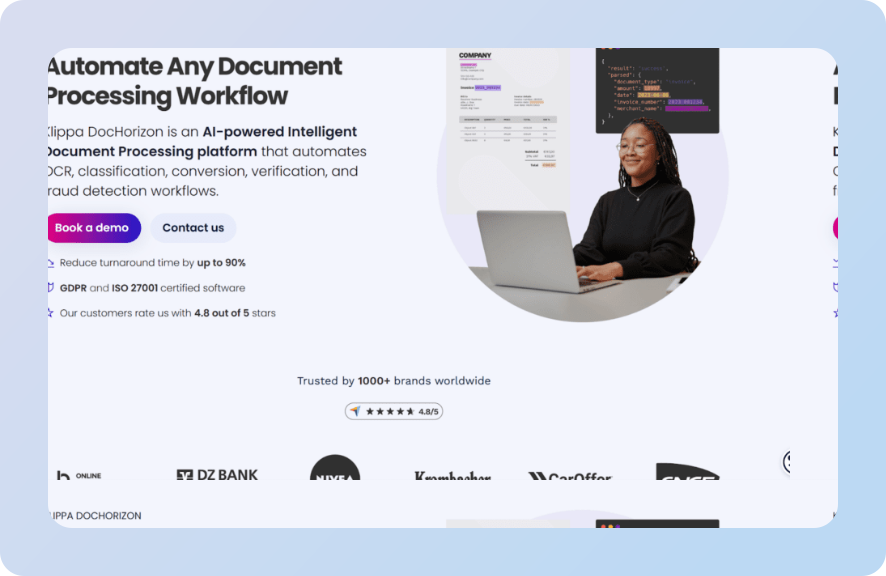
Doxis (formerly Klippa) provides DocHorizon, its cloud-based IDP platform aimed at small and mid-market businesses. It offers pre-built flows for invoice processing, receipt capture, employee onboarding documents, and customer orders.
Key Features
- Pre-built Financial Document Flows: Ready-made pipelines for invoices, receipts, purchase orders, and expense reports
- OCR solution + Deep Learning AI: High-accuracy extraction with automatic document classification
- Data Privacy Controls: GDPR-compliant handling of sensitive customer information and financial data
Pricing
DocHorizon offers custom pricing.
Where DocHorizon Shines
- Various SMB functions: Offers document-specific workflows for finance, transportation and logistics, manufacturing, KYC, and retail
- Fast setup: Comes with pre-built workflows so users hit the ground running
Where DocHorizon Falls Short
- Limited depth for complex workflows: Less suited for multi-step document processing with complex validation logic, making it a weaker fit compared to dedicated lab workflow software
- Limited function within healthcare or labs: No purpose-built workflows or specialist support for medical records, TRFs, or clinical documentation
Check healthcare document management systems built for labs.
Customer Reviews
Yogesh B. praises, “Klippa DocHorizon is being well accepted & known for its reliability, speed, accuracy, and ease of integration in document data extraction and automation.”
David notes, “At one point, after an API version update, the handling of rotated images (e.g. photos taken at a 90° angle) was not working properly, which affected the extraction quality.”
Who DocHorizon is Best For
- SMBs and mid-market finance teams automating high-volume invoice processing, expense management, and employee onboarding document flows
Why Onymos DocKnow Is the Standout IDP Solution for Healthcare Labs
Most IDP software will extract text from a document. Fewer will validate that data against connected systems before it moves downstream. Even fewer are built for the specific operational context of a diagnostic or clinical laboratory.
Here’s what makes DocKnow genuinely different across the features that matter most in intelligent document processing.
Extraction That Understands Lab-Specific Documents
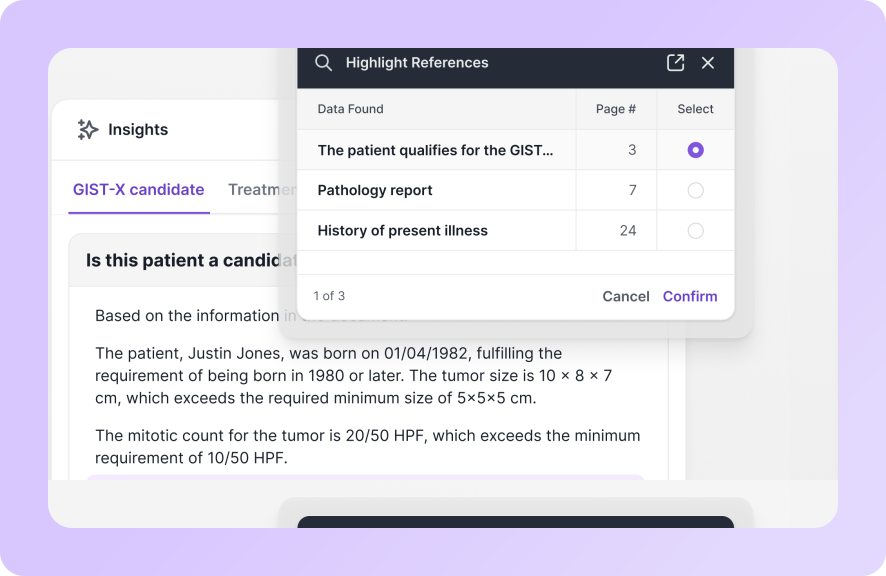
Generic IDP tools are trained on invoices, purchase orders, and contracts. DocKnow is trained on the documents labs actually process: test requisition forms, insurance cards, bills of quantity, and clinical supporting documentation. That specificity matters enormously.
When an IDP platform doesn’t understand the structure of a TRF, it falls back to generalized OCR which can produce errors that the billing team spends hours correcting.
DocKnow’s Nucleus AI system is built to understand lab document types at a structural level, not just character recognition.
Learn how labs reduce billing errors with intelligent automation systems
No-Data Architecture for HIPAA-Compliant Automation
Every IDP vendor on this list that stores data on its servers poses a HIPAA exposure risk to healthcare customers. Onymos eliminates this entirely.
Under the No-Data Architecture, patient data never touches Onymos’ infrastructure. It stays within the customer’s own environment at all times.
-> See how HIPAA and HITRUST controls map in real systems.
Validation Logic That Catches Errors Before Billing
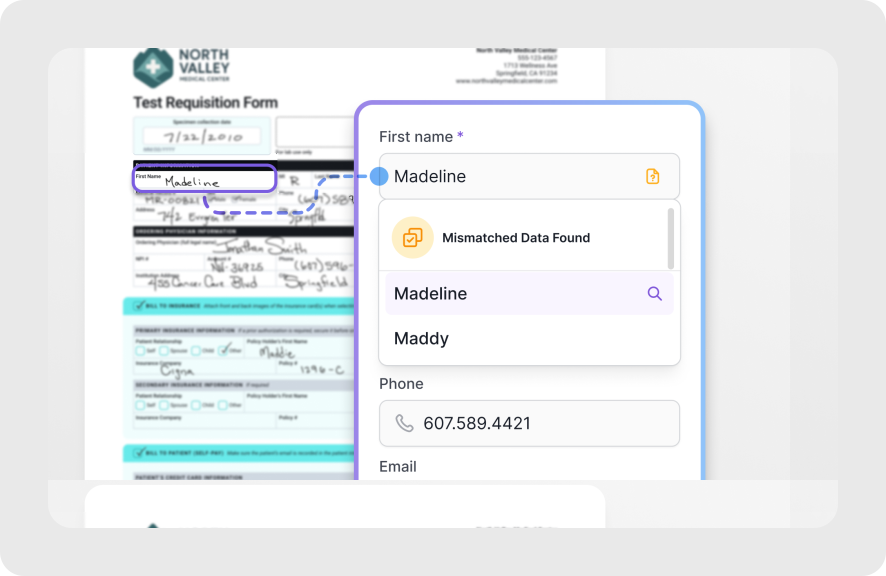
Most IDP tools stop at extraction. DocKnow doesn’t. SmartSync cross-references every extracted value against connected systems, checking patient insurance details, physician identifiers, diagnostic codes, and more before any data leaves the intake layer.
This is the difference between finding an error at intake (seconds to fix) and finding it after a claim is denied three months later. You avoid hours of appeals work, plus potential lost revenue if the timely filing deadline passes.
For labs processing thousands of specimens per week, that difference compounds fast.
See how AI lab tools prevent costly mistakes
Modular Deployment Without Platform Lock-In
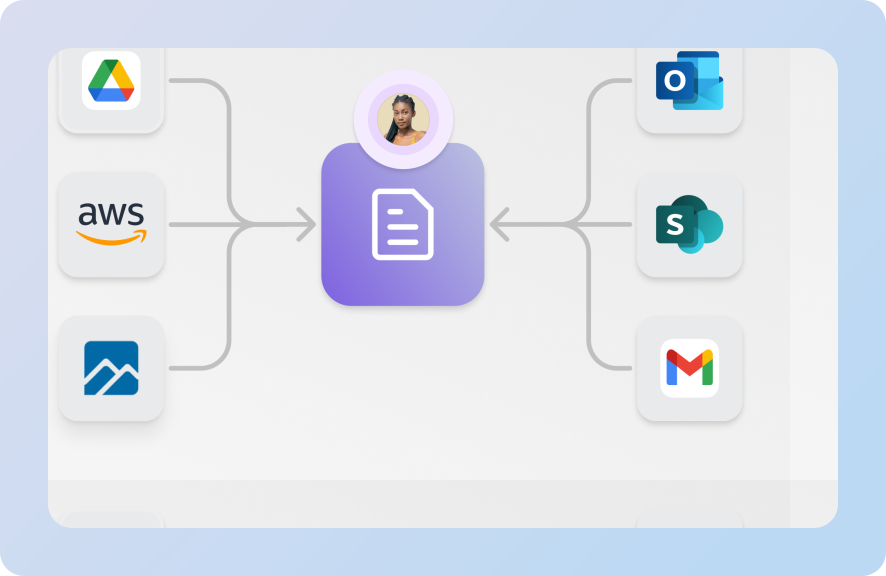
Unlike enterprise IDP platforms that require full-stack adoption to deliver any value, DocKnow is modular.
Labs can adopt lab intake automation first, then layer in billing and reimbursement automation, then client services, at whatever pace their operational maturity supports.
Each module connects via API to existing LIMS platforms, billing systems, and analytics tools, meaning DocKnow enhances your current tech stack rather than replacing it.
Automate Lab Document Workflows With Onymos
The IDP market has no shortage of platforms that will extract text from a document. The harder problem, the one that directly determines whether your lab gets paid, is what happens to that data after extraction.
Does it get validated against your connected systems, reconciled for conflicts, and routed cleanly into billing? Or does it arrive with errors that your team has to chase down manually?
For diagnostic and clinical laboratories, Onymos DocKnow is the only intelligent document processing platform purpose-built for that entire chain.
If your organization is a lab losing revenue to claim denials rooted in intake errors, the fix isn’t better OCR. It’s smarter intake.
Explore what DocKnow can do for your lab’s operations or contact the Onymos team directly to discuss your specific document volumes and workflow requirements.


Connect with our team to explore how Onymos solutions can maximize efficiency, minimize costs, and drive real, scalable growth.
Schedule your demoWe know healthcare data
AI in the lab. Workflow automation at scale. Digital front doors for hospitals and clinics. Healthcare and life sciences are changing fast. Are you ready? Subscribe to our blog for:
- Trends in healthcare tech
- Research and analysis
- Customer stories and more