5 Best Revenue Cycle Management Software (2026 Ranked)
Table of Contents
- Compare the 5 Best Revenue Cycle Management Software
- Onymos: The Intelligent Intake and Workflow Automation Layer Before RCM
- 1. Waystar: Best for AI-Powered Denial Management at Scale
- 2. Athenahealth: Best for Integrated EHR and RCM
- 3. Epic Systems: Best for Large Health Networks on Epic EHR
- 4. Oracle Health (Cerner): Best for Enterprise Hospital RCM
- 5. NextGen Healthcare: Best for Specialty Practice Billing
- Why Even the Best RCM Software Needs Onymos DocKnow
- Improve Revenue Cycle Performance Before Claims Even Begin
Need a custom demo?
Use your own workflow and see where DocKnow can reduce manual work.
Get your demoKey Takeaways
- Regardless of which RCM system your lab relies on, Onymos DocKnow is the essential first step to ensuring its success. Rather than replacing your RCM, DocKnow sits right before it, stopping claim denials at the source by automating intake, running upfront eligibility checks, and feeding clean data into your downstream systems.
- Waystar is the strongest standalone RCM platform for mid-to-large health systems that need end-to-end claims management, denial intelligence, and payer connectivity at scale.
- Athenahealth is the top pick for physician-led practices that want a fully integrated EHR and RCM in one cloud-based platform with strong automation.
- Epic Systems suits large health networks already invested in Epic’s EHR, where native RCM integration eliminates the data handoff problem entirely.
Every lab and healthcare organization has felt it: a claim submitted correctly is denied anyway, or a test already performed is found ineligible for reimbursement afterward.
Revenue cycle management looks into where labs bleed money, and most RCM software addresses the back-end of that problem while ignoring the front.
The best revenue cycle management software tools of 2026 are listed below, evaluated on denial management, workflow automation, billing accuracy, and (critically for labs) how far upstream their protection actually starts.
Compare the 5 Best Revenue Cycle Management Software
| Tool | Best For | Standout Feature |
|---|---|---|
| Waystar | Mid-to-large health systems | AI-powered denial scoring + payer connectivity |
| Athenahealth | Physician practices needing EHR + RCM together | Cloud-based, fully integrated practice management |
| Epic Systems | Large health networks on Epic EHR | Native EHR-to-RCM data flow with no handoff gaps |
| Oracle Health (Cerner) | Enterprise hospitals with complex billing environments | Deep EHR integration + revenue integrity tools |
| NextGen Healthcare | Specialty and ambulatory practices | Specialty-specific billing workflows |
Most RCM tools address claims management and denial resubmissions well. What they don’t address is the upstream documentation failures that cause many of those preventable denials.
If your lab is processing thousands of test requisition forms per week, that’s where the revenue is actually being lost, not in the billing software.
That’s the gap DocKnow fills. It’s an intelligent intake layer that ensures the data entering your RCM is complete, accurate, and usable from the start.
Onymos eliminates patient intake errors before they become claim denials.
Onymos: The Intelligent Intake and Workflow Automation Layer Before RCM
Onymos DocKnow is not a traditional RCM platform, and that’s precisely why it belongs at the top of this list for labs. DocKnow, is the intelligent intake layer that sits upstream of the RCM system your lab already uses.
It automates the ingestion, validation, and routing of test requisition forms, insurance cards, and supporting clinical documentation before any of that data touches billing.
The core insight behind DocKnow is simple: most claim denials don’t start in billing. They start at intake, when a patient name is transcribed incorrectly, an insurance policy number is missing, or a physician identifier doesn’t match what the payer has on file.
DocKnow catches those problems before they move downstream, protecting your RCM investment from upstream data failures.
Onymos Key Features
DocKnow offers a layered set of capabilities purpose-built for lab and healthcare document workflows.
- SmartSync AI Data Reconciliation
SmartSync is DocKnow’s proprietary reconciliation engine, powered by Nucleus. It compares extracted data across all connected sources (the TRF, the patient’s insurance card, medical records, and your LIMS) and flags any mismatches before data moves to billing.
Every correction is logged with a field-level audit trail for CAP and CLIA compliance.
→ Learn more about Nucleus, the AI system powering DocKnow
- Upfront Insurance Eligibility Verification
In many diagnostic laboratories, eligibility workflows run after a test has already been performed. DocKnow runs eligibility checks at the point of intake, before the specimen even reaches the bench. If a patient’s coverage doesn’t support the test being ordered, your billing team knows immediately,
This single capability can eliminate a significant share of preventable claim denials for high-volume labs.
→ Read more: How lab workflow automation reduces downstream errors
- Automated Data Extraction and Structured Output
DocKnow reads TRFs, insurance cards, superbills, and supporting documents from any source and automatically extracts, validates, and formats the key data fields.
Every field is captured, validated against business rules built around each lab’s specific payer landscape, and delivered as structured, clean data ready for the downstream RCM or LIMS.
→ Explore Onymos’s healthcare document management capabilities
Onymos Pricing
Onymos uses volume-based custom pricing. Labs can adopt specific modules without purchasing the entire platform.
Contact Onymos directly for a quote.
Where Onymos Shines
- Stops revenue loss at the source: DocKnow catches intake errors before they become denied claims. For labs processing 250K+ specimens per year, this directly protects net collections
- No-Data Architecture: Unlike every other platform on this list, Onymos never stores or accesses your data. All patient records and extracted information remain exclusively within your own infrastructure
- Integrates without replacing: DocKnow connects directly to existing LIMS, LIS, and RCM systems via API. It fills the intake gap that tools like Waystar and Athenahealth leave open without requiring a platform migration
Where Onymos Falls Short
- Not a full RCM platform: DocKnow powers the intake and data validation layer. Labs still need a downstream RCM system for claims submission, payment posting, and A/R management. Onymos is designed to work alongside those systems, not replace them
- Lab-focused by design: General hospital administration or behavioral healthcare billing teams will find better fits elsewhere on this list
Onymos Customer Reviews
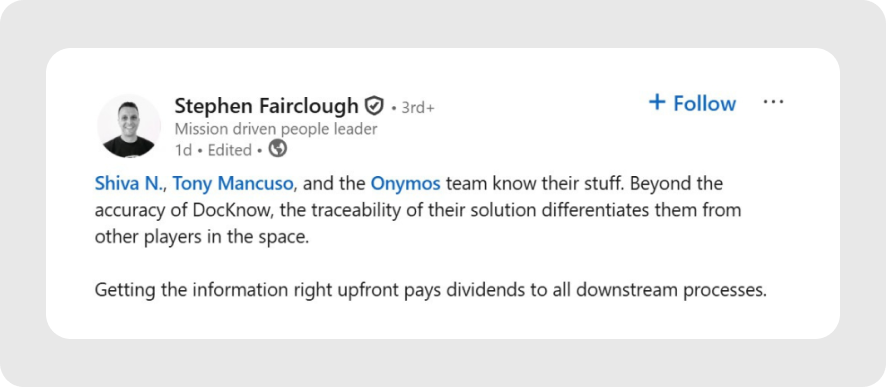
Personalis’s former VP of Informatics, Stephen Fairclough, speaks highly of the Onymos team. On LinkedIn, he wrote, “The Onymos team know their stuff. Beyond the accuracy of DocKnow, the traceability of their solution differentiates them from other players in the space.”
An Onymos user also sings praise, “Onymos is a great partner and enabled us to quickly get our Proof of Concept completed. They were very responsive and collaborative, and we had a successful Proof Of Concept deployment.”
→Read more: Our customer success stories
Who Onymos is Best For
- Diagnostic labs with high claim denial rates: Labs losing revenue to denials caused by missing or incorrect intake data
- High-volume clinical labs on growth trajectories: Organizations moving from 250K to 350K+ specimens annually who can’t scale manual data entry
- RCM directors and lab directors: Anyone responsible for clean data flow from specimen intake through to reimbursement
- Labs already using an RCM platform: DocKnow makes your existing RCM investment more effective by eliminating the upstream data failures those tools can’t prevent
1. Waystar: Best for AI-Powered Denial Management at Scale
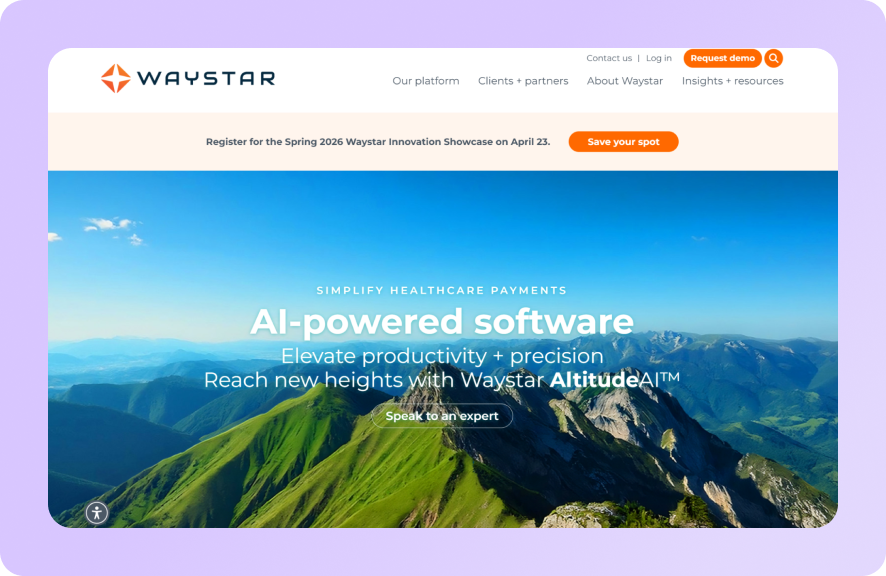
Waystar is one of the most widely used RCM automation platforms in healthcare, with deep payer connectivity and a strong suite of denial intelligence tools.
It’s built for mid-to-large health systems that need to manage high claim volumes, complex payer negotiations, and real-time visibility into financial metrics across the revenue cycle.
Key Features
- AI-Powered Denial Scoring: Predicts denial risk per claim before submission, enabling proactive claims rework and reducing denial rates.
- Payer Connectivity: Connects to thousands of payers for electronic claim submission, eligibility verification, and payment processing in a single platform.
- Claims Management Dashboard: Real-time visibility into claim status, A/R management, and net collections across the full billing cycle.
Pricing
Waystar offers four package types: Starter, Core, Performance, and Premium.
All of them are custom-priced.
Where Waystar Shines
- Denial intelligence is one of the best-in-class: The AI-enabled rules engine and denial scoring capability help billing teams prioritize claims follow-up effectively
- Broad payer landscape coverage: Strong connectivity across commercial, government, and specialty payers
- Proven at scale: Used by large health systems processing millions of claims annually
Where Waystar Falls Short
- Starts downstream: Waystar addresses what happens after intake data reaches billing. It cannot catch errors at the point of document capture which is where most lab denials originate
- Complex implementation: Enterprise deployments can involve significant configuration time and cost
Customer Reviews
A verified user praises Waystar as a one-stop shop, “for any practice who does their own in house billing and wants to keep on top of their revenue and all things related to it.”
Angela B. complains about the lack of information verification, saying, “Limitations on insurance payor information. Waystar shows that a patient is covered but does not give always give accurate account info for the payor – for example, a patient having Forward health / BadgerCare shows having active coverage in Waystar. However, the payor we need to bill / load insurance under in our EMR system, such as Security Health Medicaid, is not indicated.”
Who Waystar is Best For
- Mid-to-large health systems with complex payer mixes needing end-to-end claims management
- RCM directors who need real-time visibility into denial rates, cost to collect, and net collections across departments
2. Athenahealth: Best for Integrated EHR and RCM
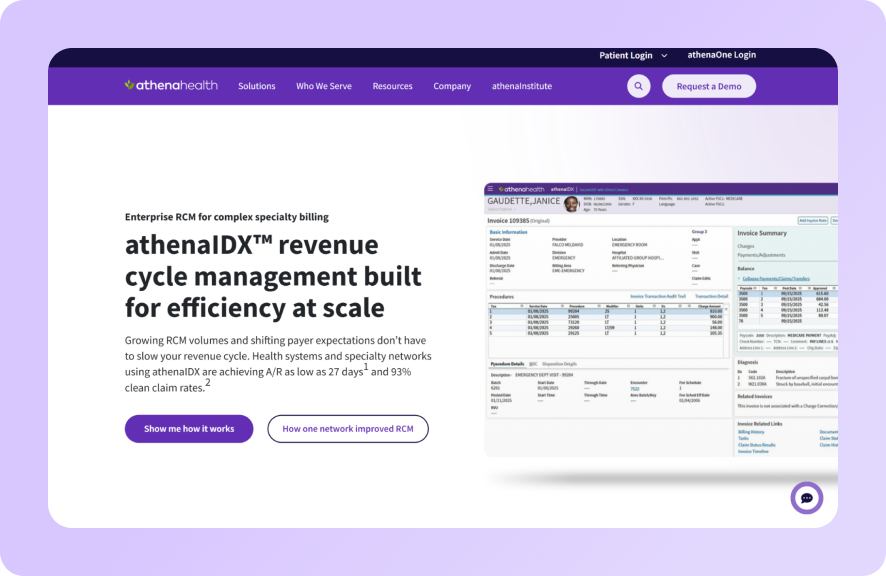
Athenahealth is a cloud-based platform that combines electronic health records, practice management, and revenue cycle management in a single, unified system.
Athenhealth is one of the few RCM solutions where the patient care record and the billing workflow live in the same environment. This eliminates a significant source of data handoff errors.
Key Features
- Integrated EHR + RCM: Patient records and billing workflows share the same data environment, reducing transcription errors between care and claims.
- Automated Claim Scrubbing: Claims are reviewed against payer-specific rules before submission, reducing first-pass denial rates.
- Patient Payment Tools: Supports patient co-pays, out-of-pocket calculations, and patient collections through an integrated patient accounting system.
Pricing
Athenahealth offers a custom pricing model.
Where Athenahealth Shines
- Best EHR-RCM integration for practices: Shared data environment reduces errors from manual data transfers between systems
- Continuously updated payer rules: Athenahealth maintains a network of payer rules that update automatically, reducing coding errors
- Strong patient payment experience: Patient-facing billing tools improve patient payment rates and reduce collections activities overhead
Where Athenahealth Falls Short
- Percentage-of-collections pricing: Can become expensive as revenue grows; total cost can exceed flat-fee alternatives
- Less suited for labs: Built around physician practice workflows, not standalone diagnostic laboratory intake and accessioning processes
Customer Reviews
Michelle G. shares, “Having an EHR and practice management platform bundled into one streamlined system is priceless for a busy mental health practice.”
David B. warns of the following areas where the platform faces issues, “RCM, price increases, poor customer support, high learning curve, long integration, poor CSM quality.”
Who Athenahealth is Best For
- Physician practices and ambulatory clinics that want EHR and RCM in one system
- Healthcare providers looking to reduce manual billing processes through tight care-to-claims integration
3. Epic Systems: Best for Large Health Networks on Epic EHR
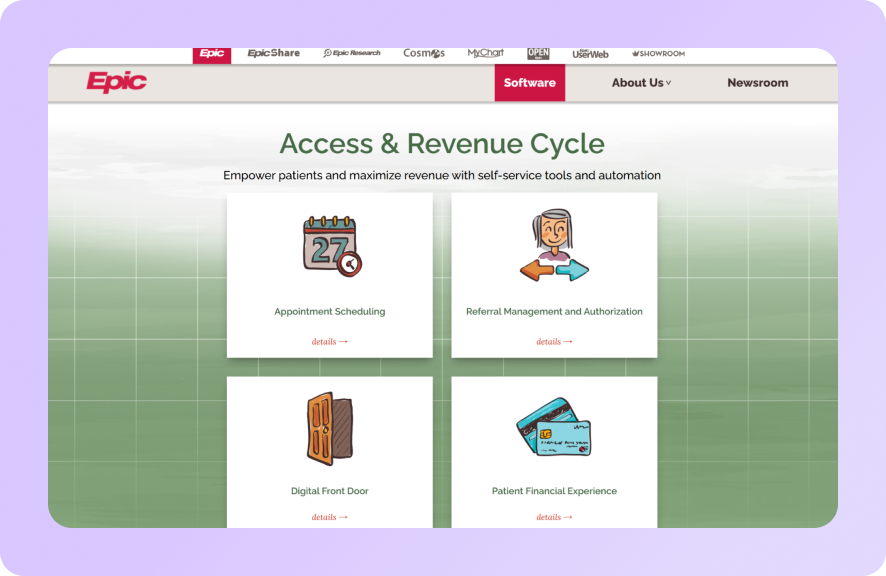
Epic is the dominant EHR platform in US health systems, and its integrated revenue cycle tools are a natural extension for organizations already running Epic.
For large health networks where Epic’s EHR is already the system of record, its native RCM capabilities eliminate the data translation layer that causes errors in disconnected billing environments.
Key Features
- Native EHR-to-Billing Integration: Clinical and financial data live in the same system, eliminating handoff errors between care delivery and claim filing.
- Authorization Verification: Pre-service authorization workflows built into scheduling and registration reduce authorization-related denials downstream.
- HCC Coding Support: Hierarchical Condition Category coding tools help health systems capture risk-adjusted revenue accurately, reducing coding gaps.
Pricing
Epic’s RCM function follows a custom enterprise contract.
Where Epic Shines
- Zero data translation between EHR and billing: For organizations already on Epic, the revenue cycle module is the cleanest integration available
- Scale and depth: Handles the complexity of large health networks with multiple billing entities, payer contracts, and service lines
- HCC coding and risk capture: Strong for value-based care organizations managing coding gaps and HCC risk scores
Where Epic Falls Short
- Cost and implementation: Epic is one of the more expensive platforms to implement and maintain. Not accessible for mid-size or smaller organizations
- Not purpose-built for standalone labs: Diagnostic labs operating outside a health system context will find Epic’s overhead disproportionate to their needs
Customer Reviews
John Dave P. praises, “With Epic’s Care Everywhere feature, patient data can be securely exchanged with other healthcare providers who also use Epic or compatible systems, improving continuity of care.”
Dr A. mentions, “User interface can be overwhelming and unintuitive, especially for new staff.”
Who Epic is Best For
- Large integrated health systems already running Epic EHR that want native RCM without a third-party integration layer
- Health systems managing value-based care contracts where HCC coding accuracy directly affects reimbursement
4. Oracle Health (Cerner): Best for Enterprise Hospital RCM
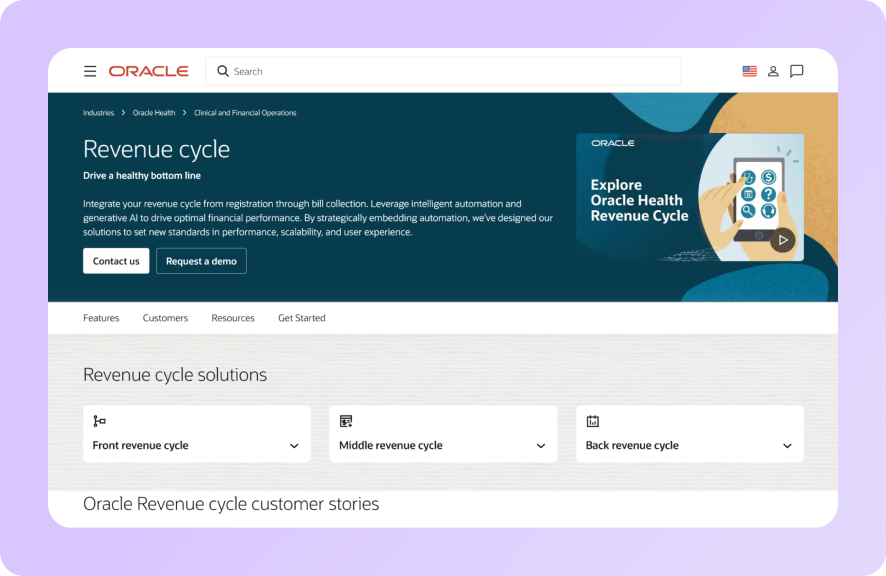
Oracle Health, formerly Cerner, is the other dominant player in large-scale hospital EHR and RCM.
Its revenue cycle tools are built for complex hospital billing environments with multiple payers, service lines, and regulatory requirements.
Key Features
- Revenue Integrity: Automated charge capture review and real-time code review catch billing errors before claim submission.
- Claims Management: End-to-end claims lifecycle from submission through denial management and resubmission.
- Patient Accounting System Integration: Deep integration with patient accounting systems supports complex payment posting and A/R management.
Pricing
Oracle Health offers custom enterprise pricing for its RCM modules.
Where Oracle Health Shines
- Revenue integrity tools: Strong for large organizations where charge capture and coding accuracy are the primary leakage points
- Enterprise scale: Designed for complex billing environments with significant claim volumes across multiple facilities
Where Oracle Health Falls Short
- Heavy implementation: Oracle Health deployments require significant IT resources and extended timelines
- Less agile: Organizations with rapidly changing workflows may find Oracle Health slower to adapt than more modular platforms
Customer Reviews
Keith K. praises, “Very good roll out. Support was top notch and was able to answer questions and issues along the way.”
Jessica S. pits it against Epic, saying, “Cerner is not as user-friendly as EPIC’s EMR. It takes about a month of daily use to get the hang of where different files and information are located in the patient chart. I wish its search feature could search more in-depth within the patient chart like EPIC does.”
Who Oracle Health is Best For
- Large hospital systems already invested in Oracle Health / Cerner EHR
- Enterprise revenue cycle teams managing billing across dozens of facilities and service lines
Organizations that depend on enterprise integration layers often evaluate MuleSoft competitors, including Workato and Boomi, alongside API-first approaches like this.
5. NextGen Healthcare: Best for Specialty Practice Billing
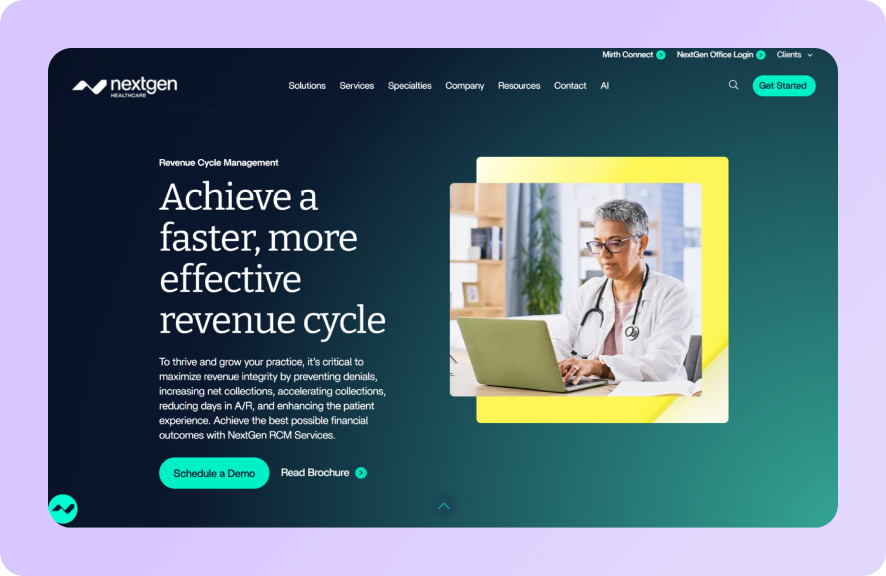
NextGen Healthcare is an EHR and practice management platform with strong specialty-specific billing workflows.
It’s widely used by ambulatory specialty practices such as orthopedics, behavioral health, and women’s health that need RCM tools built around their specific coding and payer requirements.
Key Features
- Specialty-Specific Billing Workflows: Pre-configured billing rules for over 30 specialty practice types.
- Real-Time Code Review: AI-assisted coding suggestions reduce medical claim denials from coding errors.
- Patient Experience Tools: Integrated patient payment, patient navigation, and patient collections workflows.
Pricing
NextGen, like the other providers on this list, offers custom pricing based on practice size and the modules selected.
Where NextGen Shines
- Specialty billing depth: Fewer generic workarounds; workflows are built around specialty-specific documentation and coding requirements
- Integrated patient experience: Patient-facing tools reduce friction in patient payments and improve patient relationships
Where NextGen Falls Short
- Less suited for labs: Specialty practice focus means standalone diagnostic lab workflows are not a strong fit
- Implementation complexity: Multi-specialty deployments can require significant configuration
Customer Reviews
Kim T. mentions, “This software is cloud-based, simple to set up, and user-friendly.”
Amanda B. warns, “It’s a bit of a clunky system. A lot of having to close one document to open another document, it could be more time efficient. Hated the initial setup. It was terrible.”
Who NextGen is Best For
- Specialty ambulatory practices that need billing rules and workflows specific to their clinical context
- Behavioral healthcare and behavioral health billing teams with distinct documentation and coding requirements
Why Even the Best RCM Software Needs Onymos DocKnow
Every platform on this list handles the billing and claims side of revenue cycle management reasonably well.
The problem is that none of them address the point where lab revenue is most commonly lost: the moment a test requisition form arrives with incomplete or incorrect data.
Fixing those errors downstream takes time for billing staff, creates claim rework, and costs money. Denials that go unchallenged become write-offs.
DocKnow operates upstream of all of these platforms, solving problems the RCM layer cannot.
Error Prevention Before the Revenue Cycle Begins
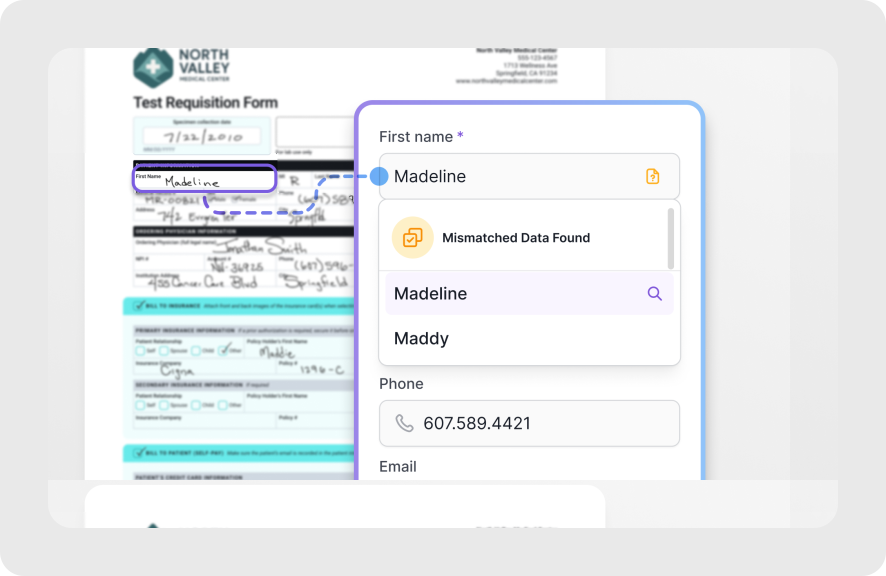
The most defensible way to improve financial outcomes is to prevent errors before they enter the billing workflow, not recover from them afterward.
DocKnow’s SmartSync engine compares data across every connected source at the moment of intake, catching errors before a single claim is even generated.
Labs that implement upfront validation report fewer claim issues, fewer denial resubmissions, and measurably lower collection costs.
Structured Data That RCM Systems Can Actually Use
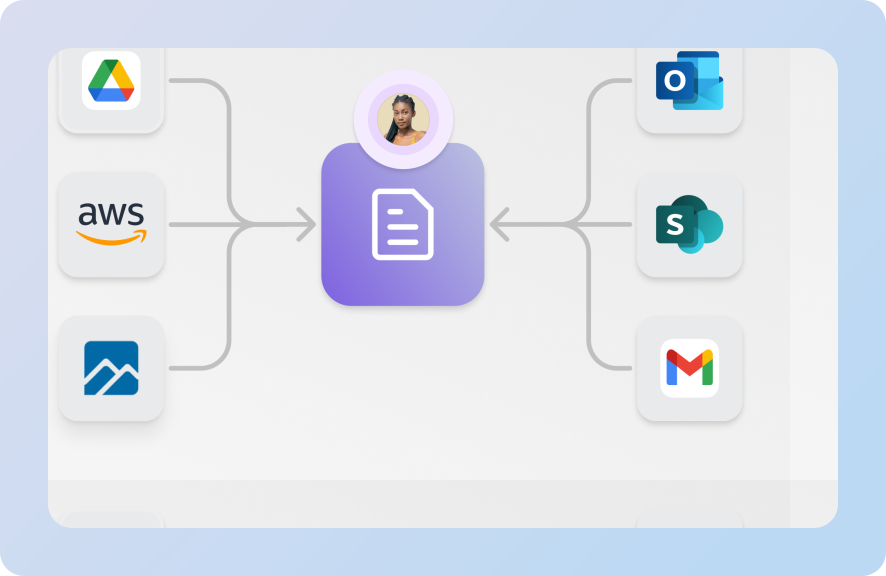
Most RCM systems receive data from intake in whatever form it arrives. This could be partially filled fields, inconsistently formatted values, or even missing codes.
Billing staff spend significant time normalizing and structuring that data before claims can be submitted correctly. DocKnow automates that normalization step completely.
Every field captured by DocKnow is validated against lab-specific business rules, cross-referenced against connected systems, and delivered as clean, structured data ready for direct ingestion.
The result is fewer manual interventions, higher accounts worked per hour, and a shorter path from specimen to reimbursement.
→ Learn more about HIPAA-compliant document management
No-Data Architecture Eliminates a Hidden Compliance Risk
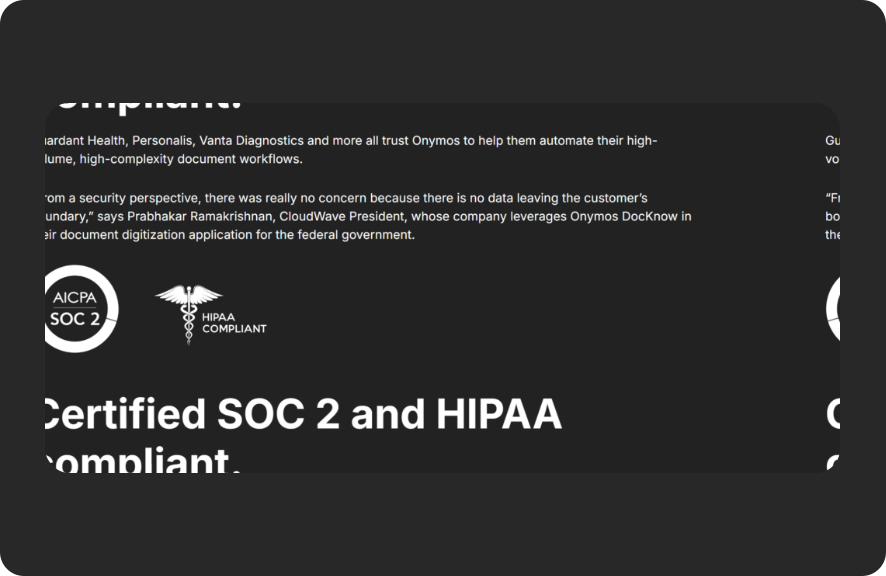
Many RCM platforms on this list store your billing data on their servers by default. That’s standard practice, but in healthcare, it’s also a significant risk. HIPAA compliance at the platform level doesn’t eliminate that exposure.
DocKnow’s No-Data Architecture means Onymos never stores, accesses, or sees your patient data. All extracted records remain exclusively within your own infrastructure.
For labs subject to strict regulatory oversight, this directly strengthens laboratory compliance posture and reduces liability exposure in the event of a breach.
Improve Revenue Cycle Performance Before Claims Even Begin
The RCM platforms ranked in this list are legitimate tools for managing billing processes, denial management, and payment processing. For health systems, specialty practices, and independent physicians, the right platform from this list will meaningfully improve financial outcomes.
But if your organization runs a diagnostic or clinical laboratory, the revenue cycle problem starts earlier than any of these platforms can reach. Claim denials caused by missing insurance details, mismatched patient identifiers, or incomplete TRFs are intake problems that require an intake solution.
Onymos DocKnow is purpose-built for that gap. It protects your RCM investment by ensuring the data that enters billing is accurate, complete, and validated before a single claim is generated.
See Onymos DocKnow in action today.


Connect with our team to explore how Onymos solutions can maximize efficiency, minimize costs, and drive real, scalable growth.
Schedule your demoWe know healthcare data
AI in the lab. Workflow automation at scale. Digital front doors for hospitals and clinics. Healthcare and life sciences are changing fast. Are you ready? Subscribe to our blog for:
- Trends in healthcare tech
- Research and analysis
- Customer stories and more