7 Best Molecular Lab Software Solutions in 2026 (Reviewed & Compared)
Compare the best molecular lab software in 2026. Explore LIMS tools, automation platforms, and solutions for genomics, diagnostics, and research labs.
- Onymos Team
- 17 min read
The best molecular laboratory software isn’t the platform with the most features. It’s the one that solves the bottlenecks holding your laboratory back.
Most molecular laboratories begin evaluating new software when turnaround times slip, reimbursement suffers, or requisition errors keep surfacing. Some of those issues originate inside the LIS, while others begin long before a specimen is ever accessioned.
Molecular lab software covers platforms that manage testing workflows, specimen tracking, reporting, billing, and laboratory intake for molecular diagnostics, genomics, and precision medicine. This guide compares eight of them, including where each fits, what it costs, and where it falls short, so you can match the tool to the problem.
Compare the Best Molecular Lab Software: At a Glance
| Software | Best For | Standout Feature | Price Starting Point |
|---|---|---|---|
| Onymos | Validating intake data before it reaches your LIS or LIMS | No-Data Architecture keeps patient data inside your environment | Usage-based; contact for a quote |
| LigoLab | Pathology and reference labs wanting LIS and RCM unified | Integrated LIS and RCM on one database | Tiered; contact for a quote |
| XiFiN | Molecular diagnostics labs managing testing and reimbursement | VisualStrata visualization across clinical and financial data | Contact for a quote |
| NovoPath | Pathology groups managing AP and molecular workflows | 150+ pre-built EMR integrations | Contact for a quote |
| Clinisys | Hospital systems on legacy Sunquest, PowerPath, or CoPathPlus | One shared database across its combined LIS and RCM lines | Contact for a quote |
| LabVantage | Large hospital systems needing one LIMS across every discipline | Enterprise LIMS spanning multiple lab disciplines | Contact for a quote |
| CGM LABDAQ | Independent and outreach laboratories running PCR | Lab IQ performance dashboard with built-in TAT monitor | Contact for a quote |
Most lab software is custom-quoted on workflow complexity, testing volume, and implementation scope. That makes it more important to understand the problem you are solving before you start comparing. If your biggest problem starts before specimens enter the testing workflow, look at Onymos first.
→ See how Onymos validates intake before it reaches your LIS
1. LigoLab
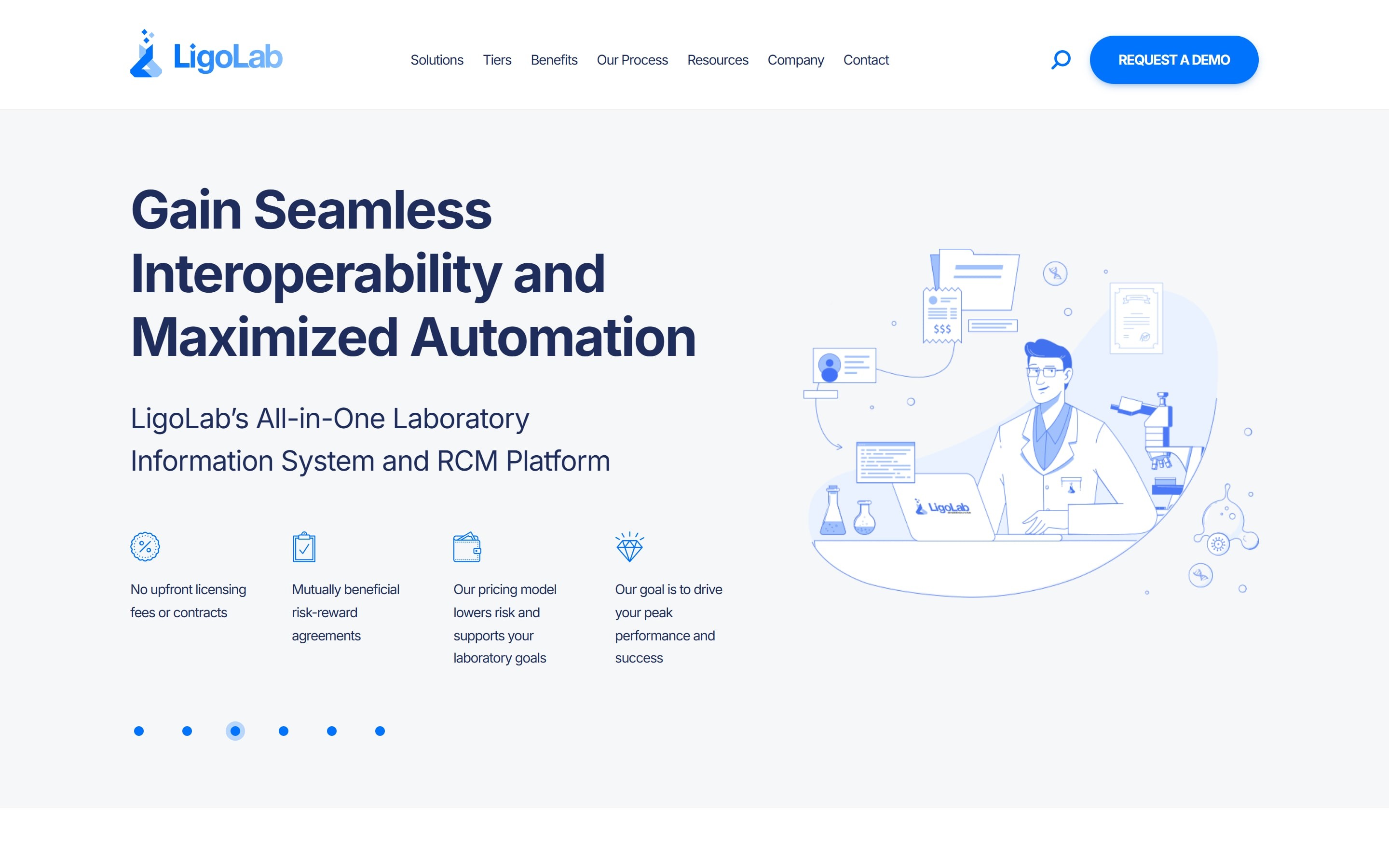
LigoLab runs anatomic pathology, clinical, molecular, and toxicology testing on one platform that combines the LIS and lab RCM. Both modules share a single database, so the lab is not reconciling two disconnected systems after the fact.
Key Features
- Billing That Starts at Order Entry: Because the LIS and RCM share one database, LigoLab begins the revenue cycle the moment an order is placed. Eligibility verification, claim scrubbing, and CPT/ICD-10 auto-coding run inside the same workflow that processes the specimen.
- Molecular and Anatomic Pathology Support: LigoLab’s molecular module supports FISH, cytogenetics, flow cytometry, and EGFR testing, with customizable result panels and the ability to merge results from different methods into one report. It runs next to the anatomic pathology module, so a lab handling both disciplines runs them on one system instead of splitting the work between an LIS and a LIMS.
Pricing
| Plan | Pricing |
|---|---|
| All plans | Custom |
Where LigoLab Shines
- Billing problems surface sooner: With the revenue cycle starting at order entry, claim-scrubbing issues get caught earlier than on platforms where RCM is a separate add-on.
- Responsive customer support: Capterra reviewers single out fast turnaround from the support team, especially during complex instrument and assay setup.
Where LigoLab Falls Short
- The flexibility can backfire: Some users report ending up with redundant workarounds for the same problem because the platform allows so many ways to solve it.
- Initial setup is demanding: Multiple reviewers describe configuration as intensive, even when they find the result worth it.
Customer Reviews
A verified user praises, “Program is fairly easy to use and pretty much straight-forward. The grossing aspect, which I use, is easy to train to new employees. I like that you can customize any protocols that we use in the lab and apply them directly in the LIS.”
Chris B. warns, “Collaboration on specific needs was cumbersome at times. With a highly customizable LIS, sometimes redundant solutions would be implemented or require a workaround.”
Who LigoLab Is Best For
- Pathology and reference labs running anatomic pathology, molecular diagnostics, or multi-specialty testing that want LIS and RCM on one shared database.
- Lab managers and executives who need operational and financial visibility without pulling reports from separate systems.
- Growing labs that want to start at Essential and scale to Enterprise without switching vendors.
2. XiFiN
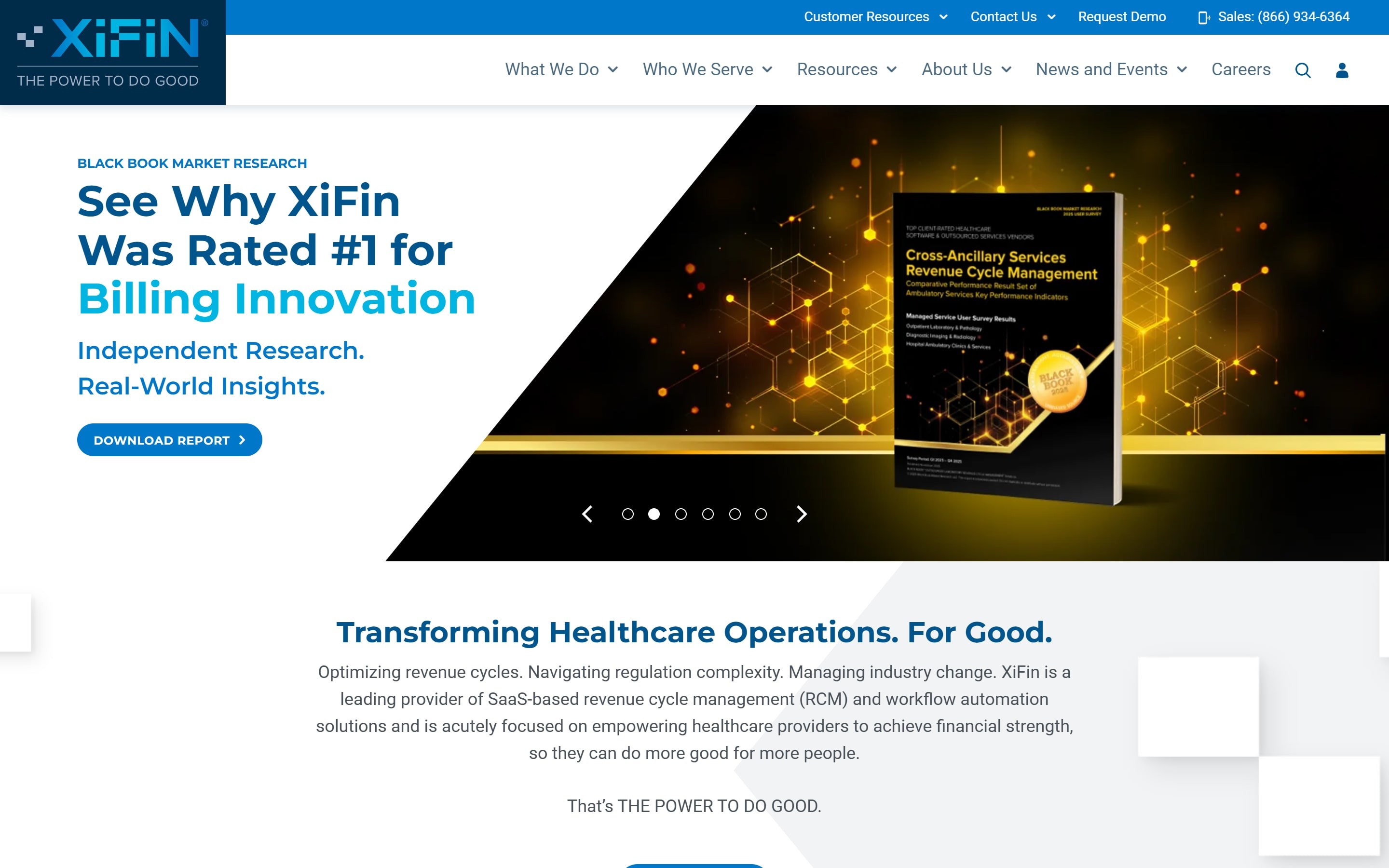
XiFiN is a cloud-based LIS built around molecular diagnostics, anatomic pathology, and lab RCM, aimed at labs that need billing performance and clinical workflow on one platform.
Key Features
- Molecular and Genomics Workflow Support: XiFiN LIS supports FISH (fluorescence in situ hybridization), gene microarray, PCR (polymerase chain reaction), NGS (next-generation sequencing), and pharmacogenomics workflows.
- VisualStrata for Combined Clinical and Financial Insight: VisualStrata combines diagnostic, clinical, and financial data from multiple sources into one view, giving lab leadership a single picture of operational and billing performance alongside patient outcomes.
Side note: XIFIN handles the clinical and billing side, while Onymos checks the data before it ever reaches those systems. The two solve different halves of the same problem, which is how clean reconciliation keeps healthcare from losing billions.
| Plan | Pricing |
|---|---|
| All plans | Custom |
Where XiFiN Shines
- Billing and operations share one ecosystem: Lab leaders read clinical and financial performance from the same place instead of stitching two reports together.
- Cloud access suits distributed teams: Reviewers consistently note that a case can be pulled up and worked from anywhere.
Where XiFiN Falls Short
- Case navigation has friction: The platform has difficulty moving to the next case in a sequence without exiting and re-searching, which slows high-volume review.
- Less suited to pure research: XiFiN’s focus is clinical diagnostics and hospital lab workflows, so research-heavy organizations may need supplementary systems for NGS data management.
Customer Reviews
Cristina M. praises, “Xifin was a pretty solid system for billing and entering patient demographics and for electronic claims submission. Our department used it to collect payments, enter patient info, submit claims.”
Lee L. complains, “The system is very confusing. And customer service requires a ticket for every issue. Even those when your system is down.”
Who XiFiN Is Best For
- Diagnostic labs and providers that want molecular testing and lab RCM on the same cloud platform.
- Labs moving from fee-for-service to value-based billing, where XiFiN’s RCM tooling is built to support the shift.
3. Onymos: Best for Automating Molecular Lab Workflows
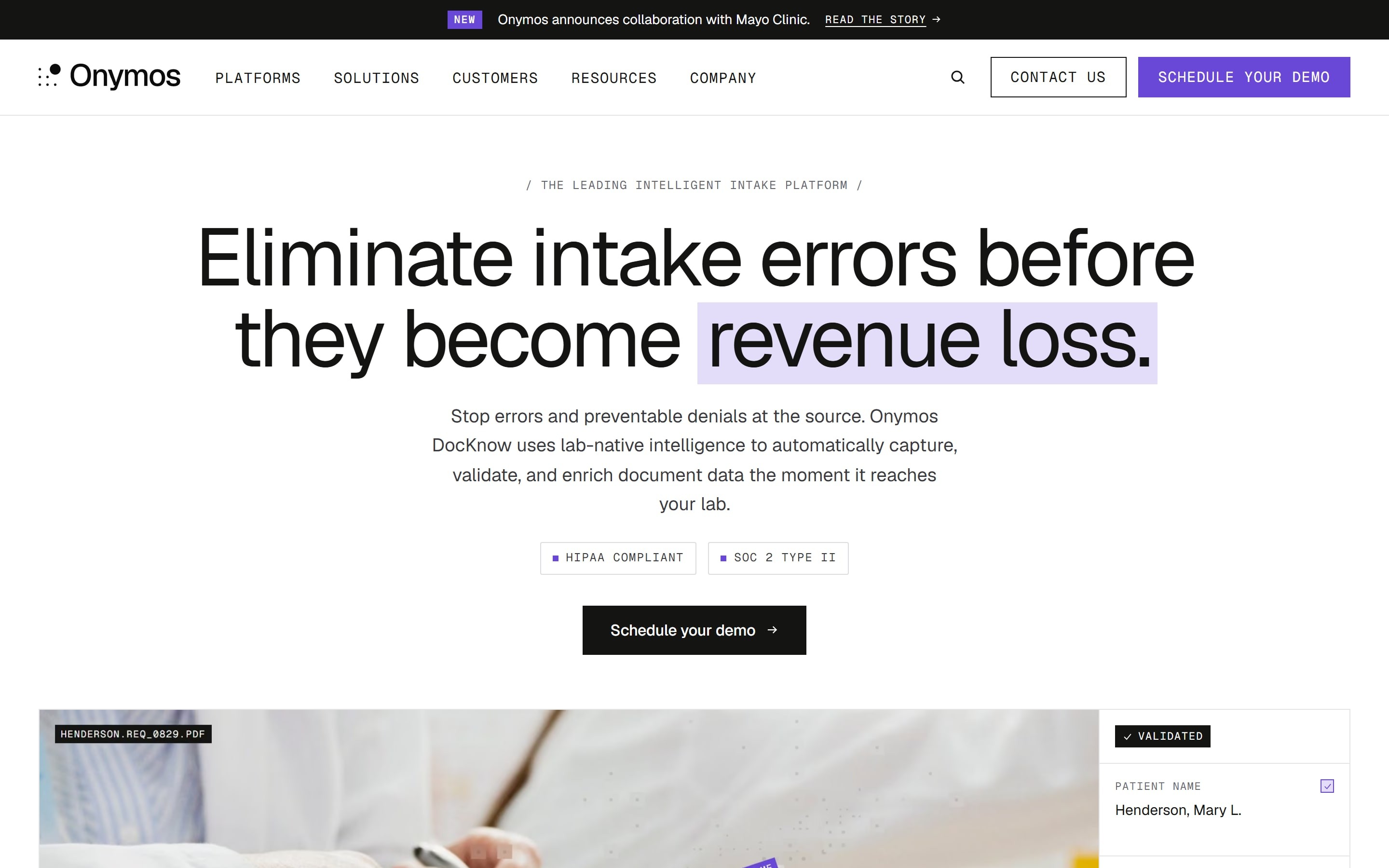
Onymos automates the molecular lab workflow at the point most platforms ignore: intake. It is an intelligent intake layer that sits in front of your LIS, LIMS, or any other system you already run. The platform catches requisition errors, mismatched test requisition forms (TRFs), and incomplete orders that otherwise do not surface until a claim is denied weeks later.
That makes Onymos an enabling layer for the rest of your molecular lab software stack instead of a replacement. It extracts, validates, and reconciles laboratory data before it enters downstream systems, which is what separates lab-native intelligent document processing from generic OCR.
Onymos Key Features
- Synapse: The Cognitive Insight Model (CIM) that powers DocKnow, trained on laboratory documents rather than general conversation. It reads test requisitions, insurance cards, and medical records using field context and layout position, interprets handwriting with over 95% accuracy, and flags low-confidence fields for human review instead of guessing.
- SmartSync: Cross-checks requisitions, insurance cards, medical records, and connected systems to catch missing or conflicting data before it moves downstream. It verifies insurance eligibility before processing and writes every validation action to an immutable audit trail built for CAP and CLIA inspection readiness.
- No-Data Architecture: Onymos’s award-winning approach to sensitive data. DocKnow processes everything inside your own environment, on-premises or in a private cloud, and Onymos never accesses, captures, or stores information on an intermediate server. It is SOC 2 certified, HIPAA compliant, and won the 2024 Fortress Cybersecurity Award.
Onymos Pricing
| Plan | What It Covers |
|---|---|
| Usage-based | Priced by API calls or forms processed, with modular feature add-ons |
Where Onymos Shines
- Catching errors early costs less: Fixing a missing identifier at intake costs a fraction of appealing a denied claim three months later, and the gap widens with test cost.
- Adoption carries no migration risk: Because DocKnow plugs in front of your existing system, there is no data migration and no rip-and-replace to bring it online.
- Security reviews get simpler: With patient data never leaving your environment, a security review becomes a question of system design rather than trust in a vendor’s controls.
Where Onymos Falls Short
- You still need a system of record: Onymos does not run testing, results, or reporting, so it sits alongside your LIS or LIMS rather than standing in for one.
- Payback tracks volume: The model rewards labs running roughly 250,000 specimens a year and growing, while a small, flat-volume lab will see slower returns.
Onymos Customer Reviews
A verified user praises, “We’ve used Onymos solutions and services for two major projects. It has been an incredibly positive experience in every aspect. Team members are extremely knowledgeable, reliable, articulate, and accommodating.”
A verified user compliments the platform, stating, “Great partnership, quick turnaround, innovative solutions leveraging modern technologies. Willingness to be agile and customize solutions to meet business needs.”
Who Onymos Is Best For
- Lab directors who need to eliminate specimen and requisition errors without swapping out their LIS or LIMS.
- RCM and billing leaders who want denial-causing errors caught before claims go out.
- Bioinformatics and lab IT leaders who need intake automation that never exposes data to a third-party processor.
- Compliance and quality leaders who prioritize verifiable standards like SOC 2 and HIPAA.
→ See how intelligent intake fits your current LIS or LIMS
4. NovoPath
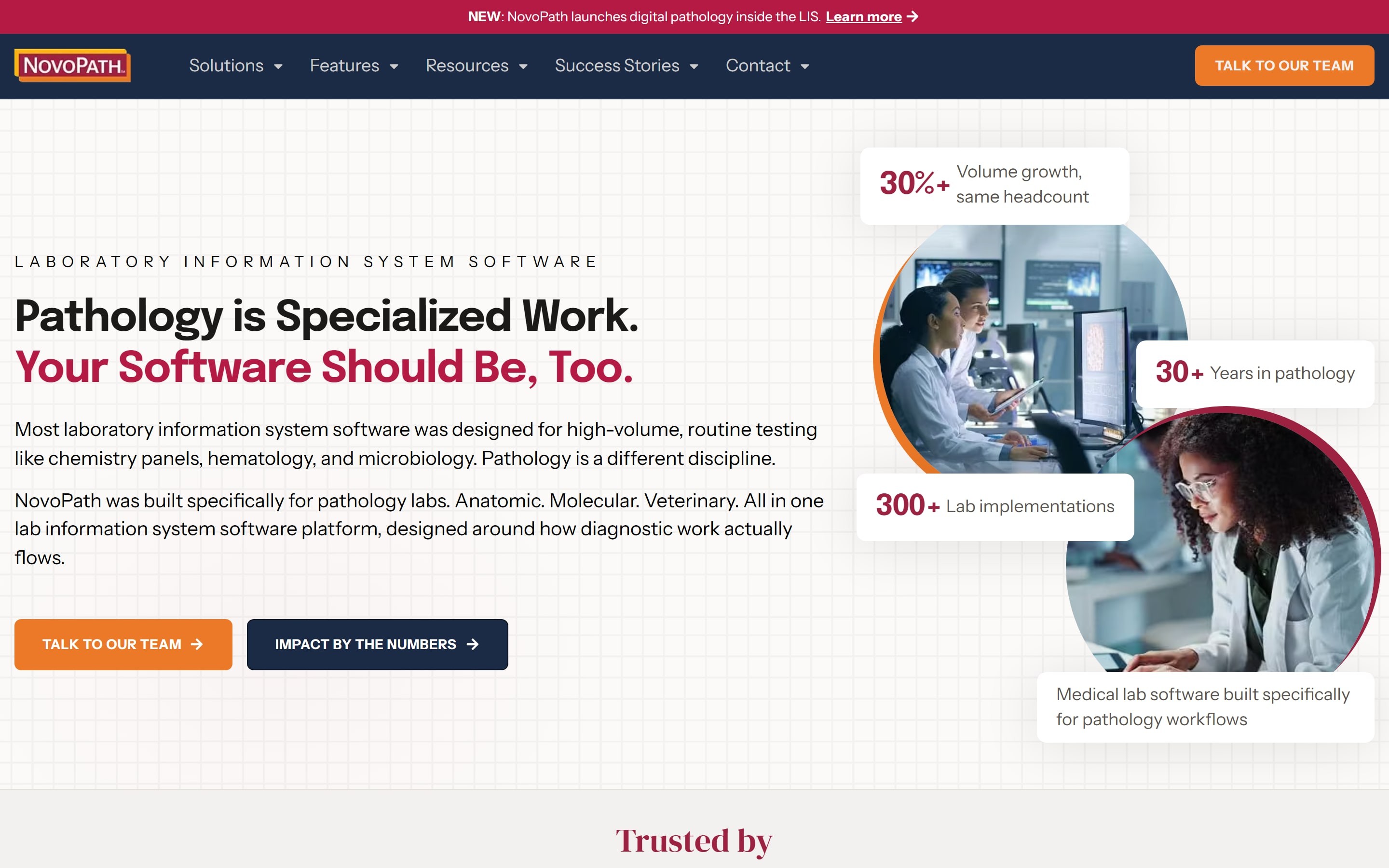
NovoPath 360 is a cloud-based LIS for anatomic, molecular, and veterinary pathology, built by a vendor that has worked in pathology for more than 30 years. It targets labs adding molecular and genomic tests to existing anatomic workflows without standing up a second system to do it.
Key Features
- One Accession for Every Test: NovoPath lets a lab open a single accession and run NGS, FISH, flow cytometry, cytogenetics, and lab-developed tests (LDTs) against it, then combine every result into one continuous report. Pre-configured workflows for each of those test types ship out of the box, so a lab adding a molecular line is not building the workflow from scratch.
- Broad EMR and Instrument Interoperability: NovoPath connects through its DXE interoperability layer, with bi-directional interfacing to more than 150 EMR systems and a range of PCR, NGS, and toxicology instruments.
Side note: Pulling many referring-physician systems into one place is as much a healthcare document management problem as an interfacing one.
Pricing
| Plan | Pricing |
|---|---|
| All plans | Custom |
Where NovoPath Shines
- Voice dictation saves time: Voice dictation during grossing lets pathologists capture findings without stopping to type.
- Automation reduces manual release work: Auto-verification and auto-release move clean results through without a tech touching each one.
Where NovoPath Falls Short
- Some workflows are inflexible: The platform has limitations when documenting notes that capture user ID, date, and time within certain workflows.
- Aggregate reporting has limits: Pulling certain data, like yearly block totals, has been described as harder than expected.
Customer Reviews
Kelli K. praises, “Ease of use, fields are specific to our business, and quick data entry within each tab. Query manager, report manager, and list manager areas are very easy to utilize and gather data.”
Gina S. complains, “This software is not meant for any other type of laboratory testing other than AP. Its not user friendly, there’s no option to document notes that capture user’s id , date, time, etc.”
Who NovoPath Is Best For
- Multi-specialty pathology labs running anatomic, molecular, and veterinary testing that need one consolidated patient report.
- Labs managing many referring-physician connections, where 150+ EMR integrations and a standalone interface engine keep connectivity intact even after other systems change.
- High-throughput molecular labs that need batch processing, auto-verification, and auto-release to cut manual work on large volumes of negatives.
5. Clinisys
Clinisys is the umbrella platform covering Sunquest, PowerPath, CoPathPlus, and Orchard after a run of mergers consolidated the lab informatics market. If your lab runs any of those legacy names, you are already a Clinisys customer.
Key Features
- Anatomic and Molecular Pathology: PowerPath provides integrated reporting for combined anatomic pathology and molecular results, plus support for foreign container IDs to eliminate relabeling of materials. CoPathPlus, long established in anatomic pathology, supports advanced protocol management and sample routing for complex multidisciplinary labs.
- A Unified Platform in Development: Clinisys is building the Clinisys Laboratory Solution (CLS), a cloud-native platform meant to consolidate its legacy lines into one LIS/LIMS. CoPathPlus, PowerPath, and Orchard each handle lab workflow differently, which is part of what makes consolidating them onto CLS a multi-year effort.
Pricing
| Plan | Pricing |
|---|---|
| All plans | Custom |
Where Clinisys Shines
- Legacy knowledge is deep: With Sunquest, PowerPath, CoPathPlus, and Orchard under one roof, Clinisys understands older lab infrastructure better than newer vendors.
- Modern user interface: Users have praised the ease of use and intuitive user interface.
Where Clinisys Falls Short
- Switching between product lines is complicated: Forced switches introduce extra steps for once-simple processes, with the support team only offering workarounds.
- Performance can lag under load: Multiple users have complained about slowdowns during high-demand tasks.
Customer Reviews
A verified user complains, “No working QC Levy Jennings, software not built for Toxicology, unable to receive specimens and check sample information on same screen.”
Who Clinisys Is Best For
- Hospitals and health systems already standardized on Sunquest, PowerPath, or CoPathPlus.
- Labs that value vendor scale and longevity over a smaller single-product company.
6. LabVantage
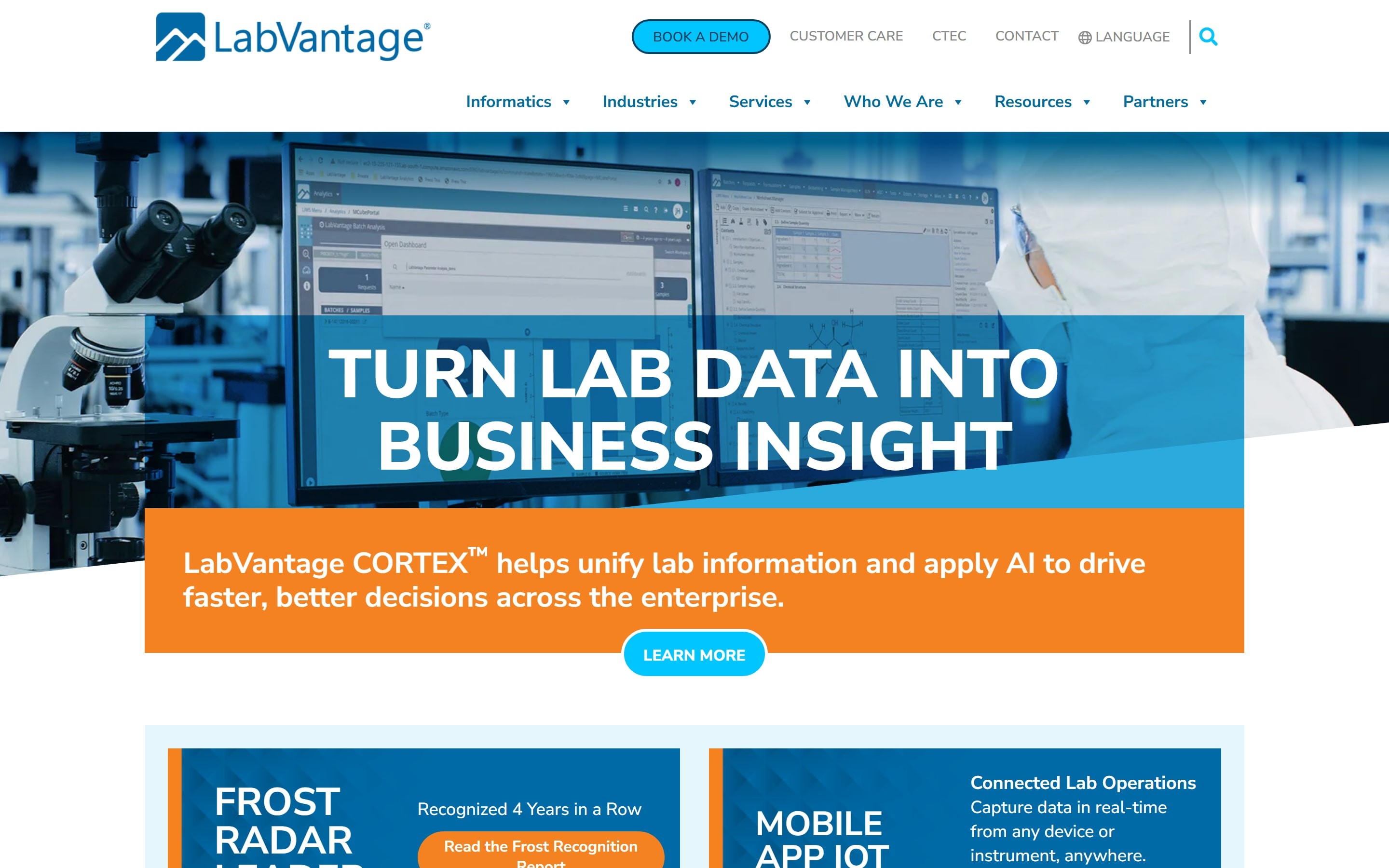
LabVantage Medical Suite is an LIS that integrates every medical lab discipline—chemistry, microbiology, pathology, blood bank, and genetics and molecular testing—under one architecture. It has a separate Diagnostics LIMS product that focuses specifically on molecular and clinical diagnostics.
Key Features
- One Platform Across Every Discipline: LabVantage’s pitch is that adding a new testing line, like genetics, does not mean adding a vendor. The platform connects to more than 700 commonly used clinical instruments through existing drivers, removing manual data entry across most disciplines a lab runs.
- Built-In Workflow Rules Engine for Molecular Automation: LabVantage Medical Suite ships with a configurable rules engine that lets lab staff automate routine tasks, define process steps, set reflex-testing triggers, and adjust worklist logic without a developer.
Pricing
| Plan | Pricing |
|---|---|
| All plans | Custom |
Where LabVantage Shines
- Cross-discipline unification: Few vendors unify chemistry, pathology, microbiology, and molecular under one system the way LabVantage does.
- Day-to-day use is straightforward: Users have praised the interface for routine data entry and sample management.
Where LabVantage Falls Short
- The test-to-production path is weak: The upgrade from test environment to live production is often cited as a pain point.
- Platform management overhead: Labs that do not need the full cross-discipline scope may find it more than they want to manage.
Customer Reviews
A user praises, “There are so many ways to input your data in the system and ways to organize it. It has the ability for you to pull all the data from the application to use to do a data review which is very convenient.”
Sri G. warns, “(…) The repeated cycle of deploying changes and then testing them inside the LIMS environment often feels slower than what I’m used to in modern web development workflows, and that can reduce development velocity when working on more complex customizations.”
Who LabVantage Is Best For
- Large hospital and health systems that need one LIMS across every discipline instead of separate systems per department.
- Molecular and genetics labs running complex multi-step workflows that need barcode traceability, approval chains, and storage management in one system.
- IT teams prioritizing low-maintenance deployment, given the browser-based, zero-footprint architecture.
7. CGM LABDAQ
CGM LABDAQ, from CompuGroup Medical, is an LIS for physician office labs, clinics, reference labs, and hospitals, with a strong installed base among independent and outreach labs running PCR-based molecular testing.
Key Features
- PCR and Molecular Testing Support: CGM LABDAQ manages PCR testing alongside general lab operations, which suits labs where molecular work is one part of a broader test menu rather than the whole focus.
- Lab IQ Interactive Performance Dashboard: Lab IQ puts a turnaround time (TAT) monitor and data mining tools directly in the interface, so lab managers track performance metrics without exporting to a separate reporting tool.
Pricing
| Plan | Pricing |
|---|---|
| All plans | Custom |
Where CGM LABDAQ Shines
- Ease of use is consistent: The platform is generally praised for intuitive daily operations and quick support response.
- Billing accuracy is built in: Medical necessity checking and verification tools aim to get tests billed correctly the first time.
Where CGM LABDAQ Falls Short
- Recurring performance issues: Some reviewers report freezes and slow response during high-volume periods.
- It is not built for enterprises: Large multi-site labs are better served by platforms designed for that scale.
Customer Reviews
Selena P. states that, “What I find most helpful is the ability to create accession numbers if I accidentally delete them or need to accept samples for verification.”
A verified user warns, “They charge quite a bit for expanding and for interfacing with instruments and other laboratory systems.”
Who CGM LABDAQ Is Best For
- Independent and physician-office labs running PCR-based molecular testing alongside general lab work.
- Reference labs managing multiple client accounts that need per-client performance analytics without a separate BI tool.
- Labs that want billing-accuracy tools built into the LIS rather than bolted on separately.
How to Choose the Right Molecular Lab Platform
Most molecular lab software comparisons start with features, but the better starting point is where your lab workflow breaks down. Here are the questions worth asking first:
Does Your Intake Process Create Problems Downstream?
For most labs, yes. The most expensive molecular lab errors often start with incomplete TRFs, mismatched patient identifiers, or unverified insurance details, long before data enters the lab.
An LIS or LIMS processes whatever data reaches it, correct or not, so intake errors propagate into billing denials, delayed testing, and rework. This is where Onymos’s SmartSync works, cross-checking requisitions, insurance cards, and medical records against connected systems before anything moves downstream.
→ See how Onymos catches intake errors before they reach your systems
Does Your PHI Stay Inside Your Own Infrastructure?
Most molecular lab software, LIS, LIMS, and intake tools alike, stores customer data on vendor-managed servers by default. That is the industry norm, and it is also where data security lapses concentrate, since over 55% of healthcare data breaches happen through third-party vendors.
Every molecular and genomic lab handles PHI and PII at volume, so every vendor with standing access to that data is a separate point of exposure. Onymos’s answer is No-Data Architecture: DocKnow runs inside the lab’s own AWS, GCP, or Azure environment, and Onymos never accesses, captures, or stores patient data on an intermediate server.
Do You Need Lab-Specific AI or General Automation With a Healthcare Label?
Many healthcare AI tools were adapted from general-purpose document platforms. The question to ask is whether the model was trained on healthcare and laboratory documents specifically.
Onymos’s Synapse is a Cognitive Insight Model trained on lab documents and aligned with ICD and CPT taxonomies. It reads requisitions and records by field context and layout position rather than generic OCR, reaching 99.7% validation accuracy and over 95% handwriting accuracy on clinical documents. When confidence is low, it flags the field for human review instead of guessing.
If your lab needs more than molecular testing capabilities, look for laboratory sample management software that can also handle specimen tracking, workflow coordination, and downstream data management.
→ See where intelligent intake fits into your stack
Final Word on Onymos
The right molecular lab software solves the problem your lab actually has. For many molecular labs, that problem starts before testing, with incomplete requisitions, eligibility gaps, and data errors that turn into downstream delays and denials.
If your core system is the bottleneck, the seven platforms above are the right place to look. If the problem is the data reaching them, an intake layer like Onymos plugs in front of whichever LIS or LIMS you keep, no rip-and-replace required, and strengthens laboratory compliance at the same time.
→ See how Onymos reduces intake errors before they reach your LIS
External sources
G2 review: Ligolab Lis Rcm Laboratory Informatics Platform G2 review: Xifin Rpm G2 review: Onymos Capterra review: NovoBilling G2 review: Clinisys G2 review: Labvantage G2 review: Cgm Labdaq