8 Best Data Entry Software Solutions by Industry (2026)
Compare the 8 best data entry software solutions of 2026 by industry, from healthcare, labs, and lending to accounting, legal, and construction.
- Jamie Goodnight
- 10 min read

For decades, Microsoft Excel and other spreadsheet apps have been the default data entry software for business.
But traditional spreadsheets are increasingly being outgrown by the workflows they’re used to manage. General-purpose tools can organize almost anything, but verticalized tech knows more about the data it handles and the workflows around it. That context is what enables more sophisticated (sometimes even fully agentic) automation.
To put the shift into perspective, a 2025 FP&A Trends survey found that the share of organizations primarily relying on spreadsheets for financial planning declined from 60% in 2022 to 45% in 2025.
The researchers suggest that the demand for automation is pushing businesses toward more specialized platforms.
That’s why the best data entry software depends on your industry and the specific problems you’re trying to solve.
So, here are 8 solutions that stand out in their fields. Keep in mind that traditional data entry software gives someone a place to type information. The platforms we’re looking at are designed to do much of that work automatically, so humans-in-the-loop only need to review the output and handle exceptions.
| Software | Industry | Best For |
|---|---|---|
| Dext | Accounting | Receipt and invoice processing |
| Ocrolus | Banking and lending | Financial document processing and income analysis |
| Onymos DocKnow | Medical and diagnostic laboratories | Test requisition and medical-record intake |
| Formstack | Healthcare | Digital patient registration and intake |
| Clio Grow | Legal services | Client intake |
| Procore | Construction | Jobsite reporting and data collection |
| Conexiom | Manufacturing and distribution | Sales order entry |
| Fulcrum | Utilities and field services | Mobile inspections and field data collection |
1. Dext: Best for Accounting and Bookkeeping
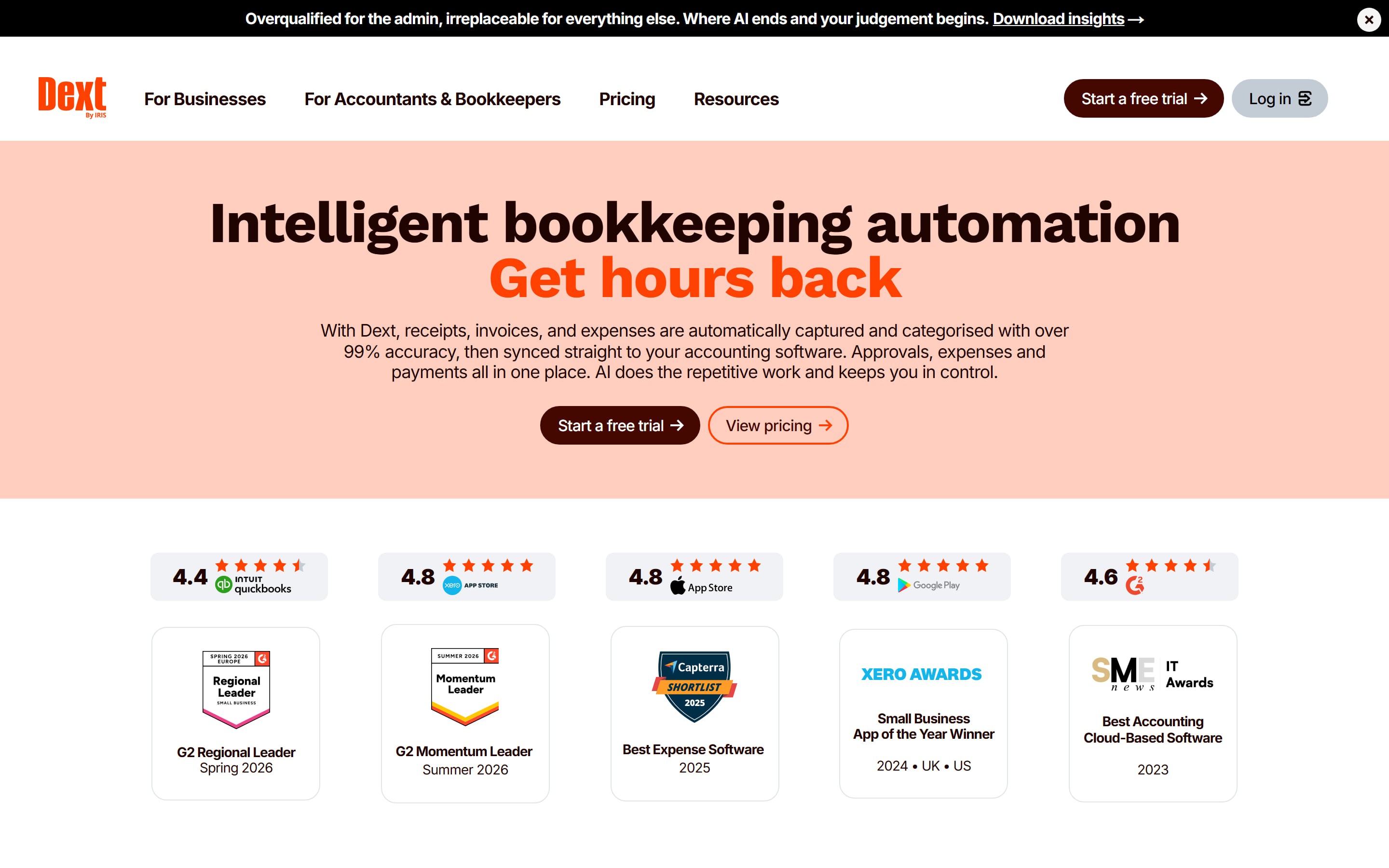
Dext’s platform automates the repetitive data entry, categorization, and posting work bookkeepers and accountants typically have to do themselves.
And it increasingly learns from its users’ decisions.
What differentiates Dext
There’s no question Dext is proven at massive scale. It reported processing 31.4 million receipts and invoices in one month alone.
In March 2026, Dext launched AI Assist, an agent designed to learn from bookkeeping decisions and recommend future automations.
According to Dext’s documentation, it can:
- Learn how a business categorizes expenses and handles suppliers
- Suggest tax codes, categories, and descriptions based on document content and previous decisions
- Recognize when the same supplier’s purchases need different accounting treatment.
- Suggest line-item splitting and categorization
- Explain suggestions and let users accept, reject, or automatically apply them
That’s a meaningful example of context-aware automation.
What to consider
Dext’s pricing is more transparent than many of the enterprise platforms on this list, but the advertised starting price doesn’t necessarily represent the cost of the complete solution. Some of its most useful capabilities cost extra.
2. Ocrolus: Best for Mortgage Lending
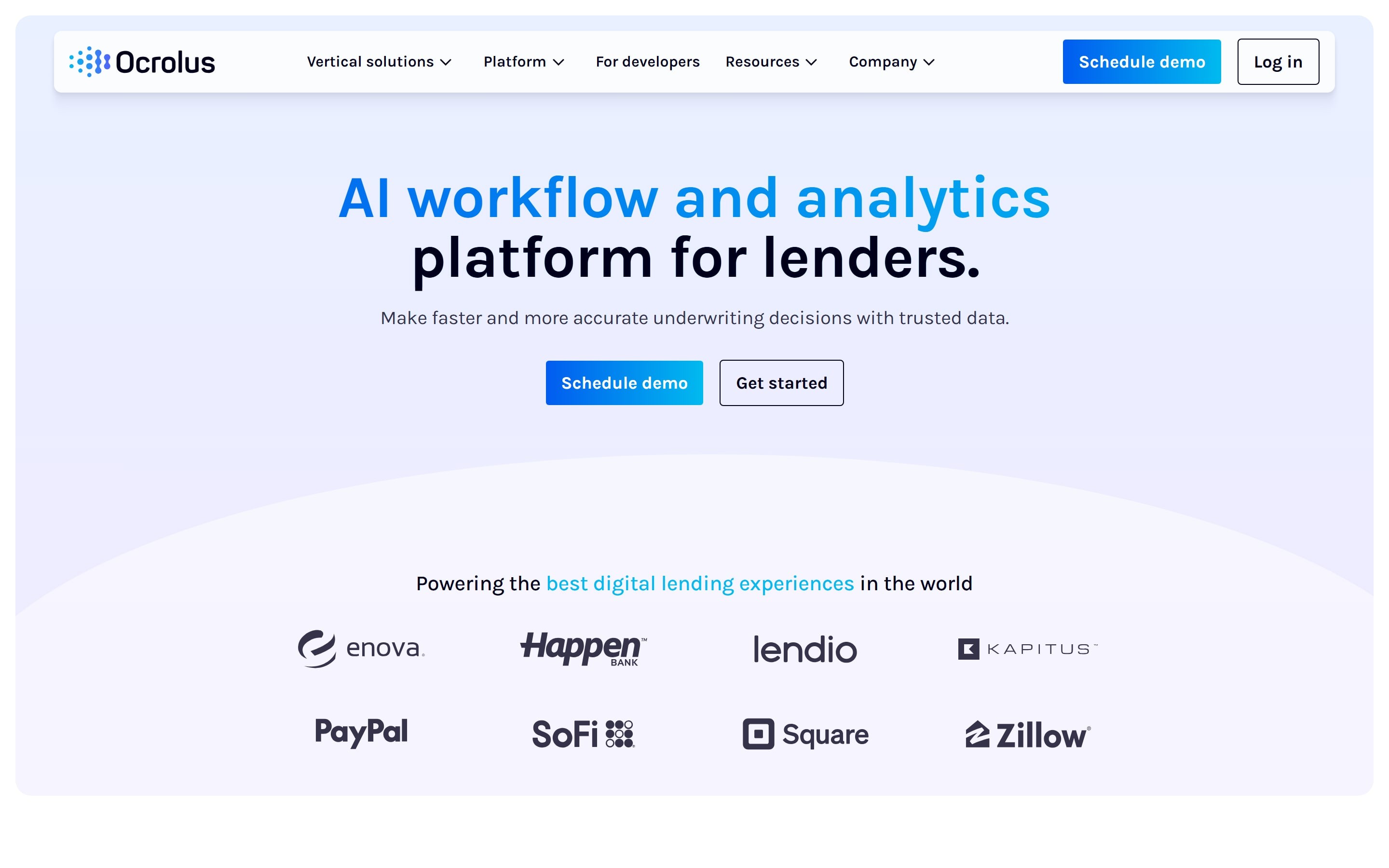
Ocrolus extracts data from bank statements, pay stubs, tax returns, and other borrower documents, then analyzes income, cash flow, expenses, and transaction patterns.
For example, Haventree Bank previously spent up to three hours per file manually transferring bank statement data into Excel calculators and analyzing borrower income. Ocrolus automated both tasks.
What differentiates Ocrolus
Ocrolus describes its platform as combining foundation models (from OpenAI, Anthropic, and Google), multiple AI agents that check each other’s work, and fraud-detection tech from Resistant AI.
It has more than 240 million pages of proprietary financial-document training data powering all of the AI under the hood.
Its published customer list includes recognizable companies like PayPal, SoFi, Brex, Enova, and Better, along with numerous mortgage lenders and financial institutions.
What to consider
Ocrolus’ competition is substantial.
Competitors like Candor, TRUE, and Prudent AI offer overlapping document-analysis capabilities. Argyle and Truv specialize in obtaining and verifying income and employment information directly from connected data sources.
But, for now, its breadth across financial-document intelligence remains one of its strongest differentiators.
3. Onymos DocKnow: Best for Complex Laboratory Intake and Accessioning
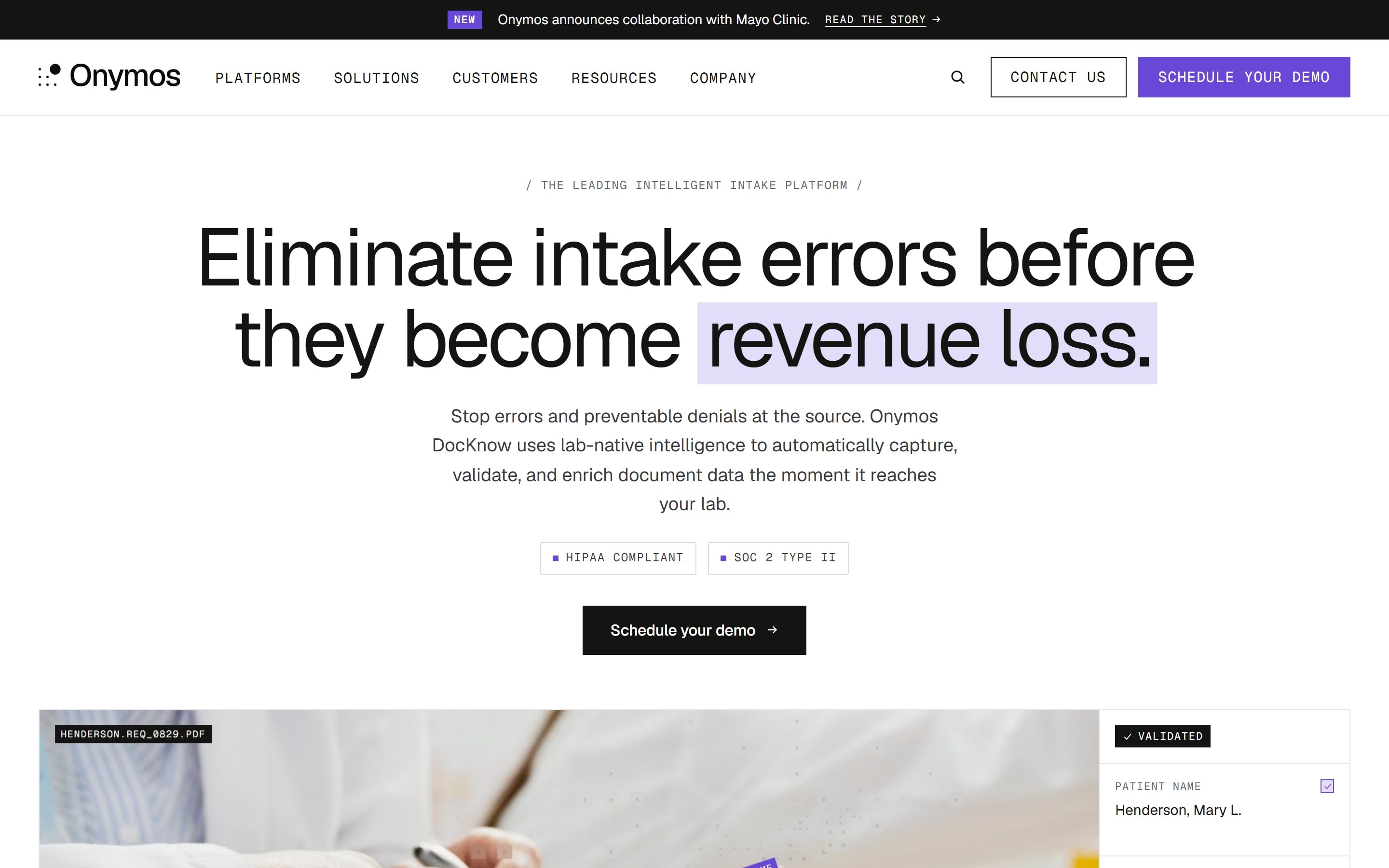
Onymos DocKnow captures information from test requisitions and medical records, validates it against laboratory-specific requirements, reconciles discrepancies across documents, and delivers structured data to existing laboratory systems.
Unlike traditional SaaS, DocKnow is built with a No-Data Architecture. It’s optimized for customer cloud and on-prem deployments, meaning Onymos “sees no data, saves no data.”
What differentiates Onymos DocKnow
DocKnow’s Synapse is a domain-trained intelligence layer that combines laboratory knowledge and programmatic rules with AI-generated results to maximize extraction accuracy and data correctness.
In 2026, Vanta Diagnostics announced that DocKnow had improved its operational efficiency by 72% while reducing data errors during accessioning by 40%.
Additionally, the Onymos team has seen how spreadsheets fail in the lab firsthand and has developed some of DocKnow’s core features (e.g., automated data reconciliation) in response.
What to consider
DocKnow’s default No-Data Architecture gives labs total control over their data, but that control comes with additional responsibility for infrastructure and associated costs. Larger labs are often equipped to handle that tradeoff. Smaller labs may find the added complexity and cloud expenses harder to absorb.
While Onymos can host DocKnow for the customer, that does negate one of the platform’s biggest differentiators.
4. Formstack: Best for Enterprise Healthcare Forms and Patient Intake
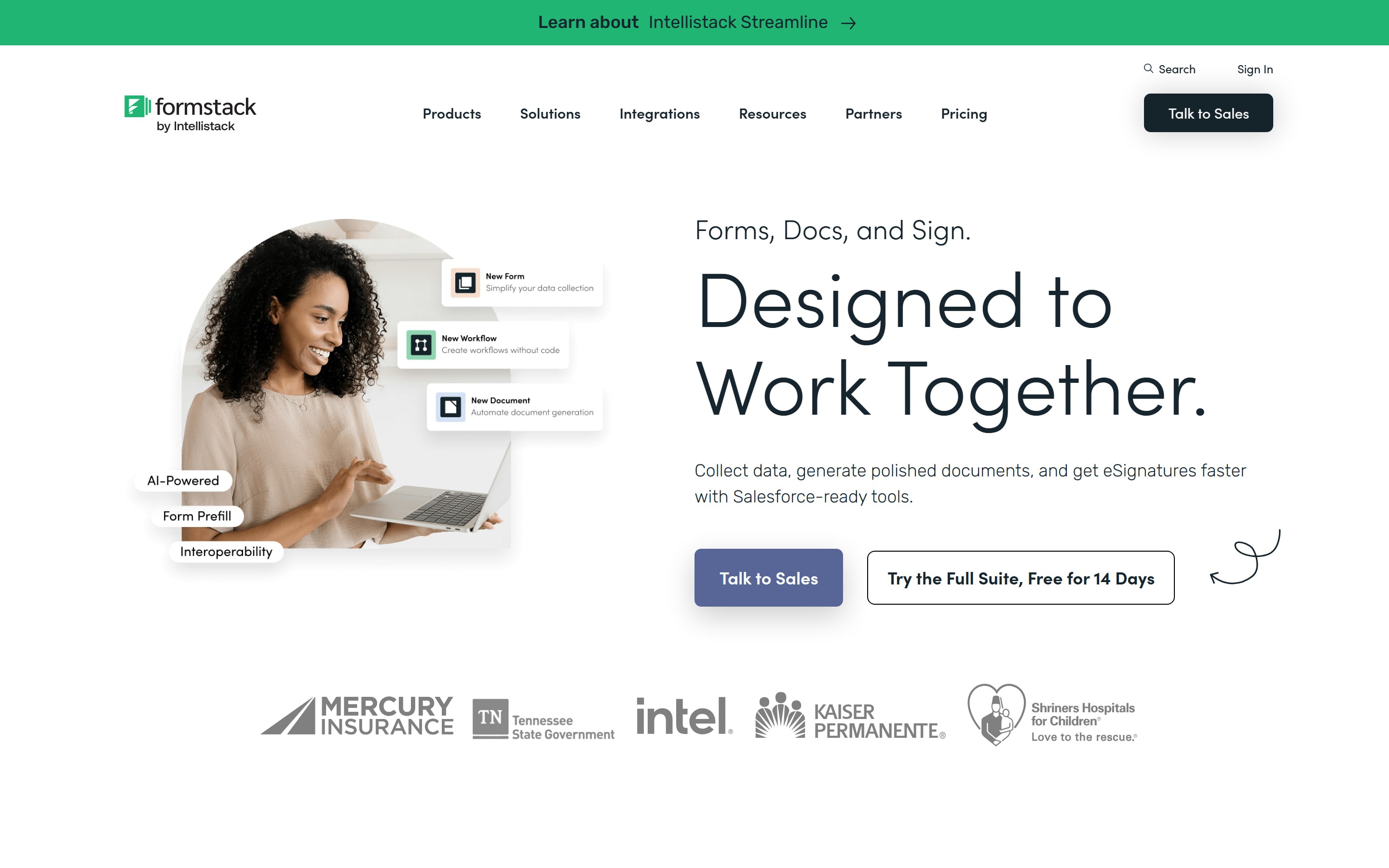
Formstack takes the paperwork out of patient intake.
It lets patients enter information online and ahead of time, so front-desk staff don’t have to re-enter it later.
What differentiates Formstack
Formstack launched in 2006. By 2021, it reported more than 25,000 customers globally and had secured a $425 million growth investment. Health systems like AdventHealth and integrated delivery systems (IDNs) like Kaiser Permanente are long-term clients.
Plus, it has a fairly broad feature portfolio:
- Forms for data collection
- Document generation
- Electronic signatures
- Workflow automation
- Salesforce-native forms and workflows
Individually, these features aren’t that novel. But together, they simplify procurement, integrations, administration, and governance for orgs that otherwise would have to rely on several vendors.
What to consider
Pricing can be prohibitive. On G2, it’s frequently cited as a disadvantage. Reviewers also mention advanced capabilities being gated behind expensive plans.
It’s also one of the less AI-native platforms on this list. Its approach to automation largely involves offloading data entry to the patient, then using predefined rules to validate and route the information.
5. Clio Grow: Best for Legal Client Intake
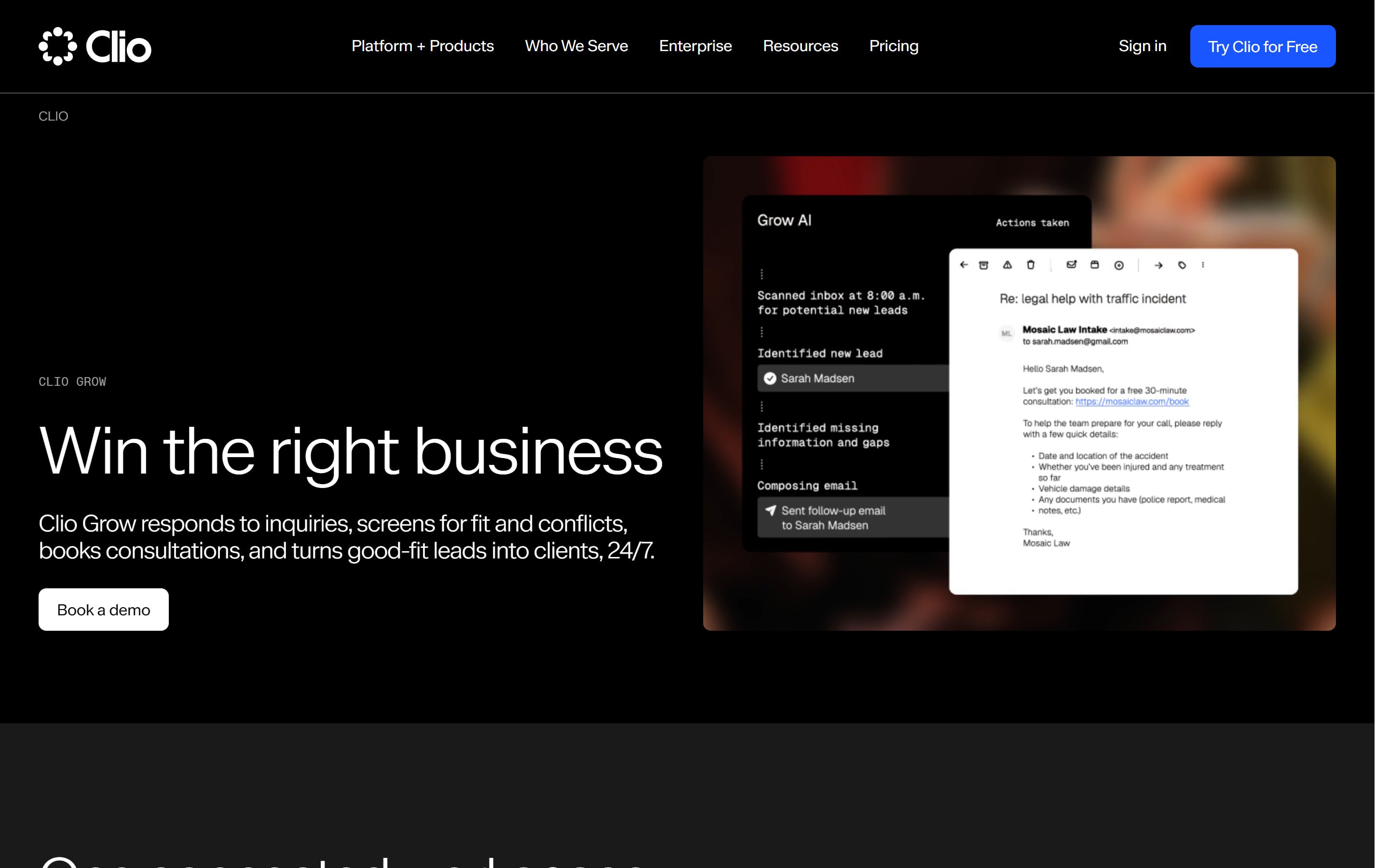
Law firms can use Clio Grow to collect information through online forms, track prospective clients, and move relevant details into their practice management workflows without repeatedly entering that same information.
What differentiates Clio Grow
Clio Manage is Clio’s core legal practice management platform and is widely adopted. It has a credible case for calling itself the market leader.
This makes Clio Grow’s integration with Manage a more meaningful differentiator than ordinary online forms or appointment scheduling software.
Clio also launched Grow AI in August 2026. Rather than making a prospective client complete a lengthy questionnaire, an AI agent can collect information through conversation, identify what’s missing, and organize the resulting details for the law firm.
What to consider
Clio Grow’s top competitor is probably Lawmatics, and the race between them is tight. There’s a good argument that Lawmatics deserves Grow’s spot on this list.
And if you’re not already using the Clio ecosystem, Lawmatics might actually be the better choice.
That said, Clio has pages of customer stories organized by practice area, segments, topics, and more. That makes it easier to trust its claims.
6. Procore: Best for Construction Field Reporting
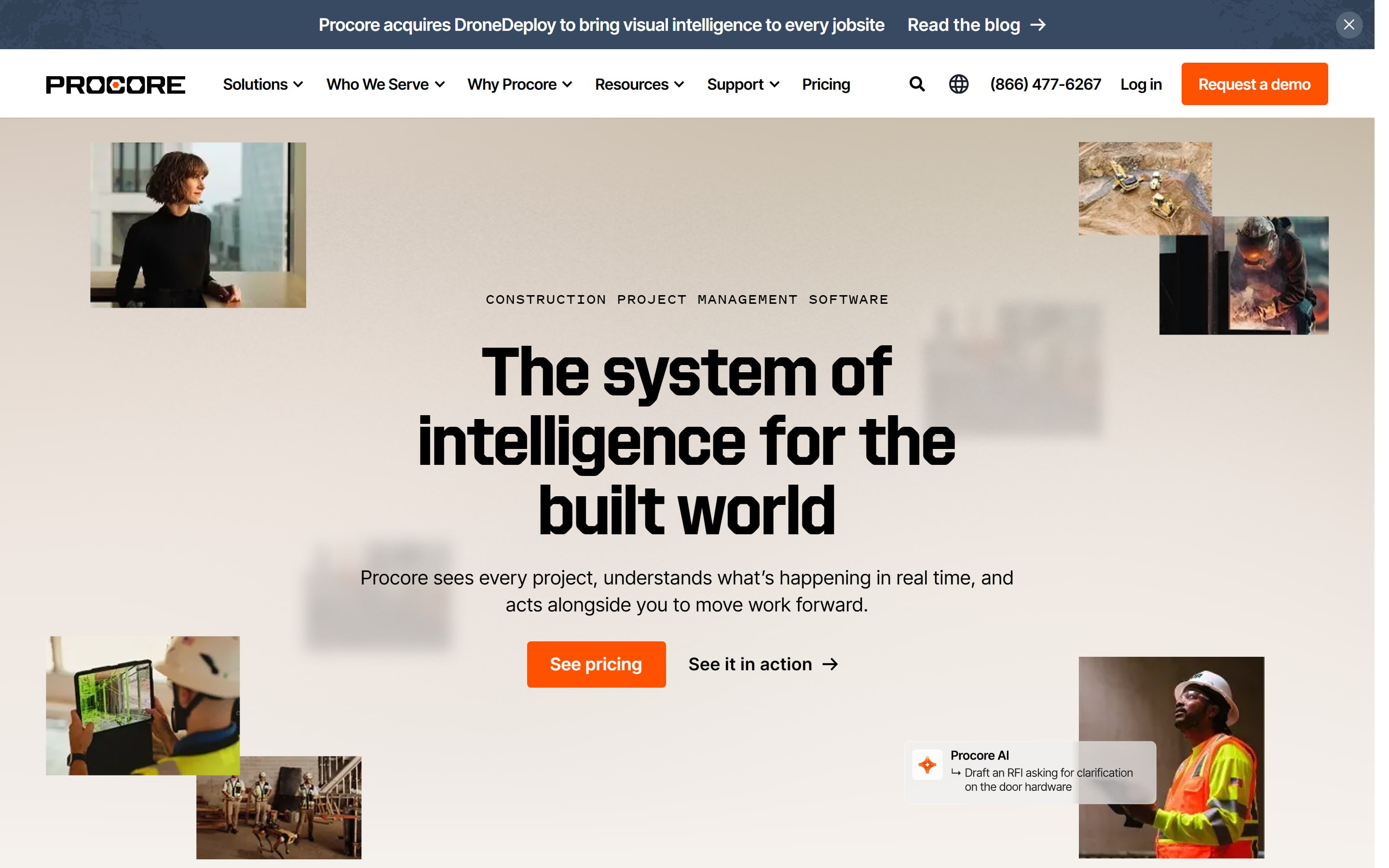
Procore’s fundamentally a construction management platform trying to solve more problems than just data entry itself, but in 2026 it introduced AI specifically for transforming field notes, photos, and voice recordings into structured project records.
What differentiates Procore
Procore might have the single biggest commercial footprint of any company on this list. It has extraordinary market adoption and maturity.
In January 2026, Procore acquired Datagrid, a construction-focused AI and data-integration company.
Then, in May 2026, Procore announced an expanded AI offering incorporating Datagrid’s multimodal document intelligence and agentic capabilities.
The platform now promotes several construction-specific AI agents, including “Daily Log Agent,” “RFI Agent,” “Submittal Review Agent,” and “Deep Search Agent.”
For example, Level 10 Construction customized a submittal review agent that ultimately saved their team twelve hours a week.
What to consider
A smaller contractor trying to solve a data entry problem might get more immediate value from Raken or Fieldwire, depending on its needs. Those are narrower products designed specifically to eliminate manual typing tasks.
But like some others on this list, Procore’s breadth makes it hard to ignore.
It’s also worth noting Procore’s AI integrations are driven almost entirely by its Datagrid acquisition, so its own track record running this kind of tech is short.
7. Conexiom: Best for Manufacturing and Distribution Order Entry
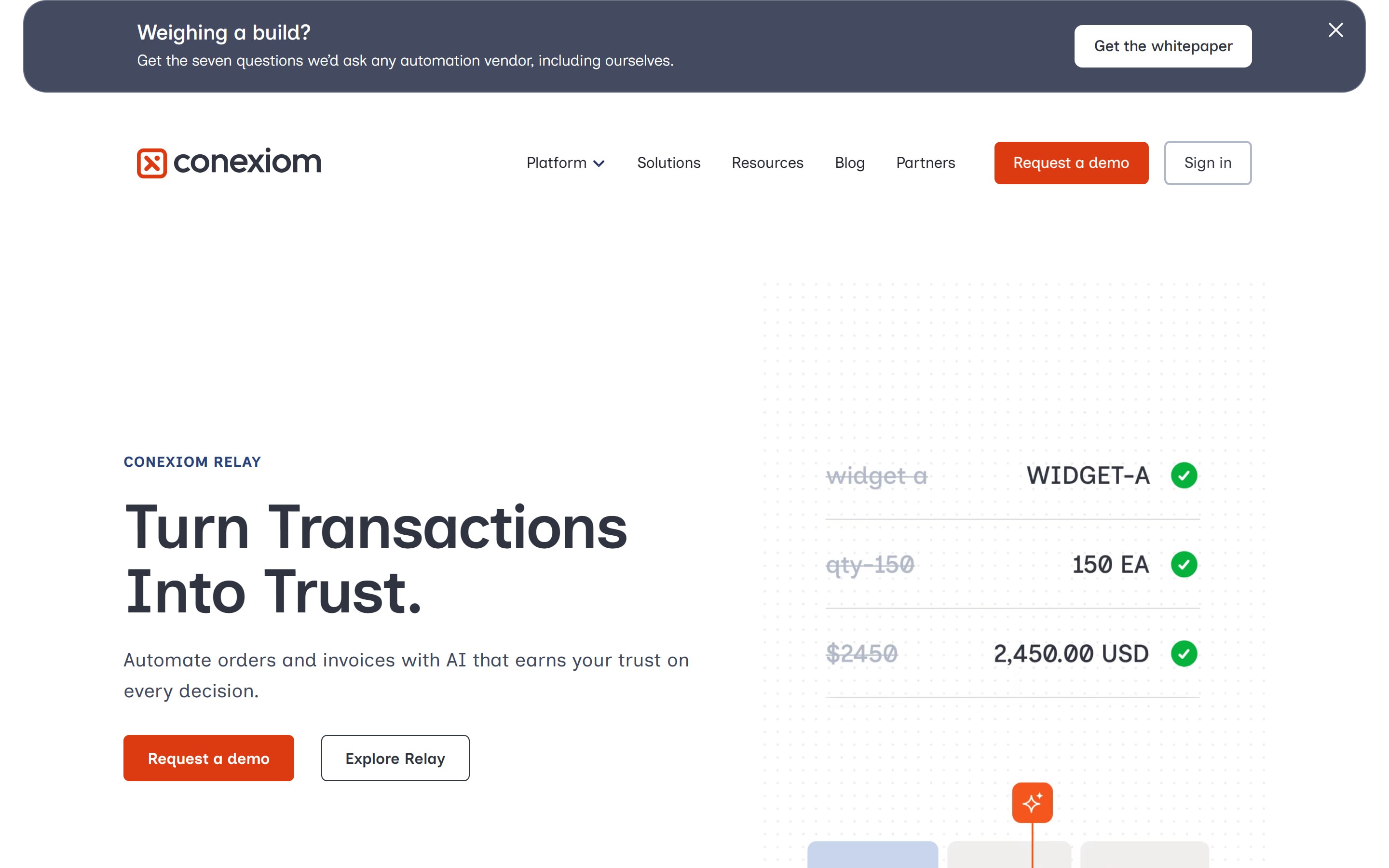
Conexiom was built specifically to eliminate manual transaction entry.
And it has something more compelling than a generic AI extraction story, because it can validate and correct incoming purchase orders against a manufacturer’s or distributor’s actual ERP data before creating an order.
What differentiates Conexiom
Consider a manufacturer receiving a purchase order.
The document might contain a product number that differs from the manufacturer’s internal SKU, an incorrect unit of measure, or a price that doesn’t match the agreed pricing.
A conventional OCR tool might transcribe all that information perfectly and still create an incorrect order.
But Conexiom isn’t just reading a purchase order. It’s checking whether that order makes sense within the customer’s business systems.
Conexiom also has more than 15 years of experience in order automation and reports processing over a billion line items every year.
What to consider
One G2 reviewer described difficult purchase-order implementations, repeated exchanges with the mapping support team, and an exception-management interface that could become clunky when many errors needed correction. That’s especially relevant because Conexiom’s marketing emphasizes increasingly adaptive AI.
They did still give it a 4.5 out of 5.
8. Fulcrum: Best for Utility Inspections and Field Data Collection
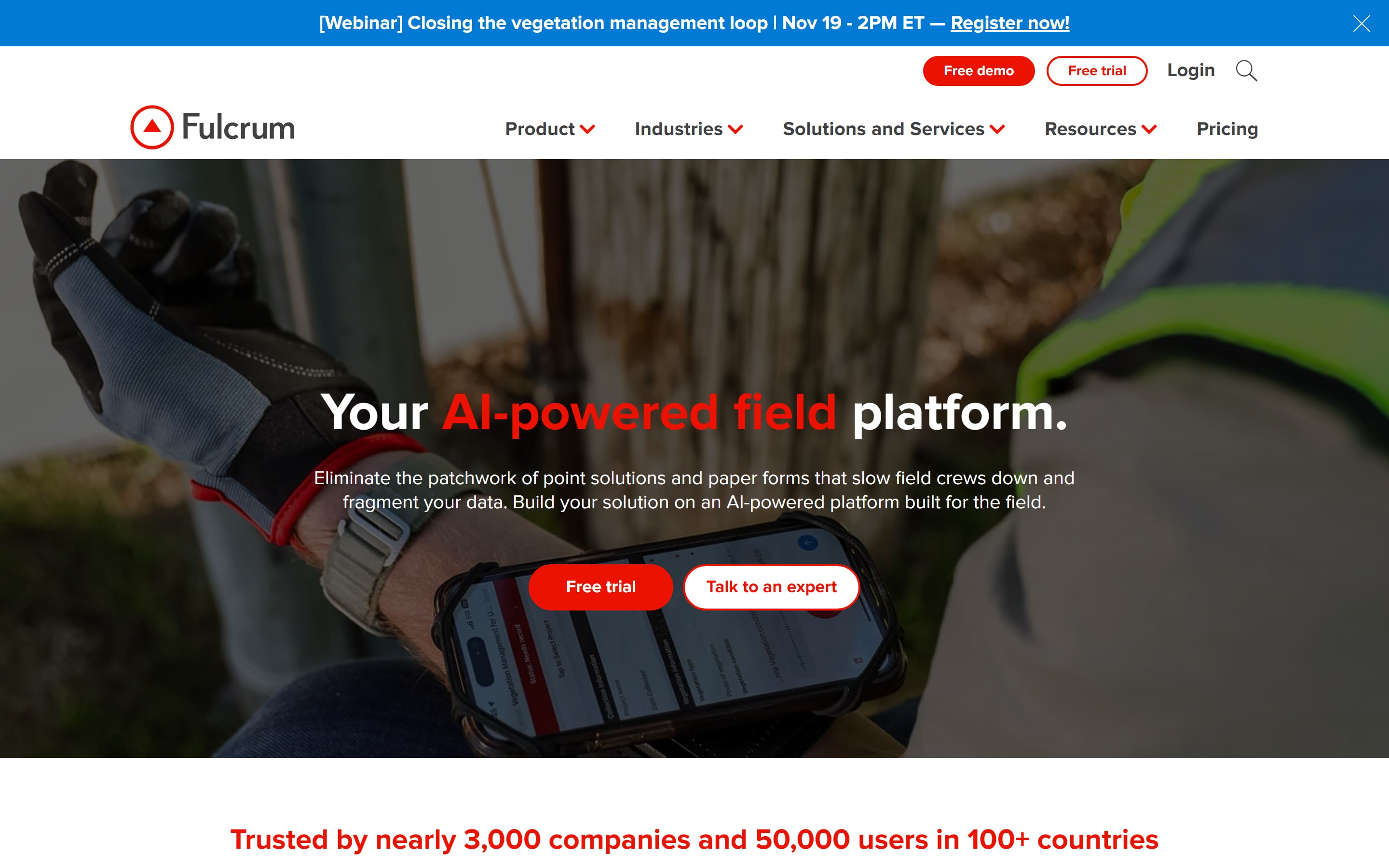
Fulcrum was designed around collecting information about physical locations and assets. In February 2026, Fulcrum also introduced Insights, allowing users to ask natural-language questions about their field data and receive summaries, charts, and other useful outputs.
What differentiates Fulcrum
Imagine a utility worker inspecting hundreds of electrical poles across a rural service territory.
Each inspection might require identifying a particular pole, recording its condition, photographing defects, documenting required repairs, and associating everything with the correct geographic location.
Fulcrum supports this through:
- GPS-linked inspection records and geospatial mapping
- Offline data entry and synchronization
- Geotagged photographs, barcodes, and QR codes
- Conditional forms and data validation
- GIS integrations
A field technician can even describe an inspection aloud. Fulcrum uses AI to interpret the description and populate multiple structured fields.
A civil engineering firm, TREKK Design Group, actually uses both Fulcrum and one of its competitors, Esri. A TREKK innovation specialist explained that Fulcrum was preferable for certain complex inspection workflows because it supports custom JavaScript logic, data validation, and reporting.
What to consider
When it comes to its voice tech, there are real limitations. Fulcrum’s own documentation advises users to keep recordings short, use recognizable field names, minimize abbreviations, and avoid overly complex choice lists.
And AI functionality isn’t included at all in entry-level plans.
The Future of Data Entry Software Is Industry-Specific
There isn’t one approach to automating data entry. Some eliminate manual input by collecting structured information at the source. Others use AI to interpret documents, apply industry-specific rules, and even take action.
What they have in common is an understanding of the workflows they’re designed to support.
That’s why the best data entry software isn’t necessarily the platform with the most advanced AI or the longest feature list. It’s the one that understands your industry’s particular challenges and eliminates the manual work surrounding them.
Before evaluating another data entry platform, consider what you’re actually trying to eliminate.
Is the problem employees manually transcribing information from documents? Entering the same data into multiple systems? Correcting errors? Or interpreting information that requires industry-specific knowledge?
External sources
FP&A Trends Survey 2025 (FP&A Trends and OneStream) Dext launches AI Assist to automate everyday bookkeeping decisions What is Dext AI Assist? | Dext Help Centre Haventree Bank cuts bank statement review time 67% with Ocrolus | Ocrolus Using Training Data for AI to Drive Advanced Document Automation Onymos and Vanta Diagnostics Report AI-Assisted Lab Intake Boosts Efficiency by 72% and Cuts Errors by 40% - MedPath Trial Formstack Secures $425M Growth Investment | Formstack G2: Formstack Forms pricing Clio press release: $500 million ARR Clio press release: Grow AI Clio customer stories New Procore AI Experience Embeds Datagrid into Procore | Procore Platform | Conexiom G2 review: Conexiom AI field data collection | Fulcrum TREKK Design Group, LLC: Innovative water utility inspections using Fulcrum, GIS and 3D imaging Audio FastFill | Fulcrum Help Center