7 Best Lab Management Software Solutions in 2026: Which One Is Right?

Table of Contents
- Compare the 7 Best Lab Management Software Solutions: At a Glance
- 1. Onymos: Best for AI-Powered Lab Intake & Document Processing
- 2. LabWare LIMS: Best for Enterprise Pharmaceutical and Regulated Labs
- 3. Benchling: Best for Biotech R&D Teams
- 4. Scispot: Best for Biotech Startups Needing No-Code Lab Automation
- 5. LabVantage: Best for Biopharma and Biobanking Organizations
- 6. QBench: Best for CLIA Labs Needing Fast Cloud Deployment
- 7. Labguru: Best for Academic and Biotech Research Labs
- How to Choose the Right Lab Management System
- See How Onymos Helps Modern Labs Automate Management Workflows
Need a custom demo?
Use your own workflow and see where DocKnow can reduce manual work.
Get your demoKey Takeaways
- Onymos DocKnow is the best lab management software for clinical and diagnostic labs that need to automate document intake, eliminate accessioning errors before they reach billing, and protect patient data inside their own infrastructure without replacing their existing LIMS.
- LabWare LIMS is the strongest laboratory management system for large pharmaceutical and regulated enterprise labs that need deep workflow configurability and true on-premises deployment.
- Benchling is the right choice for high-growth biotech R&D teams that need a unified ELN, LIMS, and molecular biology toolset in a single modern platform.
- Scispot suits biotech startups and automation-first labs that need no-code LIMS functionality and lab robotics integration without a months-long implementation project.
“Lab management software” means different things depending on who is searching.
For a pharmaceutical R&D team, it means sample tracking, ELN integration, and GLP compliance. For a clinical diagnostic lab processing thousands of test requisition forms a week, it means intelligent document capture, accessioning automation, and data validation before billing. For a biotech startup, it means getting a LIMS live quickly without an enterprise implementation budget.
The best laboratory management system for your operation is the one built for your specific workflow. This guide compares 7 of the top lab management software options in 2026, segmented by lab type, so you can find the right fit.
Compare the 7 Best Lab Management Software Solutions: At a Glance
| Tool | Best For | Standout Feature |
|---|---|---|
| Onymos DocKnow | Clinical & diagnostic lab intake + RCM automation | SmartSync AI reconciliation + No-Data Architecture |
| Labware LIMS | Large pharma and regulated enterprise labs | Deep configurability via LIMS Basic scripting + on-prem deployment |
| Benchling | Biotech R&D teams needing unified ELN + LIMS | Molecular biology tools + API-first architecture |
| Scispot | Biotech startups needing no-code LIMS + automation | Lab robotics integration + no-code workflow builder |
| LabVantage | Biopharma and biobanking organizations | LIMS + ELN + SDMS unified + complex sample hierarchy management |
| QBench | CLIA labs needing fast cloud deployment | No-code configurable workflows + HIPAA-compliant cloud architecture |
| Labguru | Academic and biotech research labs | ELN + inventory management + protocol library in one platform |
Only one platform on this list is designed from the ground up specifically for lab accessioning, TRF processing, and RCM enablement. Onymos is the best fit for clinical and diagnostic laboratories.
1. Onymos: Best for AI-Powered Lab Intake & Document Processing
Onymos is the intelligent intake layer purpose-built for clinical and diagnostic laboratories and modern medical lab software environments. Its flagship offering, DocKnow, automates the complete intake-to-billing workflow.
Note that Onymos is not a laboratory management system in the traditional sense. It is the software layer that sits upstream of your existing LIMS and ensures the data entering it is clean, validated, and complete before any downstream workflow begins, an approach increasingly seen in advanced AI lab tools.
→ See how intelligent document processing drives unexpected lab innovation
Onymos Key Features
Three capabilities define DocKnow’s value for clinical and diagnostic labs.
SmartSync: AI Data Reconciliation at Intake
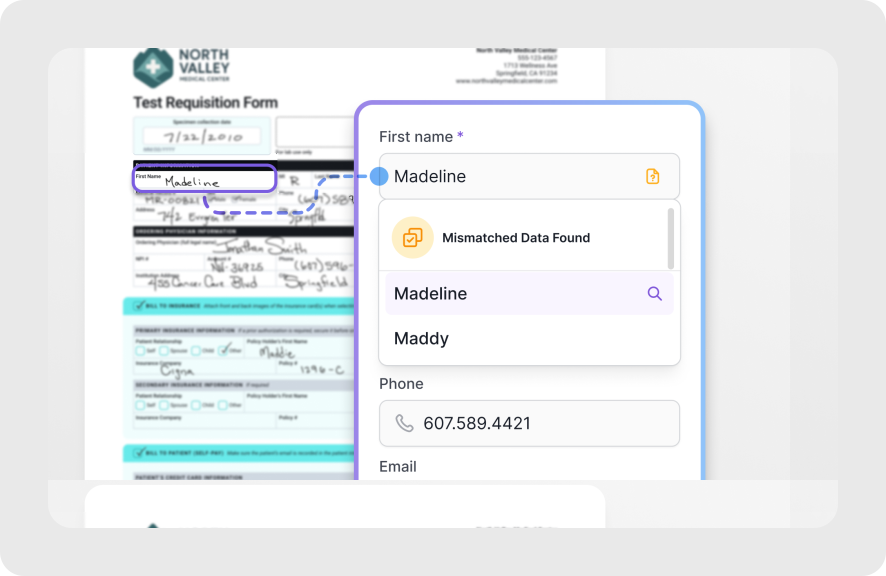
SmartSync is Onymos’s proprietary AI engine that cross-references extracted data values across TRFs, insurance cards, medical records, and connected systems simultaneously.
This is the operational mechanism behind how DocKnow eliminates the intake errors that generate denied claims 90 days later. Missing physician NPIs, unverified insurance policy numbers, and unsigned requisitions, all flagged at the point of entry. SmartSync also powers upfront insurance eligibility verification, running coverage checks before any work is done on a specimen rather than after the fact.
SmartSync’s features also help avoid the red flags in your specimen accessioning process. DocKnow’s laboratory accessioning and laboratory operations solutions are built on SmartSync’s reconciliation foundation.
No-Data Architecture: Zero Vendor PHI Exposure
Most laboratory management software, including HIPAA-certified cloud platforms, stores or routes patient data through vendor-controlled infrastructure, creating third-party exposure risk.
No-Data Architecture means the platform never accesses, stores, or processes your patient data on Onymos infrastructure. All records, extracted fields, and healthcare documents remain exclusively within the customer’s own environment (either on-premises or private cloud like AWS, GCP, or Microsoft Azure).
This architectural design decision removes the category of third-party PHI exposure entirely, regardless of what any Business Associate Agreement says.
Onymos’s security architecture earned SOC 2 Type II certification, HIPAA compliance, and the 2024 Fortress Cybersecurity Award. For labs managing CLIA, CAP, and HIPAA requirements simultaneously, this matters more than any contractual security guarantee.
Read more: The benefits of No-Data Architecture for lab data security cover the practical implications in full.
Nucleus: The AI Engine Powering DocKnow
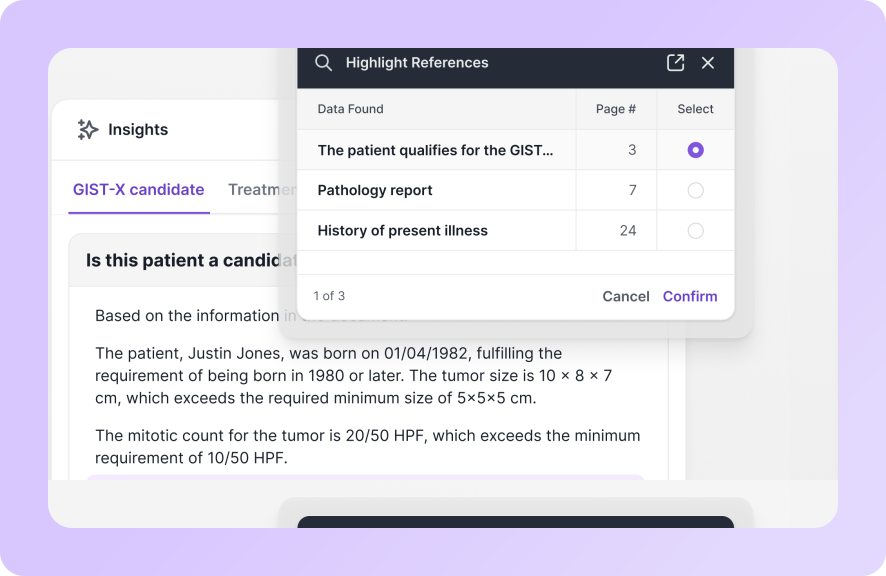
Nucleus is the underlying AI system that powers every DocKnow capability: data extraction, SmartSync reconciliation, upfront eligibility checks, compliance audit trails, and the Cognitive Insight Model that lets lab teams query their documents through natural language.
Because Nucleus runs inside the customer’s own infrastructure, it never exposes data to Onymos or any third party.
Onymos Pricing
| Plan | Pricing | Notes |
|---|---|---|
| DocKnow (modular) | Custom – contact sales | Volume-based; labs can adopt intake, billing enablement, or client services modules independently |
Where Onymos Shines
- Purpose-built for lab intake, not a generic platform adapted for healthcare: DocKnow handles the specific document types clinical and diagnostic labs process daily, with validation logic designed for TRF-based accessioning and RCM workflows, not retrofitted from enterprise content management
- Feeds your existing LIMS rather than replacing it: Onymos routes clean, validated data downstream to whatever lab management system software the lab already uses (lab workflow software and lab automation software included) via API
- Compliance built into architecture, not bolted on: Field-level audit trails, No-Data Architecture, SOC 2 Type II, and HIPAA compliance reduce regulatory exposure at the structural level
Where Onymos Falls Short
- Not a full LIS, LIMS, or RCM replacement: Onymos does not manage sample tracking, QC documentation, result reporting, or post-intake laboratory information management. Labs still need a dedicated LIS or LIMS for those workflows
- Focused on clinical and diagnostic labs: Onymos DocKnow was originally designed for diagnostic and clinical laboratory workflows, rather than for broader pharmaceutical R&D or general enterprise document management use cases
Onymos Customer Reviews
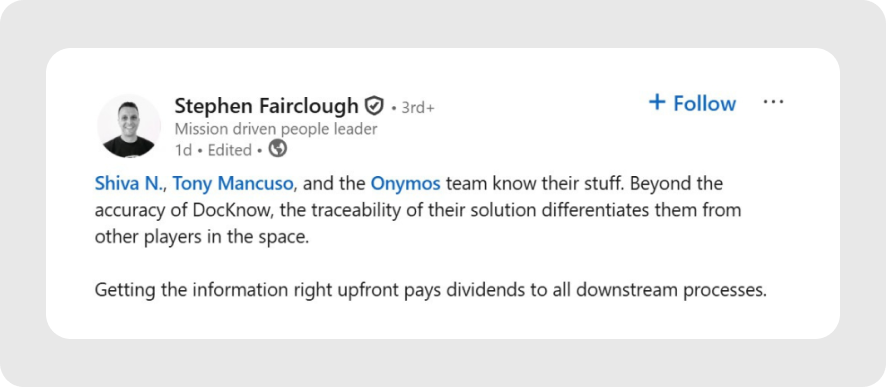
Personalis’s former VP, Stephen Fairclough, praised the Onymos team’s knowledge on LinkedIn, saying, “Beyond the accuracy of DocKnow, the traceability of their solution differentiates them from other players in the space.”
A verified user also praises, “Onymos is a great partner and enabled us to quickly get our Proof of Concept completed. They were very responsive and collaborative, and we had a successful Proof Of Concept deployment.”
Who Onymos is Best For
- High-volume diagnostic labs that cannot scale manual TRF accessioning without proportionally scaling headcount
- Clinical labs with RCM and denial problems that are losing revenue to claim denials caused by intake documentation errors
- Labs on LIMS upgrade cycles that recognize their data quality problems originate upstream of the LIMS, at accessioning, and need to fix the intake layer before LIMS performance can improve
- Labs under CLIA, CAP, or HIPAA scrutiny that need defensible, real-time audit trails at every step of the intake and accessioning workflow
→ Schedule a DocKnow demo and see SmartSync in action
2. LabWare LIMS: Best for Enterprise Pharmaceutical and Regulated Labs
LabWare, started in 1987, provides depth of workflow configurability (through LabWare LIMS Basic, its own scripting language) and its proven on-premises deployment model make it the most established laboratory management system for large, compliance-heavy multi-site operations.
Key Features
- LabWare LIMS Basic Scripting: LabWare’s proprietary scripting language lets organizations configure workflows, reports, and data handling at a granular level, independent of vendor update cycles. This is the primary differentiator for regulated environments with specific, non-negotiable documentation requirements
- QA/QC and Instrument Integration: Built-in quality control workflows, instrument data transfer automation, and audit trail management are designed for the GMP and GLP compliance requirements of pharmaceutical manufacturing
- On-Premises and Cloud Deployment: LabWare supports true on-premises deployment, essential for organizations with data sovereignty requirements, alongside cloud options for organizations where infrastructure flexibility matters
Pricing
| Plan | Pricing |
|---|---|
| All plans | Custom |
Where LabWare Shines
- Unmatched configurability for complex regulated workflows: Few laboratory management systems reach the depth of workflow customization LabWare provides for pharmaceutical GMP environments
- Proven enterprise track record: Deployed globally by pharmaceutical manufacturers with the highest compliance standards and the longest track records
- Strong audit trail and QC documentation: Every data action is logged, reviewable, and defensible; built for environments where compliance is non-negotiable
Where LabWare Falls Short
- Legacy architecture with infrequent updates: Version upgrades are disruptive for heavily customized deployments and releases are infrequent relative to modern cloud-native platforms
- High IT resource requirement: Implementation and maintenance overhead require dedicated IT staff, not suitable for labs without that capacity
Customer Reviews
Rajni S. praises, “Easy to maintain inventories and Lab workflows with their Standard Procedures and Protocols”
Matthew J. warns, “Since LabWare LIMS can be incredibly customized and specifically designed, it can be challenging when it comes time to upgrade to a new version.”
Who LabWare is Best For
- Large pharmaceutical and GMP manufacturing labs with strict regulatory requirements, dedicated IT teams, and complex compliance documentation needs across global operations
- Multi-site enterprise regulated labs that need consistent, auditable workflows across locations with different regulatory frameworks per site
3. Benchling: Best for Biotech R&D Teams
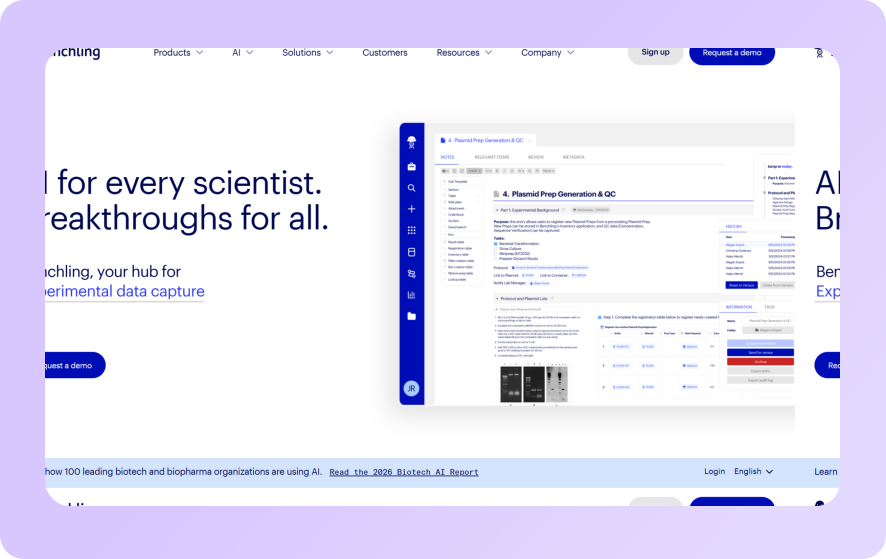
Benchling is a popular modern platform for high-growth biotech and life sciences R&D labs. It combines molecular biology tools, an electronic lab notebook, and LIMS capabilities in a unified cloud-native laboratory management system, making it significantly more R&D-native than traditional LIMS options.
Its API-first architecture connects into data pipelines, lab automation hardware, and analytics platforms with considerably less friction than legacy competitors.
Key Features
- Molecular Biology Toolset: Sequence editors, plasmid maps, and molecule registration are built natively, not bolted on from third-party integrations, making the platform genuinely useful for scientists from day one without customization
- Unified ELN + LIMS: Research experiment data and sample tracking coexist in a single laboratory management system, eliminating the integration overhead and data consistency problems that arise when ELN and LIMS are maintained as separate subscriptions on separate platforms
- API-First Architecture: Benchling’s API connectivity integrates with lab automation systems, instrument data capture, and analytics platforms with less configuration complexity than legacy LIMS competitors
Pricing
| Plan | Pricing |
|---|---|
| Academic / Small Teams | Free |
| Enterprise | Custom |
Where Benchling Shines
- R&D-native design: Built for scientists, not adapted from enterprise data management tools with scientific layers added afterward
- Modern API connectivity: Integrates with lab automation and data pipelines with significantly less friction than traditional LIMS platforms
- Strong molecular biology depth: Few laboratory management systems match Benchling’s sequence-based R&D capabilities natively
Where Benchling Falls Short
- Not built for clinical or diagnostic workflows: TRF processing, insurance eligibility, accessioning, and RCM are not part of Benchling’s scope
- Cloud-first architecture: Limits applicability for organizations with strict on-premises data sovereignty requirements
Customer Reviews
Andrew L. shares, “I love the integration of an electronic lab notebook with a suite of tools for molecular cloning. As a molecular biologist, I use Benchling constantly and it has made me a better scientist.”
Nikita C. notes the bulk upload feature need work, saying, “It’s not great for uploading multiple cell lines or boxes at once.”
Who Benchling is Best For
- High-growth biotech and life sciences R&D teams: Organizations that need molecular biology tools, ELN, and LIMS capabilities in one system without enterprise implementation timelines
- Research-heavy environments: Labs where experimental and sample data need to coexist without constant cross-system exports
4. Scispot: Best for Biotech Startups Needing No-Code Lab Automation
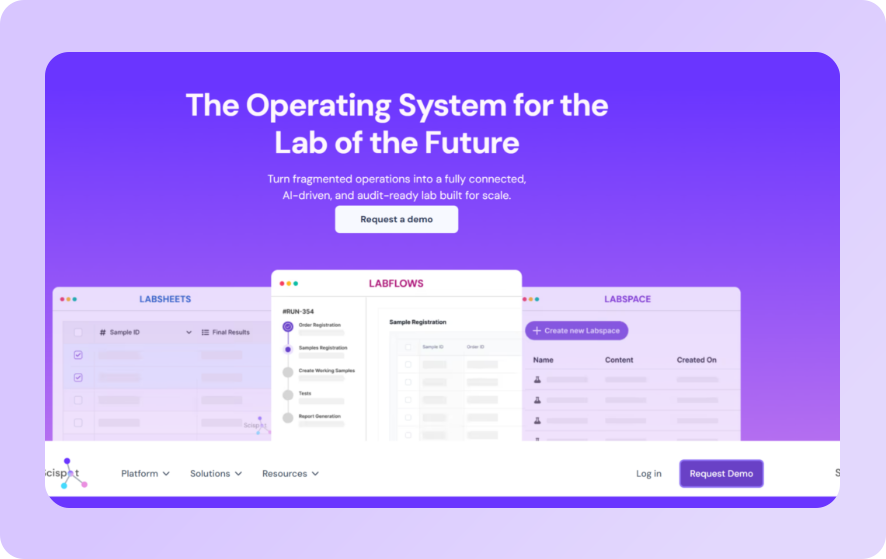
Scispot is a cloud-based LIMS + ELN laboratory management platform built for fast-growing biotech startups and automation-first R&D environments.
Its no-code workflow builder and native lab robotics integration make it one of the most accessible laboratory management systems for organizations that cannot sustain months-long implementation projects or require developer involvement for every workflow change.
Key Features
- No-Code Workflow Builder: Lab teams configure and adapt sample tracking, result routing, and reporting workflows through the interface without writing code, reducing IT dependency for day-to-day operational changes and enabling scientists to self-serve on workflow modifications
- Lab Robotics Integration: Native connectivity with lab automation hardware is built into Scispot from the start, not added as an integration layer. For automation-first labs, this means the software is built around the same workflows the instruments run
- LIMS + ELN + SDMS in One Platform: All core laboratory informatics functions in a single platform, accessible via no-code interface or API, at pricing that is more accessible than enterprise LIMS alternatives
Pricing
| Plan | Pricing |
|---|---|
| All plans | Custom |
Where Scispot Shines
- Fast time-to-value: Labs consistently go live in weeks, not months, rare at this functional depth for software for laboratory management
- Lab robotics connectivity from the ground up: Designed for automation-first environments rather than retrofitted for them
- Published, predictable pricing: One of the few lab management systems with transparent pricing tiers, making budget forecasting manageable
Where Scispot Falls Short
- Newer platform with limited peer review: Few reviews as of early 2026 limits the available peer validation relative to established platforms
- Not proven in strict GMP pharmaceutical environments: Less appropriate for organizations with highly regulated manufacturing compliance requirements
Customer Reviews
Rajan B. notes, “Scispot helped my team centralize all our animal research data from live animal data (including randomization, clinical observations, feed intake, etc.), clinical chemistry, clinical pathology, histology, anatomic pathology and all associated metadata into one single platform.”
Soumith P. notes, “I would like to see more scientific out of the box analytics.”
Who Scispot Is Best For
- Biotech startups and growth-stage R&D labs: Teams that need modern LIMS + ELN functionality without the enterprise complexity or budget requirements of established platforms
- Automation-first labs: Organizations already running or planning lab robotics integration that need a laboratory management system built for that environment natively
5. LabVantage: Best for Biopharma and Biobanking Organizations
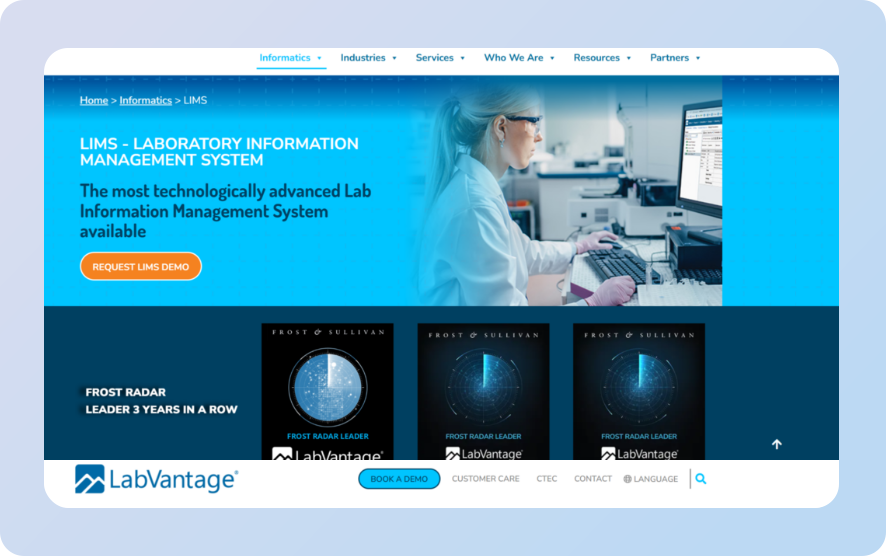
LabVantage is a well-established global laboratory management system combining LIMS, ELN, and SDMS in a unified environment.
Its strongest differentiation is in complex sample hierarchy management and long-term biobanking, making it the natural choice for biopharma organizations managing sample collections alongside active research workflows.
Key Features
- Complex Sample Hierarchy Management: LabVantage handles multi-level sample relationships, chain of custody tracking, and long-term biobanking at a depth that most general-purpose laboratory management software cannot match natively
- Unified LIMS + ELN + SDMS: Research data, sample data, and scientific data management coexist in a single laboratory management system, reducing integration overhead for organizations that would otherwise maintain separate subscriptions for each function
- Multi-Site Enterprise Support: LabVantage is deployed globally across biopharma, healthcare, and research environments, with multi-site support for organizations managing different regulatory requirements across locations
Pricing
| Plan | Pricing |
|---|---|
| All plans | Custom |
Where LabVantage Shines
- Biobanking depth: Long-term sample storage and complex sample hierarchy management go beyond what most laboratory management systems handle natively
- Integrated research and sample workflows: Research experiment data and sample tracking coexist without constant cross-system exports
- Global enterprise scalability: Deployed across biopharma and healthcare environments at genuine enterprise scale
Where LabVantage Falls Short
- Slow update cadence: Version releases are infrequent, which can delay adoption of new capabilities relative to newer cloud-native platforms
- Not built for clinical diagnostic intake automation: Like most LIMS, LabVantage manages data once it is inside the system; upstream intake automation requires a separate layer
Customer Reviews
Sri G. praises, “Overall, it’s a powerful platform for developers who need to bridge the gap between standard LIMS functionality and custom automation.”
Mohamed S. notes, “Real time integration is not possible.”
Who LabVantage Is Best For
- Biopharma organizations managing complex sample hierarchies across research and clinical workflows simultaneously
- Labs with active biobanking programs; long-term sample storage and retrieval at enterprise scale where chain of custody documentation is critical
6. QBench: Best for CLIA Labs Needing Fast Cloud Deployment
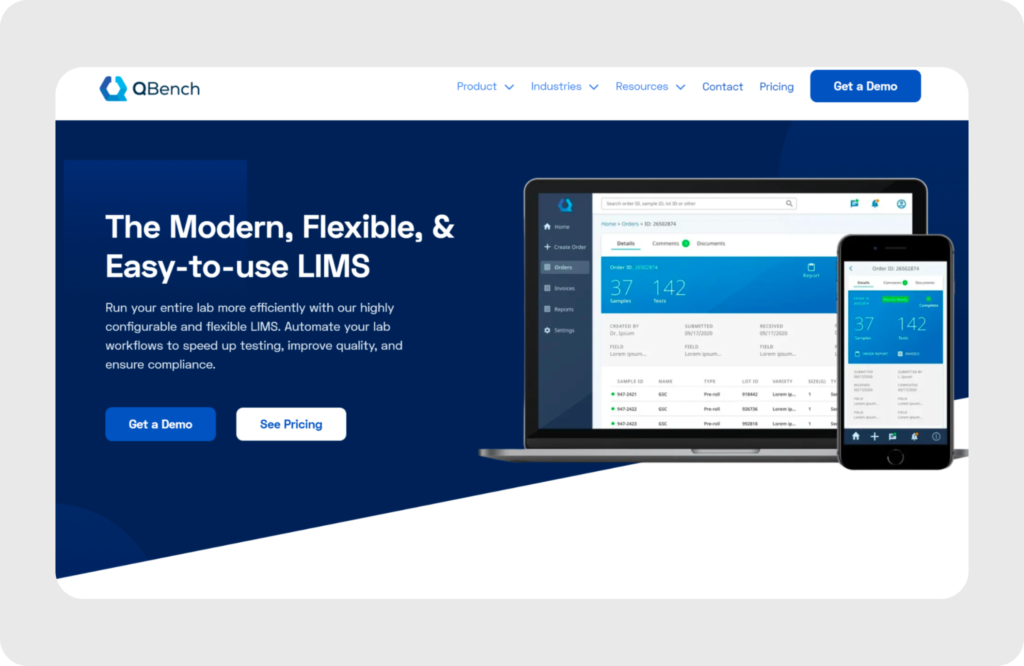
QBench is a cloud-based laboratory management system designed for CLIA-certified clinical and testing laboratories that need to deploy quickly without heavy IT involvement.
Its no-code configurable workflows and HIPAA-compliant architecture make it one of the most accessible software for laboratory management for mid-sized labs that cannot sustain extended implementation timelines.
Key Features
- No-Code Workflow Configuration: Lab teams configure sample tracking, result routing, and reporting workflows through the interface without coding, making routine workflow changes manageable without IT support involvement
- HIPAA-Compliant Cloud Architecture: Encryption, access controls, and audit logging are included by default; meeting HIPAA requirements for CLIA labs without additional configuration overhead or separate compliance modules
- Cloud-Based Sample Lifecycle Tracking: Full sample visibility from intake through reporting, accessible from any browser without on-premises hardware requirements or infrastructure overhead
Pricing
| Plan | Pricing |
|---|---|
| All plans | Custom |
Where QBench Shines
- Fast deployment: Labs report going live in weeks rather than months, rare at this level of LIMS functionality
- Accessible for non-technical lab teams: Lab technicians and operations staff can configure and operate QBench without dedicated IT support
- Compliance by default: HIPAA-compliant architecture does not require separate configuration for labs subject to PHI requirements
Where QBench Falls Short
- Limited depth for complex enterprise workflows: Better suited to mid-sized labs than large multi-site enterprise deployments with complex data hierarchy needs
- Limited AI document processing: QBench excels at sample tracking and configurable workflow management; intelligent document extraction and data reconciliation at the intake layer require a separate tool
Customer Reviews
Sereysimundy C. praised, “QBench is an excellent everyday tool for organizing and managing information for our lab. It makes data sorting, filtering, and sample management effortless.”
One verified user complains, “Some of the help documents are a bit outdated or do not go into depth as much as I’d like so it can be a bit confusing to try out new features.”
Who QBench Is Best For
- CLIA-certified clinical and diagnostic labs that need reliable sample tracking and HIPAA compliance without enterprise-scale complexity or cost
- Environmental and testing labs running standard testing workflows that prioritize speed of deployment and operational simplicity
7. Labguru: Best for Academic and Biotech Research Labs
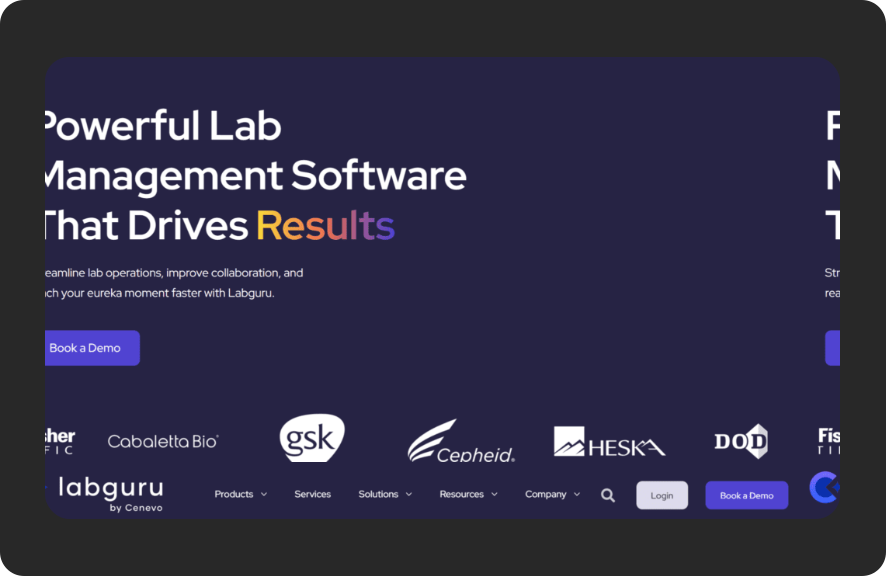
Labguru is a cloud-based laboratory management platform combining an electronic lab notebook, inventory management, and protocol library in a single system.
It is widely used in academic institutions, biotech R&D groups, and research-focused environments that need the core functions of laboratory management software without enterprise implementation complexity or cost.
Key Features
- ELN + Inventory Management: Labguru combines experiment documentation and reagent, equipment, and sample inventory tracking in one platform, reducing the need for separate systems for research records and inventory control
- Protocol Library: Researchers can create, share, and standardize experimental protocols across the lab, building a searchable institutional knowledge base that improves reproducibility and onboarding for new team members
- Collaboration and Sharing: Teams can share notebooks, protocols, and data across researchers and departments with configurable permissions, supporting collaborative research without losing traceability
Pricing
| Plan | Pricing |
|---|---|
| All plans | Custom |
Where Labguru Shines
- Accessible for research teams without IT support: Self-service setup without implementation overhead makes it practical for small research groups and academic labs
- ELN + inventory in one platform: Reduces the friction of maintaining separate systems for experiment records and reagent/equipment tracking
- Affordable team-level pricing: Published per-user pricing is more accessible than enterprise LIMS alternatives for small and mid-sized research teams
Where Labguru Shines
- Not suitable for clinical or diagnostic labs: Labguru is a research-focused ELN and inventory tool; it does not handle CLIA compliance, TRF processing, clinical sample management, or RCM workflows
- Limited scalability for complex regulated environments: Pharmaceutical GMP or regulated manufacturing environments will find Labguru’s compliance documentation capabilities insufficient
Customer Reviews
Jessica N. notes, “Labguru works well for organizing experiments, and I particularly like how easy it is to link between experiments and related data. The platform is generally well-structured and intuitive.”
Oleksii R. notes, “Working with imported tables and performing more in-depth data analysis can feel restricted. Generating detailed research reports and having direct integration with scientific databases for literature, references, or citation suggestions would significantly enhance the experience.”
Who Labguru Is Best For
- Academic research labs and university groups with small to mid-sized research teams that need ELN, inventory management, and protocol standardization without enterprise complexity
- Biotech R&D groups that need functional laboratory management software quickly and cost-effectively before scaling to enterprise LIMS
How to Choose the Right Lab Management System
Picking the right laboratory management system is less about features and more about where your workflow breaks.
Define the Problem Before You Define the Solution
Most lab management software evaluations default to comparing LIMS options. But for clinical and diagnostic labs, the most operationally and financially damaging problems often happen before any sample reaches the LIMS.
If your lab’s core problem is sample tracking or QC documentation, you need a LIMS. If your problem is intake error rates, claim denials, or accessioning throughput, you need an intake layer and a LIMS improvement will not address it.
AI governance in healthcare starts with identifying which layer your governance failures originate from. For clinical labs, it is almost always upstream.
Ask Every Vendor Where Your Data Actually Lives
For labs handling protected health information, the most consequential question in any software evaluation is about data residency. Any laboratory management system that processes or routes PHI on behalf of your lab is a Business Associate under HIPAA.
If that vendor stores your patient data on their own servers, you are inheriting their security exposure as your compliance risk.
Read more: The HIPAA-compliant automation checklist covers what to verify before signing.
Select for Lab Type, Not Vendor Prestige
The most common lab software purchasing mistake is selecting a platform used by enterprise pharma when you run a clinical diagnostic lab, or vice versa.
- LabWare is the right choice for GMP pharmaceutical manufacturing.
- Benchling is the right choice for biotech R&D.
- Onymos is the right choice for clinical and diagnostic lab intake.
These categories do not overlap in practice.
Lab automation software and lab workflow software serve different layers of the lab stack and should be evaluated separately for each problem your team is solving. like in a real clinical deployment.
See How Onymos Helps Modern Labs Automate Management Workflows
The right laboratory management system does not fix data problems that start upstream of it. The fix always happens at intake, before any data reaches your systems of record.
Onymos DocKnow is built for labs that want to address the problem where it originates.
If your team processes high volumes of test requisition forms, experiences claim denials from intake documentation errors, or needs to scale specimen throughput without scaling manual data entry, the starting point is the intake layer.
Talk to the Onymos team about automating your lab’s intake workflows.


Connect with our team to explore how Onymos solutions can maximize efficiency, minimize costs, and drive real, scalable growth.
Schedule your demoWe know healthcare data
AI in the lab. Workflow automation at scale. Digital front doors for hospitals and clinics. Healthcare and life sciences are changing fast. Are you ready? Subscribe to our blog for:
- Trends in healthcare tech
- Research and analysis
- Customer stories and more