Which Healthcare Data Extraction Approach Is Right (For You)?
Table of Contents
Need a custom demo?
Use your own workflow and see where DocKnow can reduce manual work.
Get your demoKey Takeaways
- Healthcare data extraction refers to both system-based extraction and document-based extraction.
- System extraction is becoming more scalable through newer interoperability standards, while AI is making document extraction more flexible and better at understanding context.
- Benchmark accuracy sounds good, but it’s easy for vendors to game, so focus on real outcomes when you’re deciding what success looks like.
Healthcare has a data usability problem. A HIMSS-Arcadia report found that the average healthcare org was only using 57% of its available data for decision-making, and a separate survey found that 71% of healthcare data was basically inaccessible to clinicians.
So, what’s going on? Why isn’t this a solved problem in the “AI era”? Well, it increasingly is, but industry-wide change takes time. Until very recently, structured data was the only kind of data software could use. Earlier healthcare data extraction tools were too brittle and costly to scale, and while AI has made extraction more practical, concerns about accuracy and HIPAA have kept most orgs stuck in pilot mode.
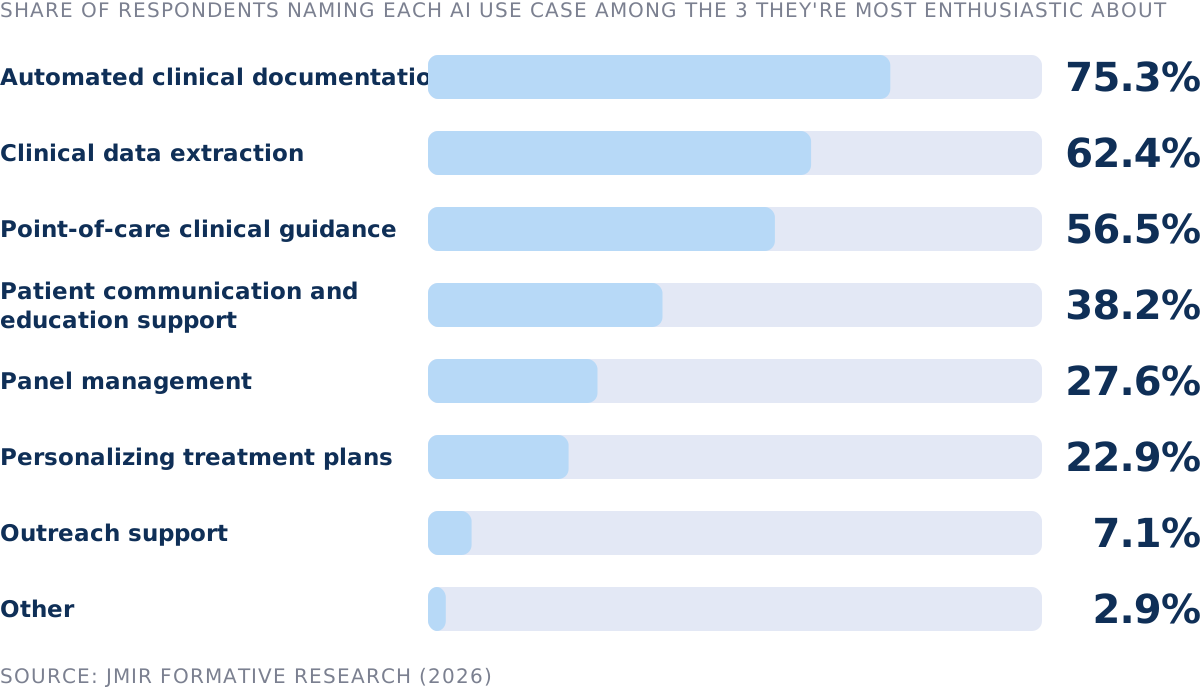
But the space may finally be starting to come around. In a 2026 Veterans Health Administration survey, 62% of primary care clinicians said clinical data extraction was one of the AI use cases they were most enthusiastic about (second only to automated clinical documentation).
But “healthcare data extraction” isn’t one-size-fits-all. The right tool or approach depends on the use case.
What is healthcare data extraction?
It usually falls into two categories:
- Extracting data from healthcare systems, such as an EHR, LIS, or legacy database.
- Extracting data from healthcare documents, such as requisition forms and medical records.
Some platforms specialize in one. Others try to do both. The tradeoff is usually depth versus breadth or cost vs capabilities.
Let’s break the two down.
1. Extracting data from healthcare systems
Maybe the most conventional form of healthcare data extraction is moving information from one system to another. Think “changing a vendor” or “replacing a legacy database.”
Historically, that’s been easier said than done. Proprietary data schemas or closed ecosystems (e.g., Epic) make interoperability difficult even when the underlying data is already structured.
But today, healthcare tech stacks are much more complex than they were even a few years ago, and AI has made inaccessible data much more obviously valuable. The pressure is pushing regulators and standards development organizations (SDOs) like HL7 to move faster on data portability. The space just has less tolerance for friction between systems than it used to.
If you’re evaluating these kinds of tools, these are the capabilities you’ll want to look for:
- Standards-native interoperability with support for HL7, FHIR, APIs, bulk data exports, and other common healthcare standards.
- Support for legacy systems, because much of healthcare still depends on proprietary tech and older interfaces.
- AI-assisted mapping and migration that automates schema discovery, translation, and quality checks.
- Bulk and incremental extraction to support large historical data migrations and ongoing extraction of newly created or modified records.
- Traceability and observability so you can see where data came from and how it was transformed.
2. Extracting data from healthcare documents
Across hospitals, clinics, and labs, paper-based documents are still everywhere. Whether they arrive as scans, faxes, or original printouts, someone still has to copy the information into the system of record by hand. At many organizations, that’s a full-time job.
Traditional optical character recognition (OCR) could turn a scanned image into raw text, but it couldn’t tell you what that text meant. A user (or a rigid, hardcoded program) would have to work out which words were what.
But by the early 2020s, OCR had been rolled into a “smarter” solution called intelligent document processing (IDP). It combines OCR with natural language processing (NLP) and machine learning to not only extract data but also understand what it means and what should happen with it next. By the end of 2025, IDP was mainstream enough that Gartner released its first Magic Quadrant for the tech.
Onymos DocKnow, our intelligent intake platform for labs, sits in this category because it focuses on processing data in test requisition forms (TRFs) and other medical records.
If you’re comparing vendors, these are the capabilities that should be on your checklist:
- Cross-document reconciliation to compare information across related documents and flag discrepancies.
- Configurable business rules to automatically format, reject, or route data based on your requirements.
- Flexible structured outputs so you can deliver extracted information as JSON, CSV, or whatever format downstream systems require.
- Automated metadata generation to capture document type, source, timestamps, confidence scores, identifiers, and other context.
- Healthcare-grade security and deployment controls with clear policies around PHI, data retention, model training, access controls, and where documents are processed or stored.
- High accuracy at scale without requiring constant tuning or correction.
- Handwriting recognition to accurately capture handwritten notes, annotations, and form entries alongside printed text.
What kind of healthcare data extraction do you actually need?
The boundary between these two categories is blurrier than you might think. A lot of data that “lives in a system” might only come out of scanned PDFs or e-faxes from another provider’s EHR. Teams that think they have a system-integration problem might really have a document problem or vice versa.
And the capabilities above are a useful baseline, but they’re still only a broad checklist. In practice, the right platform depends on which capabilities matter most for your specific workflow.
A platform might have slightly less impressive user customization options overall, but be far more resilient to (your) real-world workflow variations. Some platforms also include highly specialized capabilities that others don’t. Think features built around a particular workflow or industry problem.
When it comes to measuring actual performance, the most useful metrics are operational, not generic benchmarks. Look at straight-through processing (STP) numbers — the percentage of tasks you can complete without human intervention — and the accuracy of your final output.
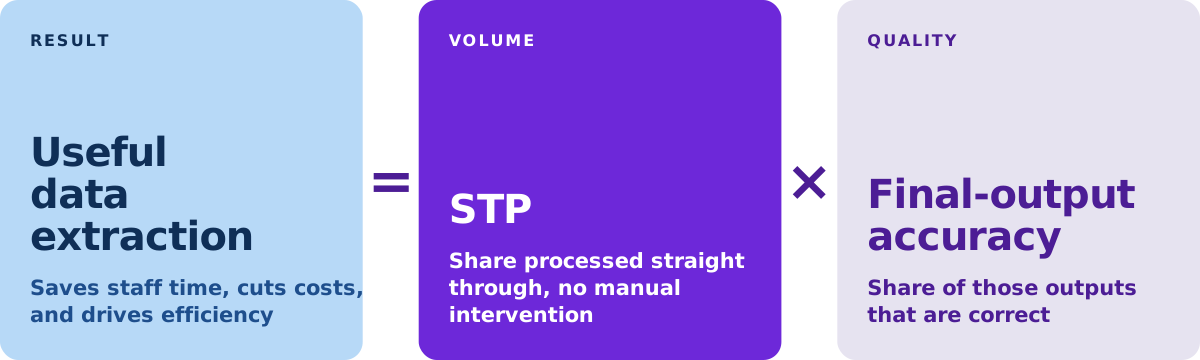
If staff constantly have to handle exceptions or correct errors, you’re not really automating the work (you’re just moving it around). Consider edge cases where a platform might have generally high accuracy, but misses the most critical data with the biggest business or clinical consequences
Build or buy?
It’s easier than ever to assemble custom data extraction systems from cloud OCR services or LLM APIs. But as much as the tech has changed over the last several years, the “build or buy” tradeoffs haven’t.
That’s because “easier than ever” and “easy” aren’t synonymous. Uploading a document to ChatGPT or Claude and watching it extract the right data can make it seem like building your own solution is now as simple as signing a BAA and plugging into OpenAI, Anthropic, AWS, Google, or another major AI provider.
Except that one-off extraction is a very long way from production-grade performance across thousands of variable documents. Building and maintaining that infrastructure still requires deep (and very expensive) expertise.
None of that means you shouldn’t build it yourself. If the workflow is important, differentiated, or tightly coupled to a proprietary system, and you have the engineering resources to own it long term, a custom solution will give you more control and flexibility than an off-the-shelf platform. Just be realistic about what you’re signing up for.
The best solution is the one that solves your problem
There’s no single technology called healthcare data extraction.
Whether you’re looking to buy an existing platform or build your own, ask yourself, “Where is the information we need today, what decisions will be made with it, and how certain do we need to be before we act?” Those answers will guide you to the right solution.
And if you’re trying to solve a data extraction problem in the clinical lab space, especially if you’re trying to optimize TRF processing or other intake workflows, reach out to us about Onymos DocKnow. We’ll create a custom demo for you tailored to how your team actually works. If we’re not a fit, we’ll recommend the best alternatives.


Connect with our team to explore how Onymos solutions can maximize efficiency, minimize costs, and drive real, scalable growth.
Schedule your demoWe know healthcare data
AI in the lab. Workflow automation at scale. Digital front doors for hospitals and clinics. Healthcare and life sciences are changing fast. Are you ready? Subscribe to our blog for:
- Trends in healthcare tech
- Research and analysis
- Customer stories and more