AI adoption in labs is still relatively early, but applications already span workflow automation, digital pathology, and data analysis.
The most immediate value may come from reducing expert busywork. AI can take on repetitive tasks so specialists can focus on more complex decisions.
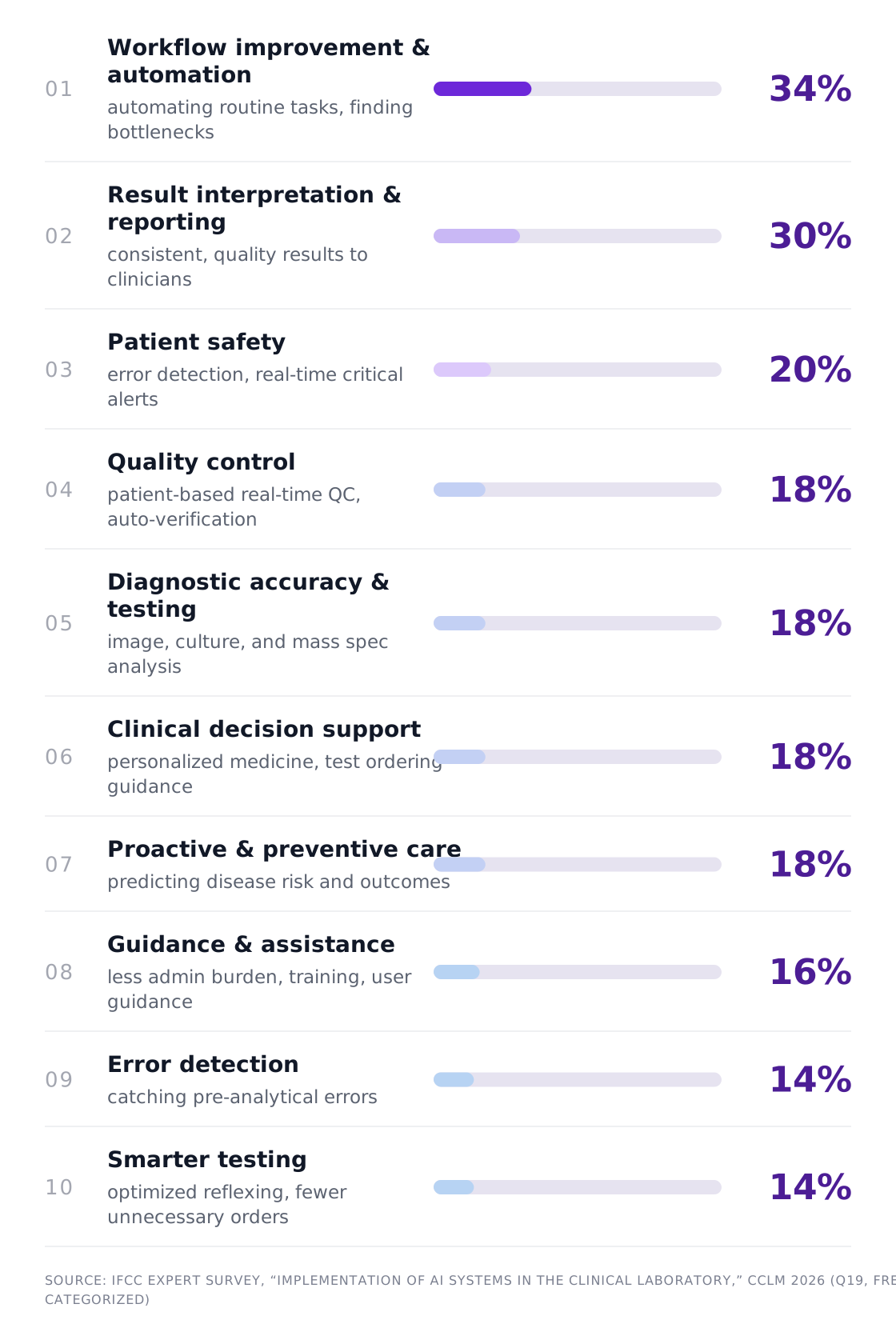
AI may dominate conversations about the future of laboratory medicine, but adoption isn’t as ubiquitous as you might think. A 2026 IFCC survey found that only 34% of laboratory professionals were using AI-enabled tools in their labs.
And while much of the hype around laboratory AI focuses on scientific and diagnostic applications, respondents ranked workflow automation as AI’s biggest opportunity, ahead of things like “result interpretation and reporting” and “diagnostic accuracy and testing.”
So, among the minority already using AI in the lab, what are they actually using it for, and how closely does that map to expert opinion about the “biggest opportunities” for AI?
Let’s look at a cross-section of some of the most prominent use cases in the space today.
1. Forecasting laboratory demand and capacity
Labs don’t experience perfectly predictable workloads, to say the least. In a 2017 Mayo Clinic Laboratories study (which explains its future interest in AI forecasting), it found day-to-day staffing needs varied more than 4x, from 0.8 FTE to 3.6 FTE.
By 2026, they’d implemented a self-learning decision support and scheduling system.
Instead of guessing at future workloads based on what’s typical, an AI model looks at the signals likely to affect demand to predict what resources the lab will need.
For example, a lab might normally staff six people based on historical averages. An AI model could spot that scheduled procedures and recent ordering trends point to a 20% volume increase and recommend staffing eight instead.
Mayo Clinic Laboratories Chief Digital Information Officer Dr. Christopher Garcia says, “The most useful thing is the feedback loop that lets tools learn from what actually happens and improve the forecast. It also means we can incorporate external signals like OR schedules and capacity changes that humans might not consistently track.”
2. Analyzing digital pathology slides
Once pathology slides are digitized, computer-vision models can analyze them at a speed and scale human experts can’t match. AI can quantify subtle combinations of thousands (or even millions) of image features, consistently, across enormous datasets.
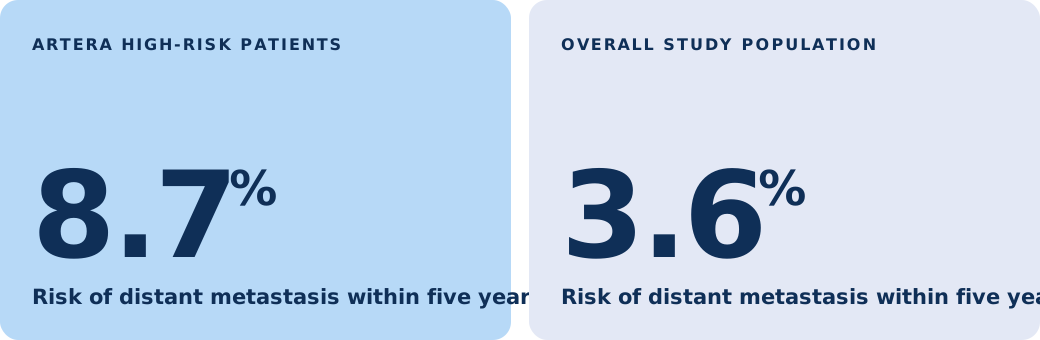
In May 2026, the FDA cleared ArteraAI Breast, software that analyzes digital pathology images to provide breast cancer prognoses. A validation study found patients ArteraAI Breast classified as high risk were roughly three times as likely to experience distant recurrence (the cancer appearing somewhere else in the patient’s body) as those classified as low risk.
But startups aren’t the only ones pushing the tech forward. Labcorp, for example, announced earlier this year that it was deploying PathAI’s AISight Dx digital pathology platform across its national network. Labcorp Chief Scientific Officer Dr. Marcia Eisenberg was explicit about the company’s ultimate goal of integrating “AI insights into routine care.”
3. Interpreting genetic variants
For molecular diagnostics labs, figuring out which genetic variants actually matter can take hours per case. Expert staff have to review published research, population databases, and clinical guidelines to determine what, if anything, a variant means for the patient.
Or, they did. Some labs already use AI to instantly synthesize all that data.
Researchers at the University of Chicago Medicine, for example, developed OLIVE, an AI system designed specifically for somatic variant interpretation within a molecular pathology workflow.
The system “summarizes multiple data sources and applies explicit gene-specific guidance files to generate structured prompts for final classification and interpretation.”
A 2026 Scientific Reports study tested several AI-assisted tools against human experts to see how well they could classify genetic variants as benign, pathogenic, or somewhere in between. The AIs performed pretty well… when the evidence was structured and straightforward. They were less reliable when cases were borderline or ambiguous in other ways.
One of the study’s strongest performers, Franklin, is already operating at scale. Its owner, QIAGEN, reports it’s supported more than 750,000 real-world case interpretations.
4. Automating laboratory intake
Before a specimen can be tested, laboratories have to process the unstructured data in requisitions, insurance cards, clinical notes, and other supporting documents that can all arrive by fax, mail, or web portal. Accessioners have to identify the relevant information, enter it into the appropriate systems, verify that required fields are present, and resolve exceptions.
That’s a lot of places for something to go wrong, and it’s part of why as many as 70% of all lab errors are preanalytical.
So, it’s no surprise that innovation-forward labs are starting to look for ways to automate those processes. One of the solutions is intelligent document processing. Instead of simply digitizing an image, these systems can identify the document type, extract relevant fields, validate them against business rules or other data sources, and convert the information into structured formats that downstream systems can consume.
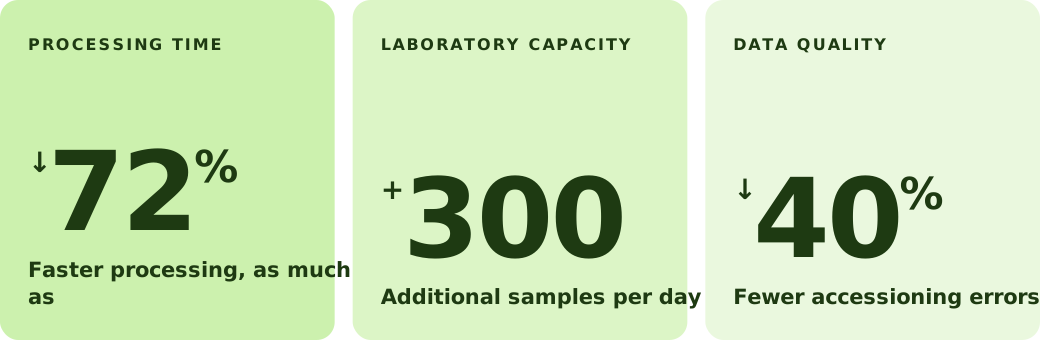
Vanta Diagnostics used Onymos DocKnow, our intelligent document processing and intake platform, to reduce accessioning errors by 40% and processing time by as much as 72% (the latter creating an additional 300 samples a day in lab capacity).
Mayo Clinic Laboratories reports using similar technology. Patrick Day, a Mayo Clinic Laboratories medical technologist says, “It is really just augmenting [staff], not replacing them. There is still a human involved in the process, but reducing the manual lookups and data entry helps work move forward faster.”
And Mayo Clinic itself has since partnered with Onymos to bring intelligent document processing into other clinical workflows.
5. Reviewing test results
Reviewing test results is a classic high-volume, pattern-recognition workflow. Rules-based automation has handled routine cases for years, but newer AI systems are taking that concept further, using machine learning to recognize patterns that are harder to capture with fixed rules
In 2026, researchers at the University of Washington School of Medicine reported deploying an AI-assisted system into the live workflow of its clinical toxicology service. The system analyzes urine drug-testing results and generates a preliminary interpretation for a specialist to review before final sign-out.
Across more than 83,000 urine drug tests, it achieved extremely high accuracy, and reduced average “sign-out time” by 23%.
Importantly, the system wasn’t designed to replace the laboratory specialists. Every result still went through a human-in-the-loop workflow.
What these use cases tell us about laboratory AI
These are far from the only ways clinical labs are using AI, but they give us a sense of where adoption is starting to concentrate.
And the examples broadly line up with expert opinion. Three of the five use cases above focus on workflow efficiency (forecasting demand, automating intake, and accelerating result review). The other two (digital pathology and variant interpretation) map directly to the diagnostic and interpretive applications that ranked just behind workflow automation in the IFCC survey.
In the near-term future, laboratory AI may look less like a single revolutionary “AI lab” and more like a collection of specialized tools solving very specific problems.
And across nearly all of our use cases, the role of AI looks similar under the hood. It’s doing more of the repetitive searching, sorting, pattern recognition, and first-pass analysis while keeping humans in control of decisions that require expert judgment.
For the 66% of lab professionals who haven’t adopted AI, that might be the more useful way to think about the tech. The question isn’t necessarily “How do we bring AI into the lab?” It’s “Which tasks require an expert, and which are simply taking up expert time?”
Jamie Goodnight
Jamie Goodnight
Jamie’s an engineer turned tech evangelist. A former full-stack developer and technical product leader, he focuses on helping people understand how technology works, where it fits, and why it matters.
Use Onymos for: diagnostic and clinical workflows / billing and claims / compliance
Connect with our team to explore how Onymos solutions can maximize efficiency, minimize costs, and drive real, scalable growth.
AI in the lab. Workflow automation at scale. Digital front doors for hospitals and clinics. Healthcare and life sciences are changing fast. Are you ready? Subscribe to our blog for: