6 Best Specialized Intelligent Data Extraction Platforms (2026)
Explore six of the best specialized intelligent data extraction platforms across healthcare, logistics, legal, and more.
- Onymos Team
- 5 min read

When IDC asked orgs from across every industry to name their top data investment priorities, more than half said data intelligence.
For many, that will mean choosing intelligent data extraction solutions designed for the specific documents, workflows, and terminology they deal with every day.
In radiology, a domain-trained model outperformed GPT on structured data extraction, scoring 97% versus 78%. In industrial safety, specialized models improved classification performance by 11% to 31%. And in legal, a 2026 study found that a “legal-domain small language model” performed better than five frontier LLMs on contract data extraction (while operating at substantially lower cost).
Specialization isn’t just about extraction accuracy either. It’s about everything a platform offers and how it’s designed.
Below, we break down six standout solutions for intelligent data extraction across different industries.
Ocrolus: Fraud Detection for Lending
A generic IDP like ABBYY or Nanonets can extract fields from any structured document (e.g., invoices, receipts, forms, whatever you feed it).
But Ocrolus’ models are specifically trained on bank statements, pay stubs, and tax forms at massive scale. For reference, the company says it processes roughly 750,000 credit applications each month.
Its flagship “Detect” tool is designed to spot document tampering and other anomalies in financial data, then interpret how much risk those signals represent. A generic solution, on the other hand, has no concept of “this is riskier than that” when making loan decisions. That ability to move from document extraction to interpretation is one of the biggest benefits of intelligent data extraction when the technology has been designed for a specific vertical.
Best for: Digital-first mortgage and consumer lenders, underwriting teams
Onymos: Data Validation for Precision Medicine
Onymos DocKnow is an intelligent document intake platform built around complex healthcare and clinical laboratory workflows.
DocKnow reconciles data extracted from requisitions, insurance cards, handwritten physician notes, and other structured and unstructured documents against connected systems and linked medical records. Its SmartSync engine cross-references these sources in real time, flagging missing, mismatched, or conflicting information before it moves downstream.
And, uniquely, the platform is built on a “No-Data Architecture” model. By default, it never “sees” or stores customer data, with everything staying in the customer’s own on-prem or cloud environment. That’s a direct response to how sensitive and breach-prone healthcare data is (industry reports suggest 80% of stolen patient records originate from third-party vendors). Generic platforms aren’t built around that threat model.
Best for: Clinical LabOps teams needing more reliable data, health systems and hospitals trying to replace compliance-heavy, manual data entry tasks
Raft: Workflow Automation for Freight
Raft’s platform processes hundreds of different logistics documents across more than 35,000 partners.
It integrates bidirectionally with TMS, ERP, customs authorities, and carrier networks so data flows straight through these connected systems without any rekeying.
Raft says its models and agent fleets are trained on more than 5 billion labeled data points verified by human experts, with over $10 billion in freight invoices processed to date. That’s not just a highly specialized training corpus… It’s a very big one.
Best for: Freight forwarders, logistics operators, customs brokers
Traydstream: Rule-Checking for Trade Finance
The Traydstream platform validates data extracted from trade documents against proprietary software encoding 250,000+ permutations of internationally standardized trade rules. Calling it “specialized” undersells it.
Like DocKnow for healthcare and clinical laboratories, Traydstream’s core function (aside from data extraction itself) is reconciliation and verification. It automatically performs the tedious line-by-line cross-referencing a human would do manually across dozens of documents per transaction. For example, it can determine whether the information on an invoice matches the corresponding letter of credit.
Traydstream also incorporates a custom optical character recognition (OCR) technology to handle both e-documents and paper.
Best for: Trade finance desks at banks, companies engaged in international trade
Litera: Contract Analysis and Legal

Litera Kira has been around long before the AI boom. By the time “Kira Systems” was acquired by Litera in 2021, 84% of the top 25 global M&A firms were already using it. It analyzes contracts and identifies specific clauses, provisions, and other key information.
Once powered by pre-generative AI machine learning, the platform now incorporates the latest AI tech in a hybrid architecture. But that missing “AI native” quality might be a feature, not a bug. Pure-LLM competitors that require extensive prompt engineering produce results that are harder to audit in regulated environments.
In fact, it’s a good example of how vertical-specific data extraction can retain an advantage over even the latest LLM wrappers.
Best for: BigLaw M&A, due diligence teams performing high-volume contract review, consulting firms
Sprout.ai: Claims Automation for Insurance
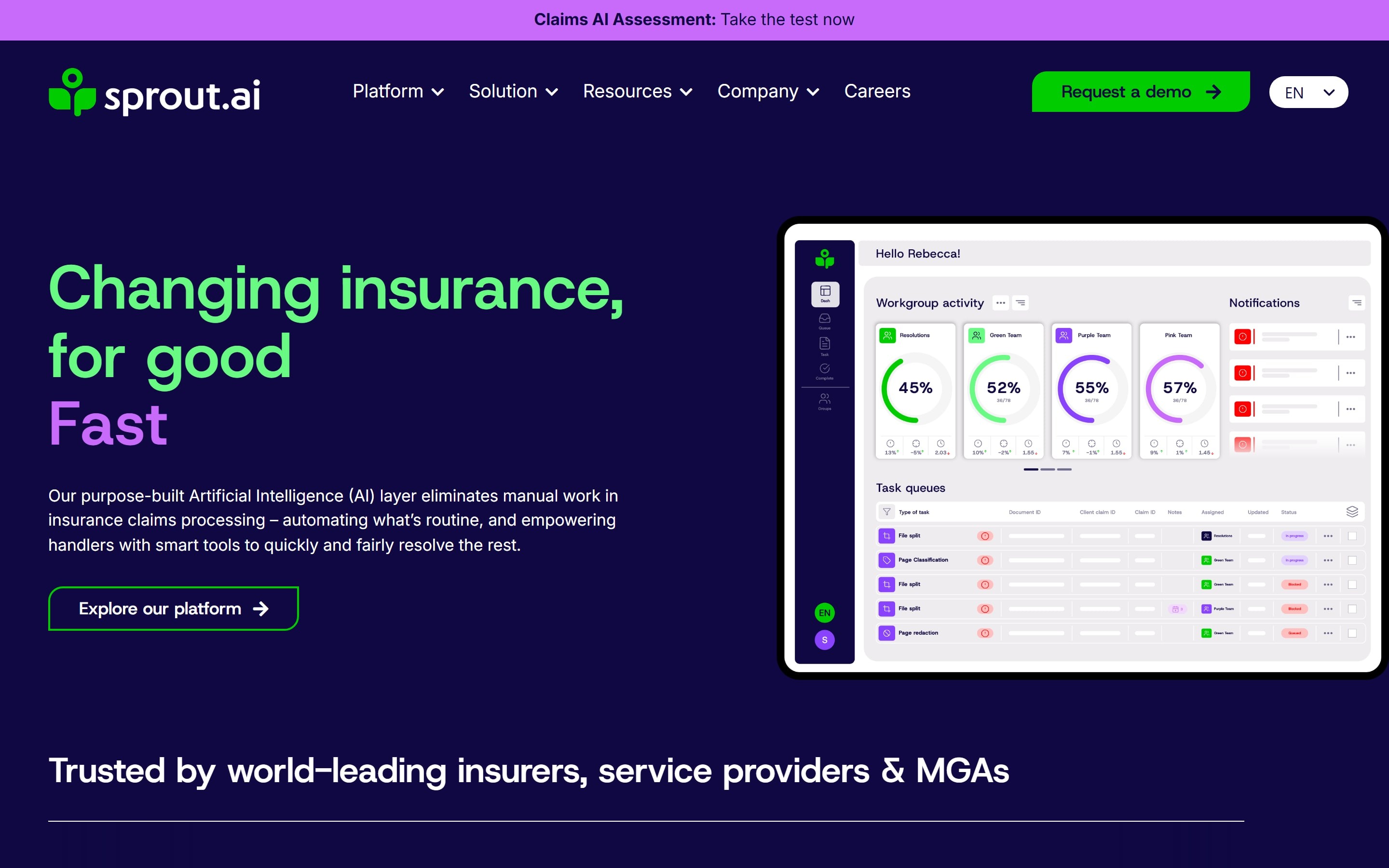
Sprout.ai is a pioneer in insurance data intelligence. It launched its first customer pilots in 2021, using computer vision and synthetic data techniques to train models to handle new claim types.
The platform is broken down into five distinct modules: Document Processing, Coding & Enrichment, Policy Coverage Checking, Fraud Flagging, and Decisioning.
In a 2025 case study with AdvanceCare, Sprout.ai says it extracted and validated claims data across documents, flagged missing information, verified coverage, and mapped claim descriptions to categories or codes. Processing time for settling some routine claims was as little as 60 seconds
Best for: Insurers already running core claims systems (Sprout.ai’s module-based architecture and integrations make it easy to “slot in” to existing infrastructure)
The Real Difference Is What Happens After Extraction
In intelligent data extraction, the extraction is table stakes. Differentiation depends on what the platform does with the data once it pulls it from the page.
If you’re evaluating vendors, consider what “specialized” is buying you. A horizontal IDP vendor can bolt an insurance or healthcare label onto a generic platform, but they can’t shortcut the years of domain-specific enhancements or proprietary training data.
External sources
Navigating the Evolution of Data for a Smarter Future General-Purpose vs. Domain-Adapted Large Language Models for Extraction of Structured Data from Chest Radiology Reports Bridging the safety-specific language model gap: Domain-adaptive pretraining of transformer-based models across several industrial sectors for occupational safety applications A Few Good Clauses: Comparing LLMs vs Domain-Trained Small Language Models on Structured Contract Extraction 2025 Cybersecurity Year in Review, Part One: Breaches and Defensive Measures | AHA News