What is a CLIA Laboratory? Benefits, Compliance & Challenges
Table of Contents
- Why is CLIA Certification Important for Laboratories?
- Challenges in Maintaining CLIA Compliance
- The Growing Administrative Burden in Modern Laboratories
- How CLIA Compliance Improve Laboratories Workflow Efficiency and Patient Care
- Best Practices for Managing CLIA Laboratory Workflows
- How to Choose Technology for CLIA-Regulated Operations
- Automate Compliance-Heavy Laboratory Workflows With Onymos
Need a custom demo?
Use your own workflow and see where DocKnow can reduce manual work.
Get your demoKey Takeaways
- A CLIA laboratory is any U.S. facility that tests human specimens for health assessment or diagnosis and holds federal certification from CMS. Without it, a lab cannot legally bill Medicare, Medicaid, or private insurance.
- CLIA compliance is not just regulatory but also financial. Incomplete TRFs, manual data entry errors, and fragmented system integrations are the leading causes of claim denials, and nearly all of them originate at intake, not billing.
- The biggest operational challenges for CLIA labs are managing complex test requisition forms, keeping pace with changing payer regulations, avoiding manual transcription errors, maintaining audit trails, and connecting disjointed LIMS and billing systems.
- When compliance is automated rather than manual through tools like Onymos, labs gain faster specimen turnaround, lower denial rates, cleaner accessioning data, stronger data security, and the ability to scale test volume without proportionally scaling administrative headcount.
Running a clinical laboratory means dealing with a mountain of paperwork, tight turnaround times, and strict federal regulations. If you find yourself asking, “what is CLIA and what is its purpose?”, you are likely feeling the friction of compliance slowing down your testing operations.
The Clinical Laboratory Improvement Amendments (CLIA) establish federal quality standards for any facility that tests human specimens for health assessment or diagnosis. While the regulation exists to protect patients, its operational reality creates one of the most demanding administrative environments in all of healthcare.
In this guide, we will explore what a CLIA laboratory is, the challenges of maintaining certification, and how building automation into your compliance workflows can transform them from a drag on revenue into a driver of it.
Why is CLIA Certification Important for Laboratories?
CLIA certification isn’t just a box to check. It forms the legal and operational foundation that determines whether your lab can bill, grow, and be trusted by ordering physicians and patients alike.
Enacted by Congress in 1988 and administered by the Centers for Medicare & Medicaid Services (CMS), CLIA applies to any U.S. facility that performs laboratory testing on human specimens; from a simple glucose screen to a complex molecular diagnostic panel. As of 2024, the CMS oversees more than 330,000 CLIA-certified laboratories across the country.
Here is why CLIA certification matters operationally:
- Standardized Quality: CLIA creates a federal baseline for test accuracy across all facilities, regardless of size or specialty.
- Reimbursement Eligibility: You cannot bill Medicare, Medicaid, or private insurance without appropriate CLIA certification.
- Patient Trust: A CLIA meaning signifies to patients and providers that your lab adheres to strict quality controls. This matters enormously when referring physicians are deciding which lab to route specimens to.
- Data Security and Integrity: Compliance naturally overlaps with healthcare data security, making sure that patient information tied to testing is handled correctly.
Challenges in Maintaining CLIA Compliance
Knowing what CLIA requires is straightforward. Executing it on the floor of a high-volume laboratory, where hundreds or thousands of specimens arrive daily, is where the real difficulty lies.
Here are the five operational hurdles that trip up even well-run labs.
#1. Managing Complex Test Requisition Forms (TRFs)
Every specimen arriving at a CLIA lab must be accompanied by a TRF containing the ordering physician’s NPI, patient demographics, insurance information, and the specific tests ordered. In practice, these forms arrive handwritten, faxed, or scanned, often with missing fields, illegible entries, or mismatched data.
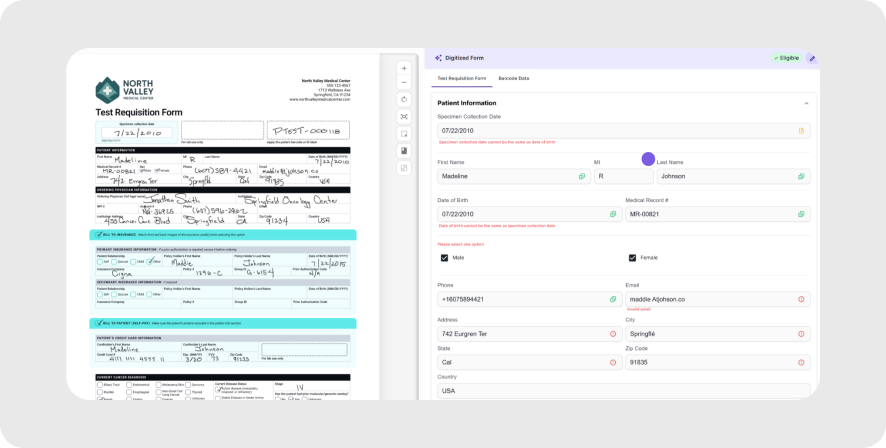
When a TRF is incomplete, the specimen cannot move to testing without manual intervention. Lab technicians are pulled away from their core work to track down a missing NPI or call a clinic to confirm a date of birth. These red flags in your specimen accessioning process create compliance risk and revenue leakage at the very first step of the workflow.
#2. Keeping Up with Changing Regulations
CLIA guidelines, payer medical necessity requirements, and CPT coding standards are not static. CMS updates coverage determinations, private payers revise their reimbursement policies, and accreditation bodies like CAP periodically adjust inspection checklists.
For labs relying on static paper-based processes or manually updated spreadsheets, adapting to regulatory changes is slow and error-prone. The issue compounds for labs trying to transition from paper to automated workflows, a shift many scaling labs struggle to execute without disrupting operations.
#3. Manual Data Entry Errors
In many labs today, billing staff and lab technicians are manually transcribing patient demographics, insurance policy numbers, and diagnosis codes from paper TRFs into the LIS or LIMS.
This is exactly the kind of workflow that produces the clinical equivalent of “Medics using Excel while overwriting patients’ data” which has become a common reality in labs that have not yet automated intake.
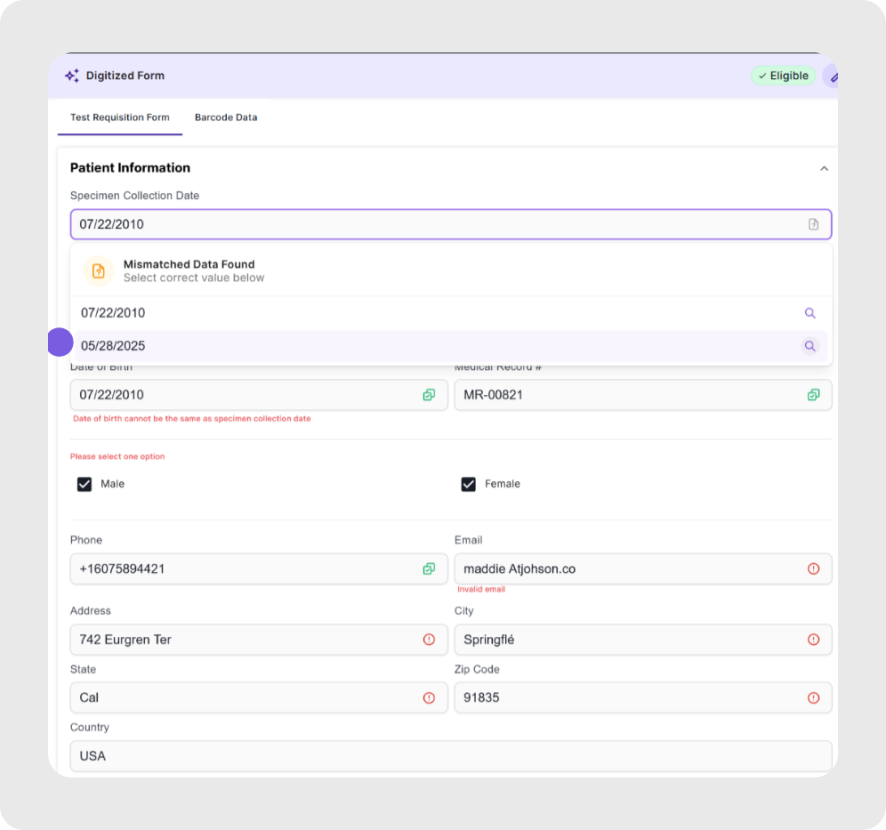
A single character transposition in a patient name or an incorrect date of birth is enough to trigger a claim denial. And because the denial often does not arrive until 60 to 90 days after the test was run, the root cause is easy to miss and even harder to fix retroactively.
#4. Maintaining Strict Audit Trails
CLIA inspections require labs to produce detailed documentation of testing procedures, quality control records, personnel qualifications, and any corrective actions taken. Every document that enters the lab must have a verifiable chain of custody.
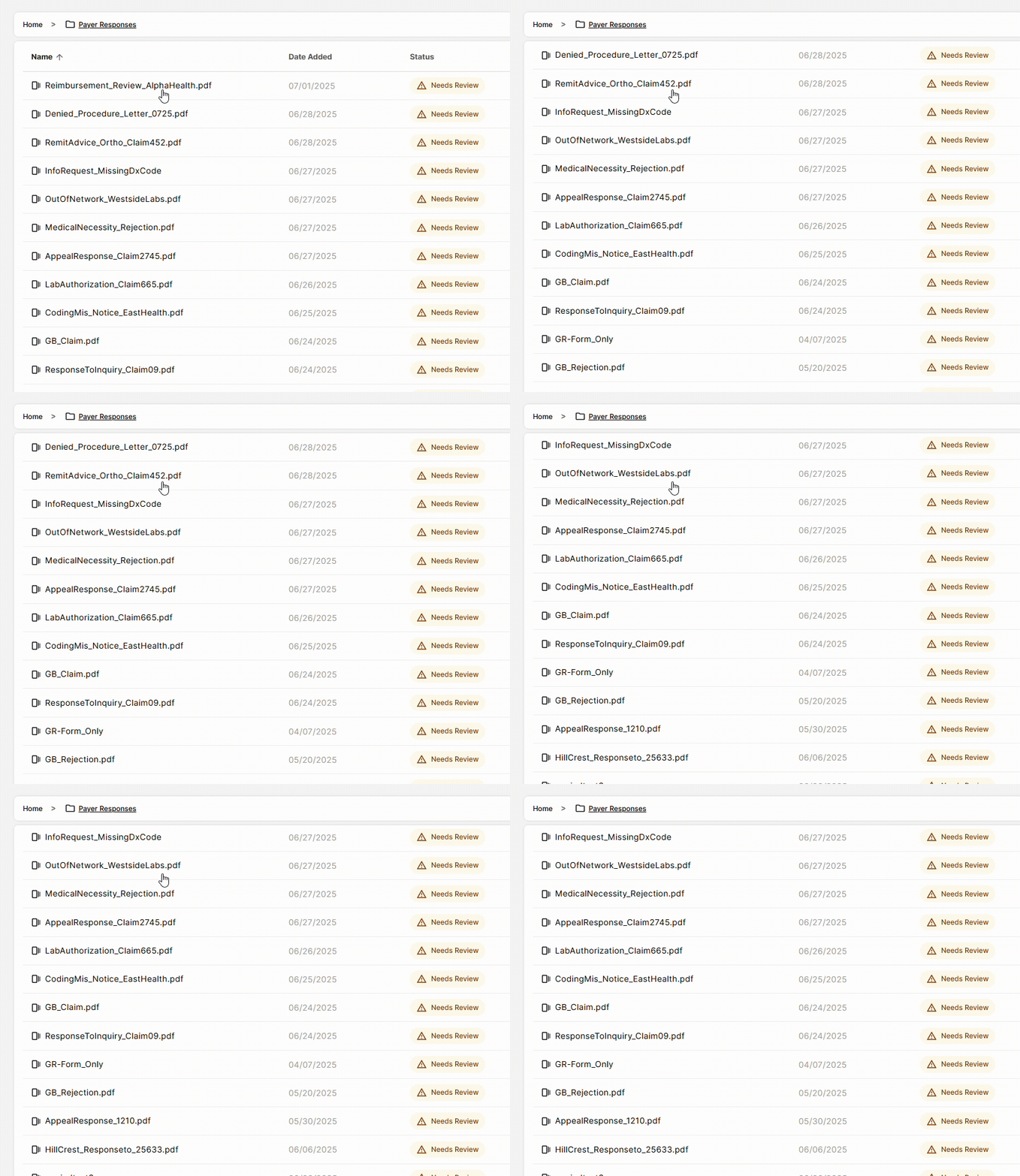
Relying on shared drives, email chains, or static spreadsheets makes that audit trail nearly impossible to reconstruct on demand. If an inspector asks who modified a diagnostic code and when, a folder of PDFs is not an answer.
#5. Fragmented System Integrations
Most labs operate across multiple disconnected systems: a LIMS for sample tracking, a separate LIS for patient information, a third-party billing platform for claims, and possibly a clearinghouse for insurance adjudication. When these systems do not share data natively, every handoff becomes a point of potential error.
The result is data silos that make it impossible to catch mismatches before they cause problems downstream. A patient identifier entered correctly in the LIMS but truncated when passed to the billing platform is enough to trigger a rejection.
The Growing Administrative Burden in Modern Laboratories
The science of clinical testing is, in many ways, the easy part of running a CLIA lab. The bottleneck is the administrative machinery surrounding it.
Consider the life of a single specimen: it arrives with a TRF, gets accessioned, moves to testing, generates a result, requires a coded billing entry, gets submitted to a payer, and then either gets reimbursed or denied at which point the appeals process begins. Every step in that chain requires human touchpoints, and every human touchpoint is an opportunity for error.
As test volumes grow, this burden scales exponentially. A lab processing 250,000 specimens per year and aiming to reach 350,000 does not need 40% more billing staff but intake infrastructure to be clean enough that the additional volume does not create a proportionally larger wave of denials and rework.
Labs that have not addressed this tend to face a false choice: hire more manual data entry staff to keep up, or accept a rising denial rate. Neither option is sustainable.
The more defensible path is eliminating intake errors at the source before they reach the LIS, the billing platform, or the payer.
How CLIA Compliance Improve Laboratories Workflow Efficiency and Patient Care
Counterintuitively, CLIA compliance is one of the most powerful frameworks for workflow optimization available to diagnostic labs. Here is how leaning into it creates operational advantages.
Accelerated Specimen Turnaround
CLIA requires that specimens are handled, tracked, and tested according to documented procedures. When you build automation around those requirements such as using lab automation software that flags incomplete TRFs at intake rather than at billing, the downstream effect is faster turnaround.
Specimens that arrive with complete, validated data move to the testing floor without manual intervention.
Drastic Reduction in Claim Denials
The most direct financial benefit of a compliant, automated intake process is a lower denial rate. When patient demographics, insurance details, and physician identifiers are validated at the point of intake, the downstream data is clean by construction.
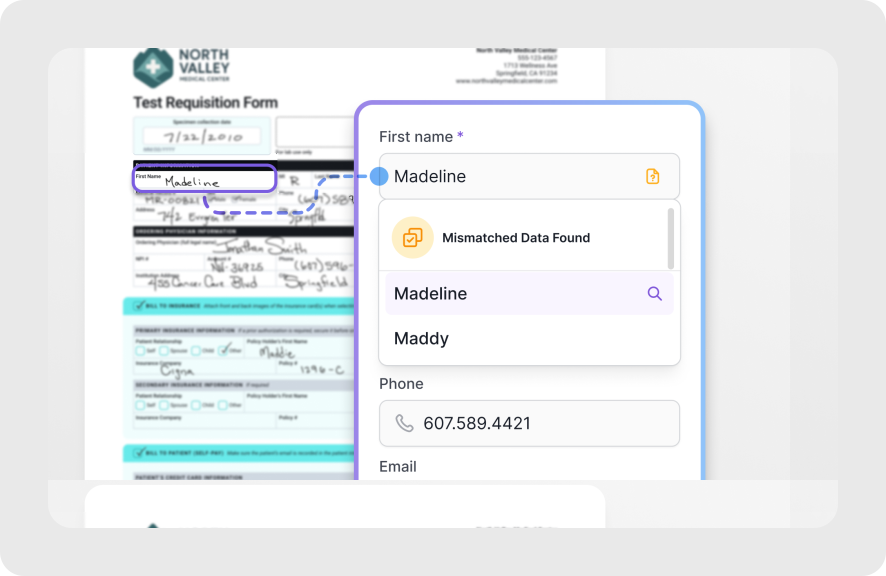
Platforms like Onymos DocKnow cross-reference extracted TRF data against payer eligibility systems and existing patient records in real time. If there is a mismatch, it gets flagged immediately, while the ordering clinic can still be reached to correct it.
Enhanced Data Accuracy at Accessioning
CLIA’s quality standards for laboratory accessioning exist precisely because errors introduced at the front of the workflow propagate through everything that follows. A misread date of birth at accessioning becomes a mismatched patient identifier in the LIS, a rejected claim in billing, and potentially a delayed or misdirected result for the patient.
AI-powered intelligent document processing can validate data contextually, cross-referencing extracted values against known formats, payer requirements, and existing records. This is categorically different from OCR, which simply converts an image to text without checking whether the text is correct.
Strengthened Security Posture
CLIA compliance and HIPAA compliance operate in parallel. Both require documented access controls, audit trails, and data handling procedures. Upgrading your intake infrastructure to meet CLIA’s evidentiary standards naturally reinforces your healthcare data security posture.
The specific risk vector that most labs underestimate is third-party data exposure. When a document management or IDP vendor stores PHI on their own servers, every breach in their environment becomes your breach.
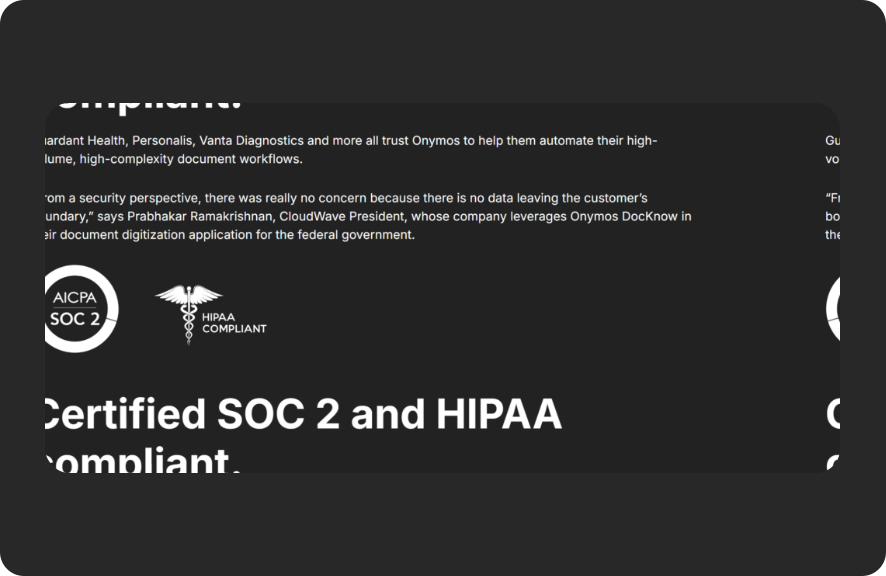
Onymos’s No-Data Architecture eliminates this exposure entirely as all data processing occurs within the customer’s own cloud or on-premises environment, with nothing retained on Onymos’s infrastructure.
Scalable Laboratory Operations
Perhaps the most strategically important benefit of CLIA-aligned automation is scalability. When compliance requirements are baked into automated workflows rather than enforced manually, increasing test volume does not require proportional increases in administrative headcount.
Labs that have automated their intake and accessioning workflows can absorb volume growth without a corresponding rise in denial rates or compliance risk. Structuring your laboratory operations around automated compliance processes is what enables a lab to grow from 250,000 to 350,000 specimens per year without also growing its billing team from 10 people to 20.
Best Practices for Managing CLIA Laboratory Workflows
Clean workflows start at the front door. These are the practices that consistently separate high-performing CLIA labs from those perpetually fighting denials and compliance gaps.
#1. Digitize Intake at the Point of Receipt
The moment a TRF or insurance card arrives, whether faxed, mailed, or handed over at the accessioning desk, it should be digitized. Every minute a document spends on paper is a minute it is at risk: misplaced, damaged, manually misread, or simply untracked.
Using intelligent document processing to capture and digitize TRFs at intake creates an immediate searchable record that satisfies CLIA’s chain-of-custody requirements and gives your billing team clean data from day one.
#2: Automate Cross-System Data Reconciliation
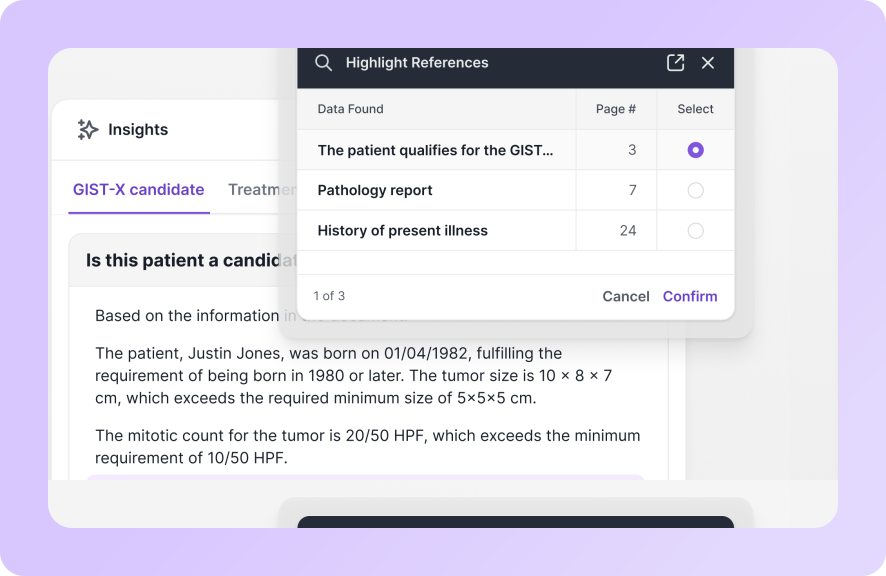
The most common source of claim denials is mismatched data between systems. This can come up in the form of:
- A patient’s name spelled differently in the TRF and the LIS.
- An insurance ID that does not match the payer’s records.
- A physician NPI that was transposed by one digit.
Platforms like Onymos DocKnow use SmartSync (an AI-driven reconciliation engine) to automatically cross-reference incoming TRF data against your LIS, payer eligibility databases, and patient records in real time. Discrepancies are flagged before the specimen moves downstream, not after the claim gets rejected.
#3: Run Eligibility Checks Before Testing Begins
Insurance eligibility verification is one of the most commonly deferred steps in lab intake and one of the most expensive to skip. Running an eligibility check after the test has been completed leaves the lab with few good options if the coverage has lapsed or the plan requires prior authorization.
Integrating automated eligibility checks into the intake workflow, at the point of accessioning, ensures that coverage issues are surfaced while the ordering physician can still be reached to provide an alternative payer or secure authorization.
#4. Enforce Field-Level Audit Trails Across Every System
CLIA inspections do not just want to know that your data is correct. They want to know how it got to be correct and who was responsible at every step. If your LIS can tell you a patient’s name but not when it was entered, who entered it, or whether it was ever modified, you have an audit trail in name only.
Every system in your intake-to-billing workflow should log field-level changes with user attribution and timestamps. If an AI system auto-corrects a misspelled diagnosis code, that correction should be logged as a distinct event. This level of traceability is what makes CLIA inspections straightforward rather than stressful.
How to Choose Technology for CLIA-Regulated Operations
Most software vendors claim to support healthcare compliance. Very few are actually built for the operational realities of clinical and diagnostic labs. Here is what to evaluate before committing to a platform.
#1. Purpose-Built Laboratory Intelligence
Generic document management platforms, even the strong ones like DocuWare or Hyland OnBase, are designed around broad healthcare document workflows. They handle HR records, consent forms, and administrative paperwork well. They do not inherently understand the structure of a TRF, the significance of an NPI, or the chain of custody requirements for specimen accessioning.
Look for platforms designed specifically for diagnostic and clinical lab intake.
Onymos DocKnow, for instance, is purpose-built to understand the data elements on a TRF, cross-reference them against payer requirements, and route clean data into downstream LIMS and billing systems.
This is a categorically different capability from generic LIMS software or document repositories.
#2. No-Data Architecture for PHI Protection
Any platform you deploy for document intake and processing will, by definition, touch your most sensitive data. The question is whether that vendor retains copies on their infrastructure. A HIPAA-compliant document management system should be able to process your PHI without ever storing it outside your environment.
Onymos’s No-Data Architecture is the outlier in this category. All intelligent document processing occurs within the customer’s own cloud or on-premises environment, with zero data retained on Onymos’s servers.
For labs subject to both CLIA and HIPAA audits, this architecture significantly limits legal exposure.
#3. Native AI Data Reconciliation, Not Just OCR
Basic OCR converts document images to text. That is a solved problem. The unresolved problem in clinical lab intake is one of validation. Did the OCR engine read the insurance ID correctly? Does the date of birth on the TRF match what is already in the patient record? Is this physician NPI valid and active?
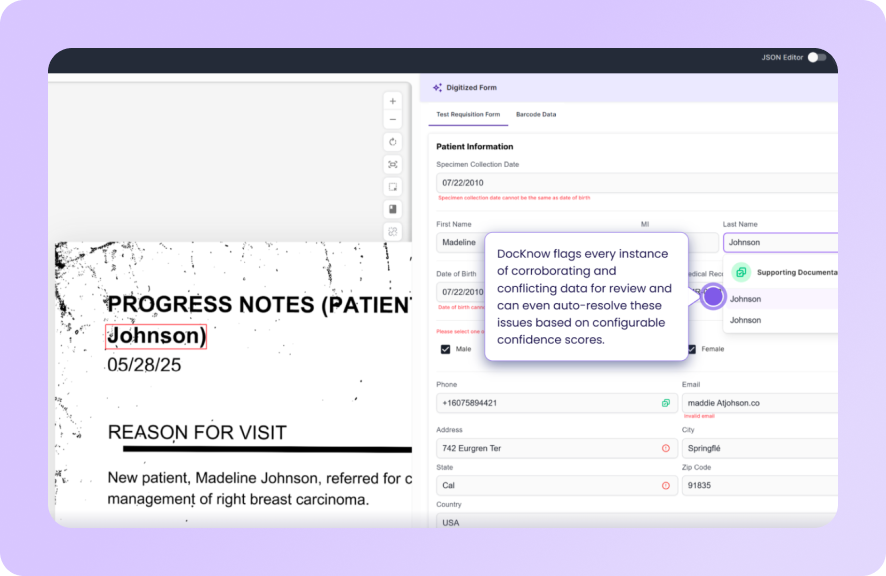
The technology that actually reduces denial rates and CLIA compliance risk is AI-powered reconciliation: a system that reads the document, understands the semantic context of each field, and cross-references extracted values against connected databases in real time. Onymos’s Nucleus AI system performs this function natively, acting as a continuous quality gate at the intake layer.
Automate Compliance-Heavy Laboratory Workflows With Onymos
If your lab is watching claim denials accumulate while your billing team manually chases down missing NPIs and mismatched insurance IDs, the problem is the absence of an intelligent intake layer.
Onymos DocKnow is built specifically for clinical and diagnostic laboratory intake and accessioning. Powered by the Nucleus AI system and SmartSync data reconciliation, it catches errors at the point of capture and before they touch your LIS, your billing platform, or your payer. Its No-Data Architecture also ensures your PHI never leaves your environment.
Stop letting intake errors become denied claims. Contact us today to see why DocKnow is the best intelligent document processing software for high-volume diagnostic laboratories.
FAQs
What Is a CLIA Laboratory?
A CLIA laboratory is any facility in the United States that performs testing on human specimens for health assessment, diagnosis, or treatment, and holds the appropriate federal certification from CMS.
What is the CLIA method in the Laboratory?
CLIA establishes federally mandated standards for quality control, personnel qualifications, proficiency testing, and testing procedures to ensure all clinical lab results are accurate and reliable.
Why is CLIA certification required?
It is legally required by the Centers for Medicare & Medicaid Services (CMS). Without it, a laboratory cannot bill Medicare, Medicaid, or most private insurers, and cannot legally perform tests on human specimens for clinical purposes.
Are there different types of CLIA certificates?
Yes. CLIA certificates vary based on the complexity of the tests a lab performs. A Certificate of Waiver covers simple, low-risk tests. A Certificate of Compliance or Certificate of Accreditation is required for moderate- and high-complexity testing, including most diagnostic and molecular panels.
Can a lab lose its CLIA certification?
Yes. CMS can suspend, limit, or revoke a CLIA certificate following failed inspections, proficiency testing deficiencies, or documented quality failures. Revocation also triggers a two-year bar on the ownership group from operating any certified lab, making compliance far less costly than non-compliance.


Connect with our team to explore how Onymos solutions can maximize efficiency, minimize costs, and drive real, scalable growth.
Schedule your demoWe know healthcare data
AI in the lab. Workflow automation at scale. Digital front doors for hospitals and clinics. Healthcare and life sciences are changing fast. Are you ready? Subscribe to our blog for:
- Trends in healthcare tech
- Research and analysis
- Customer stories and more