Why Proving Clinical Utility Matters More Than Ever
Table of Contents
Need a custom demo?
Use your own workflow and see where DocKnow can reduce manual work.
Get your demoKey Takeaways
- Clinical utility is moving from best practice to requirement.
- The pressure is coming whether or not MolDX goes national. Enhanced CLIA, FDA oversight, and payer policy all point toward a higher bar for evidence.
- Labs that capture ICD codes and clinical criteria on their requisitions are better protected in audits and more likely to get paid.
For years, laboratories understood that demonstrating the clinical utility of their tests was good practice, and that they should be able to prove it…
But depending on the test, payer, and market, they often didn’t have to prove it. CLIA asked whether a lab could run a test accurately. Payers mostly paid. Labs took the path of least resistance.
That era’s ending. Proving clinical utility is becoming a requirement for every lab. Here’s why:
1. MolDX could go national
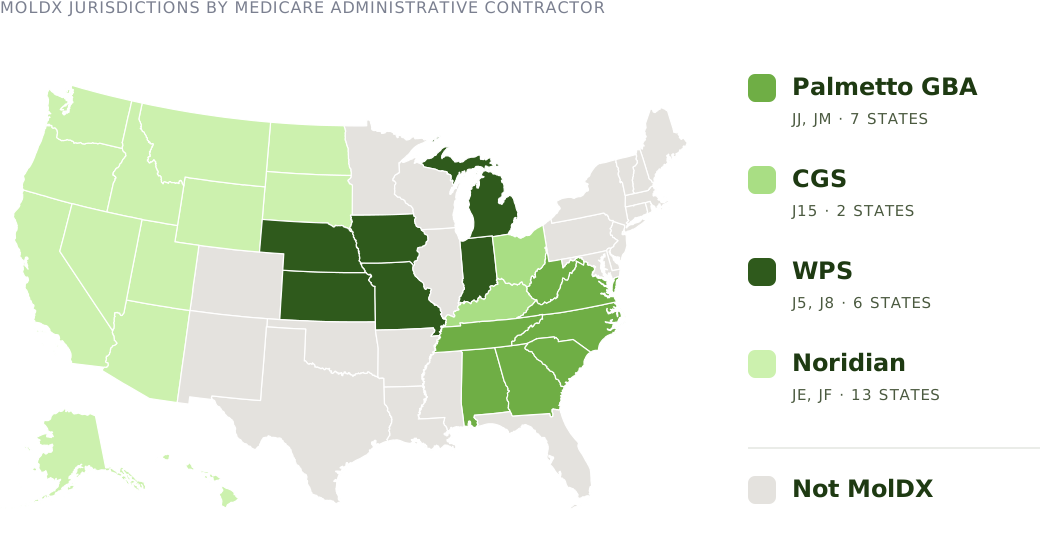
MolDX has always been a regional program, covering molecular diagnostics in some Medicare jurisdictions but not others. That could be about to change. CMS has been weighing whether to expand MolDX nationwide, and asked the public for input at the beginning of 2026. We spoke with industry expert and Chief Commercial Officer at Doc Lab Ashley Zarling, who expects a decision soon, with national adoption potentially taking effect in 2027.
And MolDX asks much more of a lab than CLIA does. To get coverage, each test has to pass its own technical assessment proving three things.
- Analytical validity: the test measures what it claims to measure, accurately and reliably.
- Clinical validity: the result is linked to a real clinical condition.
- Clinical utility: using the test improves patient outcomes or reduces burden on the healthcare system.
The first two are familiar territory for most labs. The third is where many are unprepared. Randomized controlled trials (RCTs) are the gold standard for proving clinical utility, and those take years to run.
That doesn’t mean labs have to wait for an RCT or that it’s always required. Payers and programs such as MolDX accept a spectrum of evidence, including:
- Real-world evidence (RWE) drawn from electronic health records, showing associations between test results, subsequent decisions, and patient outcomes.
- Decision-impact studies that measure whether the test actually alters physician behavior (therapy choice, hospital length of stay, etc.).
- Systematic reviews or meta-analyses that synthesize existing data and estimate clinical and economic impact.
But again, these take time. Even the more accessible options typically require months of careful design, data collection, and analysis.
2. Even if it doesn’t, every path leads to the same place
MolDX isn’t the only option on the table. Enhanced CLIA was expected to move through the Senate but stalled in subcommittee. FDA oversight of laboratory-developed tests has come and gone and could return. MolDX came back into focus because CMS wants something in place for the start of 2027.
Whichever path wins, the destination looks similar. As Zarling puts it, they “all achieve very similar endpoints, which is an enhanced sense of validation and proving of clinical utility.” FDA leans more toward patient safety than clinical utility, but the end goal is a higher bar for evidence.
Current CLIA rules for LDTs were built for an earlier generation of testing. They were designed around chemistry-based tests, not genetic or multiplex ones. Yet that’s exactly where testing has moved.
A 30-sample analytical validation may be enough for vitamin D. It isn’t enough for a 48-pathogen panel, where 30 samples will repeatedly return the same handful of pathogens and miss the real-world distribution the panel is meant to detect.
So labs shouldn’t treat an announcement about MolDX as the moment to decide whether to act. Labs have been on notice for years. Those that started building evidence five years ago are in a very different position from those starting now, and both are ahead of labs still waiting to see what happens.
3. Payers want proof, and it starts at the point of order
Regulation is only part of the pressure. Payers increasingly only want to pay for tests shown to improve care.
We’ve seen this play out with vitamin D. It was once ordered broadly as a screening test. Then the data never showed that screening healthy people led to better outcomes. Today, the Endocrine Society recommends against routine vitamin D testing, and Medicare coverage policies explicitly exclude screening, limiting tests to patients with specific conditions.
Notice what didn’t happen. Vitamin D testing wasn’t banned. It was narrowed to the patients where it makes a difference. That’s the shift labs now face across their menus. And proving clinical utility in a trial is only half the job. Clinical utility is proven once, for a population. Medical necessity has to be documented every time, for each patient. The requisition is where the two meet.
A payer will ask whether this patient belongs to the population where the test was proven to help, and the answer has to be captured on every order through the test requisition form (TRF). A checklist of tests with a slot for ICD codes isn’t enough now. A modern TRF collects ICD codes plus clinical criteria where the codes alone don’t tell the full story.
The labs that collect the right clinical information up front can improve compliance and profitability by ensuring they run tests with a clear path to reimbursement.
What labs should do now
The labs in the strongest position are the ones acting before a deadline forces them to. That means:
- Audit the test menu. For each test, ask what payers, trial data, and guidelines say about its clinical utility.
- Start building evidence where it’s thin. You don’t always need an RCT, but whatever methods you use, they’ll take time, so start sooner rather than later.
- Redesign requisitions around the evidence. Narrow each test to its intended-use population, and capture clinical criteria at the point of order.
- Retire old TRFs. A new requisition only helps if providers actually use it, and outdated forms still circulate long after they’ve been replaced.
- Validate and enrich every order at intake. Check each requisition for missing ICD codes, clinical criteria, and signatures, and fill gaps from medical records and other supporting documents, so every order includes the evidence that justifies it.
Clinical utility always mattered. Now labs have to prove it.


Connect with our team to explore how Onymos solutions can maximize efficiency, minimize costs, and drive real, scalable growth.
Schedule your demoWe know healthcare data
AI in the lab. Workflow automation at scale. Digital front doors for hospitals and clinics. Healthcare and life sciences are changing fast. Are you ready? Subscribe to our blog for:
- Trends in healthcare tech
- Research and analysis
- Customer stories and more